Start with the bottleneck, not with the metal
Every copper-versus-aluminium argument on the internet compares conductivity. Almost none of them asks where your heat is stuck — and that question, not the W/m·K table, decides whether copper is worth 3.3× the weight and several times the metal cost. There are only two answers:
Spreading-limited — a laser diode, a power module, a die a few millimetres across pushing serious watts. The flux has to fan out sideways through the base before any fin can help. Here the base metal is the bottleneck and copper's ≈388 W/m·K is bought for a reason. Convection-limited — a wide, evenly loaded plate, a TEC array, most LED boards. The flux arrives at the fins already spread, and from there the air sets the pace. Here the winning move is more aluminium area, not denser metal.
| Metal | Thermal conductivity | Density | When it pays |
|---|---|---|---|
| Copper C11000 | ≈388 W/m·K | 8.96 g/cm³ | Concentrated flux, tight envelope, weight not a concern |
| Aluminium 6061-T6 | ≈167 W/m·K | 2.70 g/cm³ | Most machined sinks: more fin area per dollar and per gram |
| Aluminium 6063 | ≈201 W/m·K | 2.70 g/cm³ | The extrusion and skiving alloy — outconducts 6061 |
| Aluminium 7075-T6 | ≈130 W/m·K | 2.81 g/cm³ | Almost never: a structural alloy that trails 6061 thermally and costs more. Only when the sink is also a load-bearing part |
| Stainless 304 | ≈16 W/m·K | 7.93 g/cm³ | Never on thermal grounds — roughly 24× below copper. Corrosion or structure are the only reasons it appears here |
Scale check, since percentages hide weight: the same 100 × 100 × 12 mm fin field comes off the machine at about 430 g in C11000 and about 130 g in 6063. Multiply by your quantity and your freight bill before falling in love with the conductivity column.
The copper spreader — the part many of these enquiries should have been about
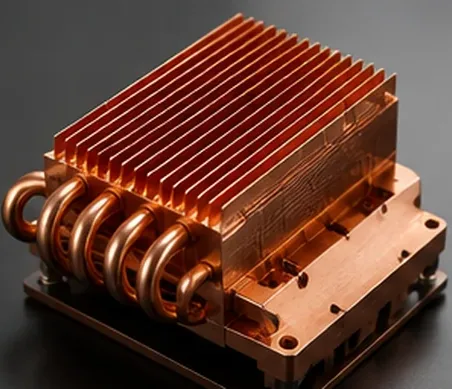
Look at the left half of that picture again. The copper is doing all its work in a slab a few millimetres thick under the device. That slab has a name — a copper heat spreader — and it can be its own part: a plate or block between the die and a larger aluminium sink, sized to catch the flux while it is still concentrated. Among the skived copper footprints we build regularly is exactly this construction, a 60 × 58 mm fin block sitting on a separate, larger spreader plate.
Two callouts belong on a spreader drawing and rarely make it there. Flatness and finish on the contact face — that joint is where a spreader lives or dies, and no alloy upgrade buys back a face that does not sit flat. And the mounting: a spreader that needs its own screws through the fin field above it changes both parts. If either is missing from the drawing, we ask before we cut — it is the first thing our quote checks.
The pairing that closes most of these enquiries: copper where the flux is dense, aluminium where the air does the work. We machine both parts and ship them fitted to each other. And when the fin field itself has to be copper on an aluminium base, that exact pairing is what a bonded fin build exists for.
"Copper" is not a grade: what a bare callout costs you
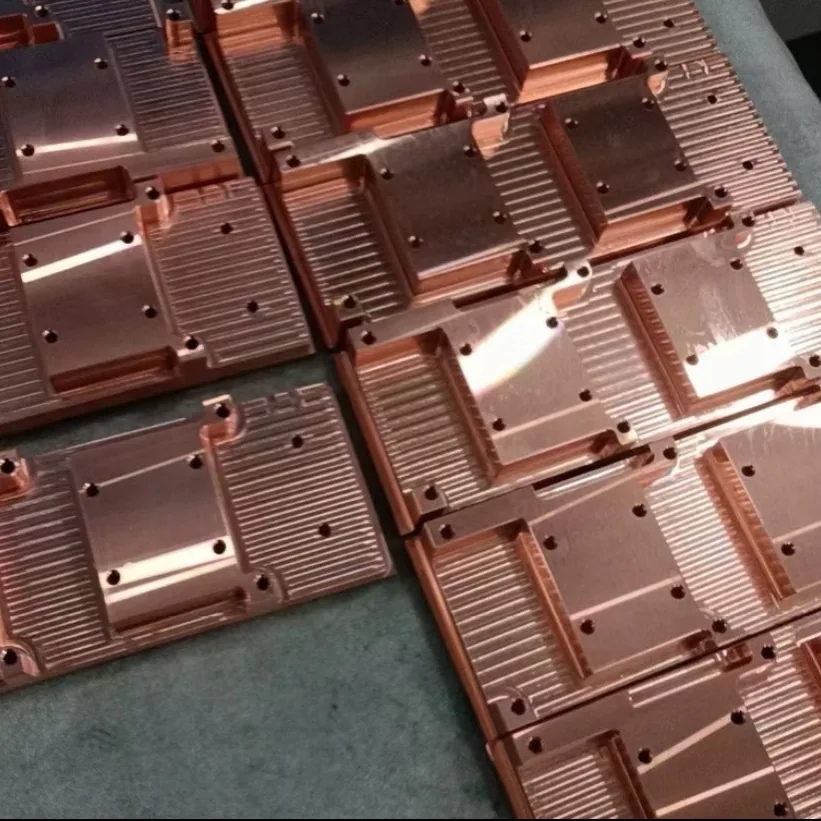
Write copper on a purchase order with no number and the supply chain fills in the blank for you: what arrives is C11000 — electrolytic tough pitch, Cu-ETP, the metal US stockists shorthand as C110 and order to ASTM B152 in plate. As a conductor it is the reference: 101% IACS. On a milling machine it is a punishment: machinability index 20, a metal that smears onto the cutting edge instead of breaking a chip, strings, and raises a burr on every arris the cutter leaves.
The grade a machinist would rather see on that PO is C14500 — tellurium copper, C145, ordered to ASTM B301. The dispersed tellurium snaps the chip, and the index jumps to 85, in free-machining brass territory.
| Grade | Machinability index | Electrical conductivity | Thermal conductivity |
|---|---|---|---|
| C11000 · Cu-ETP · "C110" · ASTM B152 | 20 | 101% IACS | ≈388 W/m·K |
| C14500 · tellurium copper · "C145" · ASTM B301 | 85 | ≥85% IACS | ≈355 W/m·K |
Priced the way a shop prices it: over four times the machinability, for about 15% of the conductivity. Fin fields, pockets, drilled patterns — every one of those features costs machine hours, and machine hours are most of a copper part's price. A bare "copper" callout quietly commits you to the slow one. If the grade is open, tell us how the part is cut and joined and we will name it for you — that question is free and it is the first one we ask.
One more naming trap, because it shows up weekly: C1100 is not C11000's twin — it is its Japanese name. JIS C1100, GB/T T2 and EN Cu-ETP / CW004A are all the same 99.90% Cu metal wearing three different standards. Send whatever designation your drawing carries; the four-standard cross-reference lives on our skived fin page and the matching is our job, not yours.
The fin process picks the grade — not the other way round
Here is where the C14500 advice reverses, and it is the paragraph this page exists for. Free-machining copper earns its index from an additive whose entire purpose is to snap the chip into short pieces. Skiving is the opposite bet: a blade lifts one continuous ribbon off the block and folds it upright through ninety degrees, still attached at the root. A metal engineered to break its chip cannot take that fold. The grade call therefore belongs to the process, and it flips as the process changes:
| Your part | Grade to order | Why |
|---|---|---|
| Milled fins, pockets, drilled patterns — lots of cutting | C14500 | Index 85 against 20: the tool survives, the edges come out clean, the hours stay honest |
| Skived fin field | C11000 or C10200 only | The ribbon must fold without cracking — chip-breaking is exactly what skiving cannot tolerate. C14500 does not skive |
| Joints brazed in a hydrogen atmosphere; vacuum service | C10200 oxygen-free | The residual oxygen in C11000 embrittles at brazing temperature in hydrogen; oxygen-free copper carries no such risk |
| Plain spreader plate, chill bar, block — little cutting | C11000 | Machinability hardly matters when there is hardly any machining. Keep the full ≈388 W/m·K |
This is why "C11000 or C14500" has no one-line answer — the geometry plus the fin process decides it. It is also a cheap way to grade your suppliers: a quote for a skived sink in C14500 means nobody there noticed that one of those words cancels the other.
Copper heat sinks for welding — the other meaning of the search
A steady share of the people searching for a copper heat sink are not cooling electronics at all — they are welders. Clamp copper against thin sheet and it pulls heat out of the joint faster than the arc feeds it in: a chill block behind a TIG seam on 20-gauge stainless, a backing bar under a butt weld, a shaped block guarding a machined face sitting two millimetres from the arc. Copper gets the job for the same ≈388 W/m·K — and because steel spatter will not fuse to it.
The honest boundary first: if a straight rectangular bar does it, buy C110 flat bar from your stockist and saw it to length. Bar stock needs no machine shop and we would only be marking it up. Send it to us at the point the block stops being a bar — contoured to follow your part, carrying a gas groove along the seam for back purging, tapped for clamps, or drilled for cooling water when the duty cycle runs long. That is machining in one setup, from 1 piece, same as everything else on this page.
One piece now, a thousand later — what actually changes
The fair worry before ordering a prototype: if this works, does the volume order mean starting over with a different supplier? No — what changes with volume is the process, and we tell you the crossover quantities with numbers instead of a sales pitch.
| Quantity | Route we propose | Tooling | Why |
|---|---|---|---|
| 1 – 10 pieces | CNC machined from plate | none | Prototype or one-off: nothing to amortise |
| 10 – 200 | Machined; brazed copper fins where the fin field outruns the cutter | none | Pre-series and field validation — all-copper fin builds are brazed or soldered, never epoxy bonded |
| 200 – 2,000 | Ask the aluminium question again — an extrusion die amortises here; staying copper, skiving once past roughly 500 | die, or blade + fixture | The die or blade spreads; machining stays for pockets, holes and flatness |
| 2,000 + | Skived copper, or stamped fins on copper bases through a qualified partner press shop | own tooling | High fin density at low piece price |
The purchasing view: prototype and series come off the same drawing, through the same contact. No repeated approvals, no re-explaining the part — and when tooling starts to make sense, the recommendation comes with the arithmetic attached.
What is in the catalogue — and where we come in
Most copper heat sink searches should never reach a machine shop, and sorting that out up front saves everyone a week.
| What you need | In the catalogue? | What we do about it |
|---|---|---|
| Retail copper cooler for a CPU, GPU, SSD or Raspberry Pi | Yes — a whole retail industry | Buy it off the shelf. Retail prices are set by volumes no machine shop can touch |
| Skived copper sink in a stocked footprint that suits you | Yes — catalogue sizes exist | Buy the catalogue part — it will beat anything we cut to the same print |
| Straight chill bar for the weld bench | Yes — C110 flat bar at any stockist | Saw it yourself; we would only be marking up bar stock |
| Your footprint, hole pattern and boss heights, from a STEP | No | Machined to your drawing, from 1 piece, no tooling |
| A reasoned C11000 / C14500 / C10200 call for your geometry | Not offered — catalogues sell what is on the shelf | We ask how the part is cut and joined, then name the grade and the why |
| Copper base or spreader fitted under aluminium fins | Not offered as one part | Both parts machined and delivered fitted to each other |
| Chill block following the seam of your weldment | No — catalogues stop at straight bar | Contour-machined, gas groove and clamp holes in the same setup |
| Dense copper fin field, 20 pieces | No — skiving shops quote 500 minimum | Brazed copper fins, or a bonded fin build — from 1 piece |
Six lines that make a copper quote fast
Copper punishes vague drawings harder than aluminium does — the stock is expensive and the cutting is slow, so every ambiguity is priced defensively. Six lines close the gap:
- The alloy by number, not "copper" — C110 and C145 behave nothing alike under a cutter. Or leave the call to us and say how the part is cut and joined.
- Flatness and finish on the contact face — the one surface that earns tight callouts. Tolerancing the rest of the part to match only buys cost.
- The finish, decided now — bare, passivated or nickel plated. Copper does not anodise; see below.
- Fin thickness honest for copper — sections that mill cleanly in aluminium can chatter or smear in gummy C11000; a tenth of a millimetre more often settles it.
- Base thickness that matches the fin process — a thin base under a tall skived field contradicts itself; the skiving force needs metal under the fin roots, so one of those two numbers has to move. We flag it at quote time, not after.
- Quantity now, and quantity later — the pair that decides machined against skived against die, and the line most often missing.
Inch and dual-dimensioned drawings are welcome — we run metric inside and confirm the critical faces in both units before cutting, so a flatness called in thou converts cleanly (0.002 in ≈ 0.05 mm).
Copper does not anodise — and why "black" was doing real work
If the spec says black anodised copper, the spec cannot be built as written: anodising is an aluminium process. What copper takes:
- Machined and deburred, light passivation — slows the tarnish; the normal state for a part living inside an enclosure.
- Electrolytic or electroless nickel, thin — for exposed parts and parts that will be soldered.
Two details hiding in that choice. Nickel conducts far less than copper — on the thermal contact face, call the plating as thin as possible or mask the area bare, or you hand back part of what copper cost you. And the black you lost was not cosmetic: bright copper radiates almost nothing — emissivity around 0.04, against roughly 0.85 for black anodised aluminium — so in still air, where radiation carries a real share of the load, a black anodised aluminium sink quietly claws back part of copper's conductivity lead. One more reason the aluminium question deserves a straight answer before the copper order goes in.
Enquiries that reach this page
"Skived copper sink from a STEP, 2–10 pieces — thin base, tall dense fin field."
The quantity is workable; the drawing usually is not, yet. A thin base under a tall skived field is the contradiction we see most — the skiving force needs metal under the fin roots — so we come back with a base/fin split that keeps the stack height, and with the two questions a photonics part lives on: contact-face flatness and finish.
"The aluminium sink keeps up everywhere except right under the module."
That sentence is the spreader case in one line. The part does not need to become copper — a copper block under the hot spot, sized to the spreading cone, with the aluminium keeping the fin area, usually closes it at a fraction of the weight and cost. Both parts arrive machined and fitted.
"TIG on thin stainless keeps warping the panel — I need copper behind the seam."
A chill block, and the only question is whether a straight bar does it. If yes, buy bar stock and saw it — we say so. If the block has to follow a contour, carry a purge-gas groove or bolt to the fixture, that is a machined part and we quote it from 1 piece.
No drawing yet? A hand sketch or the old part in a box is enough — we redraw the CAD at no cost and send it for your approval before anything is cut. See all fin processes compared, machined aluminium heat sinks or copper CNC machining.
Frequently Asked Questions
Half the time aluminum is the right answer, and we would rather lose the copper order than sell it to you anyway. The physics: C11000 moves ≈388 W/m·K against ≈167 for 6061 — 2.3 times the conductivity — but at 8.96 g/cm³ it carries 3.3 times the weight, and the stock costs several times more per kilogram. Copper's edge lives in the spreading path, the few square centimeters of base directly under the die where the flux is still concentrated; out in the fins the limit is convection, and convection does not care what the fin is made of. Wide, evenly loaded source: aluminum. Small, hard-driven source: copper base, or a copper spreader under an aluminum sink. For scale, the same 100 × 100 × 12 mm fin field weighs about 430 g in C11000 and about 130 g in 6063.
For a part with real cutting on it, C14500 tellurium copper — and if the drawing only says copper, that is the conversation to have before anyone quotes. A bare copper callout defaults to C11000 (C110, Cu-ETP): full conductivity at 101% IACS and ≈388 W/m·K, but machinability index 20 — it smears onto the cutting edge, strings instead of chipping, and leaves a burr on every arris. C14500, ordered to ASTM B301, machines at index 85, near free-machining brass, and still holds ≥85% IACS and ≈355 W/m·K. More than four times the machinability for about 15% of the conductivity — on a finned copper part that trade lands directly in machine hours, and machine hours are the price.
C11000 or C10200, and nothing else — the machined-part advice runs backwards here. A skiving blade lifts one continuous ribbon off the solid block and folds it upright through ninety degrees; the metal has to take that fold without cracking. Tellurium exists in C14500 to snap the chip into short pieces, which is precisely the behavior a skived ribbon cannot survive. So the fin process picks the grade: C14500 when the fins are milled, C11000 or C10200 when they are skived. A quote for a skived sink in C14500 means somebody has not noticed that one of those two words cancels the other.
Yes — and for concentrated sources it is usually the design we end up recommending. Copper goes where the flux is dense: a base or spreader block sized to the die and the spreading cone above it. Aluminum goes where the air does the work: the fin field, which is convection-limited and gains nothing from heavier metal. You keep most of copper's advantage at a fraction of its weight and cost. We machine both parts and ship them fitted to each other; where the fin field itself must be copper on an aluminum base, that pairing is what a bonded fin build exists for.
Yes — a welding chill block or backing bar is a machined copper part, which is exactly our trade. The honest boundary first, though: if a straight rectangular bar does the job, buy C110 flat bar from your metal stockist and saw it to length — there is nothing we can add to bar stock. Send it to us when the block stops being a bar: contoured to follow the part, grooved for backing gas along the seam, tapped for clamps, or drilled for cooling water on long duty cycles. All of that is machining in one setup, from 1 piece.
No — anodizing is an aluminum process, and a spec that says black anodized copper cannot be built as written. The realistic finishes are machined-and-deburred with a light passivation to slow tarnish, or thin electrolytic or electroless nickel where the part is exposed or will be soldered; on the thermal contact face, call the plating as thin as possible or mask it bare, because nickel conducts far less than copper. And the reason black mattered in the first place is worth checking: bright copper radiates almost nothing — emissivity around 0.04 against roughly 0.85 for black anodized aluminum — so in still air, where radiation carries a real share, a black anodized aluminum sink claws back part of copper's conductivity lead for free.
Yes — 1 piece, no tooling, because the part is machined rather than extruded or stamped. Copper makes the no-tooling point matter more than aluminum does: the stock is expensive and the tool wear is real, so a single part's price is dominated by material and machine time, not by setup. The same program then carries a small series unchanged, and when your volume starts to justify a skiving blade or an extrusion die we tell you the crossover quantity with numbers rather than with a sales pitch.
No CAD needed, and yes to inches. A STEP plus a dimensioned drawing is the fastest route, but a hand sketch, a photo with something for scale, or the old part in a box is enough — we redraw it and send the drawing back for approval before cutting. Inch and dual-dimensioned drawings are welcome; we work in metric and confirm the critical faces in both units, so a flatness called in thou converts cleanly (0.002 in ≈ 0.05 mm). What we need in writing: the alloy by number or the grade call left to us, flatness and finish on the contact face, the surface finish, and quantity now against quantity later.
Related: all fin processes compared · skived fin — where copper fin fields go at volume · bonded fin — copper fins into an aluminium base · microchannel cold plates · copper CNC machining
Get a Free Quote
Send the STEP and the dimensioned drawing — inch or metric. We check the geometry, name the copper grade that fits, and say if aluminium would do. Reply within 12 hours — from 1 piece.
// Grade by process
Milled
C14500
Index 85 vs 20
Skived
C11000
The ribbon must fold
H₂ brazed
C10200
Oxygen-free
- →Spreader + aluminium fins quoted as one fitted pair
- →No CAD? A sketch with the footprint is enough
Response within 12h · Drawings kept confidential