Channel scale, and what each step down costs
The names are about hydraulic diameter, and they are worth knowing mostly because of what they imply for your pump.
| Scale | Hydraulic diameter | Heat transfer | Pressure drop | Blockage risk | Where it belongs |
|---|---|---|---|---|---|
| Conventional milled | above ~3.00 mm | Baseline | Low | Low — flushes easily | Most instrument plates. Start here. |
| Mini-channel | ~1.00 – 3.00 mm | Substantially higher | Moderate | Manageable with filtration | The usual practical compromise |
| Microchannel | below ~1.00 mm | Highest per unit volume | Steep — rises far faster than the channel shrinks | High — needs a designed loop | Laser diodes, power semiconductors, concentrated flux |
Each step down costs pumping power much faster than it buys cooling. That is why most plates that arrive here specified as "microchannel" end up built as mini-channel: the thermal target is met, the pump stays ordinary, and the plate does not need a laboratory-grade loop to survive. We will say when your number needs sub-millimetre passages — and when it does not.
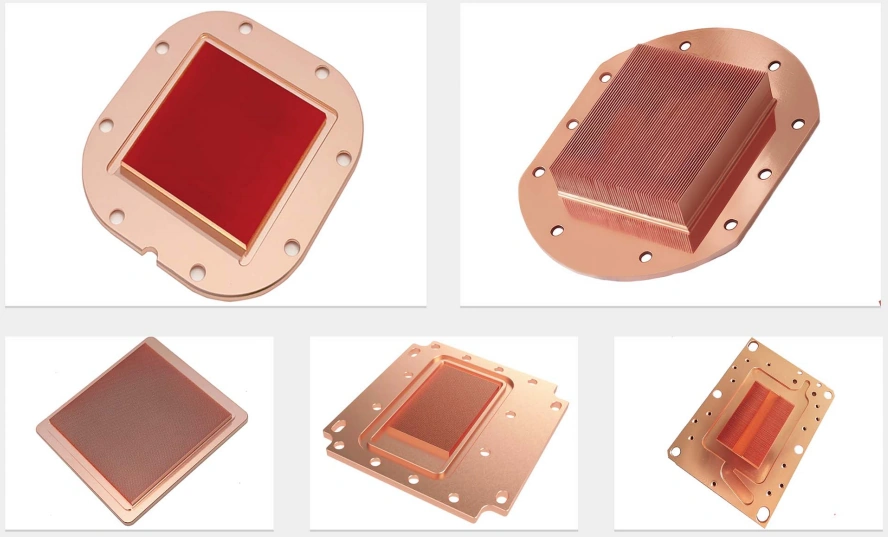
Blockage, not thermals, is what comes back
Thermal design is the part everyone gets right. Here is the part that generates the support call two years later.
In a closed loop every particle stays in the loop. It has nowhere to go but round and round until it reaches somewhere narrow enough to stop it — and in your system, that place is the inside of the cold plate. Four sources produce nearly all of it:
- PTFE tape and liquid sealant from tapered threads. Both shed on make-up, and again on every service disturbance. This is the single biggest avoidable source.
- Braze or solder flux residue left inside a sealed plate that was never properly flushed after joining.
- Machining swarf from cross-drilled intersections that were drilled but not deburred and flushed.
- Corrosion product from a mixed-metal wet circuit — which is self-feeding, because the corrosion generates exactly the particles that then block the channels.
What makes this expensive is the symptom. A partly blocked plate does not leak and does not fail a test. One device simply runs a few degrees hotter each month until something trips, long after commissioning, in a system nobody is currently looking at. By then the plate is the last suspect on the list.
The design consequences follow directly, and we build them in by default: ports that seal on a face rather than on thread flanks, so nothing consumable ever enters the flow path — parallel BSPP with a bonded washer, or an O-ring in a machined seat. Filtration matched to the smallest passage in the plate, not to the pipework. And one metal in the wet circuit. More on the fitting side of this on the liquid cooling fittings page.
How the plate gets closed
A channel is only a channel once there is a lid on it. Three ways, and the cheapest is often right.
| Lid | Pressure | Serviceable? | Trade |
|---|---|---|---|
| Bolted, O-ring in a machined groove | Moderate | Yes — opens for flushing in the field | Gasket stays on the maintenance list; bolt pattern costs footprint |
| Soldered or brazed | Higher | No — permanent | Gasket off the list, but flux residue must be flushed out properly |
| Welded | Highest | No | Least forgiving of a channel-layout mistake — get it right first time |
For an instrument in quantity one to ten, bolted is usually the right answer, and we say so even though the sealed versions bill more. A plate that can be opened and flushed in the field outlives one that cannot, in exactly the failure mode this page is about.
Material — and why the loop decides it
| Material | Conductivity | Use it when | Watch |
|---|---|---|---|
| Aluminium 6061 | ≈167 W/m·K | Default — light, machines cleanly, cost-effective | Never in a loop containing copper or brass |
| Copper C11000 | ≈388 W/m·K | Concentrated flux under a small device | Heavy, soft, dearer; pairs with brass or stainless fittings |
| Stainless 316L | ≈15 W/m·K | Aggressive or contaminated coolants, chloride exposure | Poor conductor — chosen for chemistry, not for cooling |
| Aluminium 7075-T6 | ≈130 W/m·K | Nothing thermal. Worse than 6061 and dearer. | Strength alloy in the wrong job |
| Stainless 304 | ≈16 W/m·K | Structural only | About ten times worse than 6061 |
The material question that decides service life is not which metal cools best — it is whether your wet circuit contains more than one metal. An aluminium plate in a loop with copper pipework or a brass pump body is a galvanic pair. While the coolant inhibitor is fresh, nothing happens. As it ages, the aluminium starts dissolving to protect the copper, corroding from the inside where nobody can see it, and shedding the particles that block the channels. Keep the wet circuit to one metal, nickel-plate the aluminium, or run inhibited coolant and change it on schedule — but decide deliberately rather than discovering it.
Cleanliness is a deliverable, not housekeeping
The same passages that catch tape debris in service catch swarf in manufacture. So cross-drilled intersections are deburred, bores are flushed, and ports are capped before packing. Pressure or leak testing is available on request, with method and hold time agreed at quotation rather than assumed.
If your loop has a filtration specification, send it — there is no sense flushing a plate to a coarser standard than the filter you intend to run behind it.
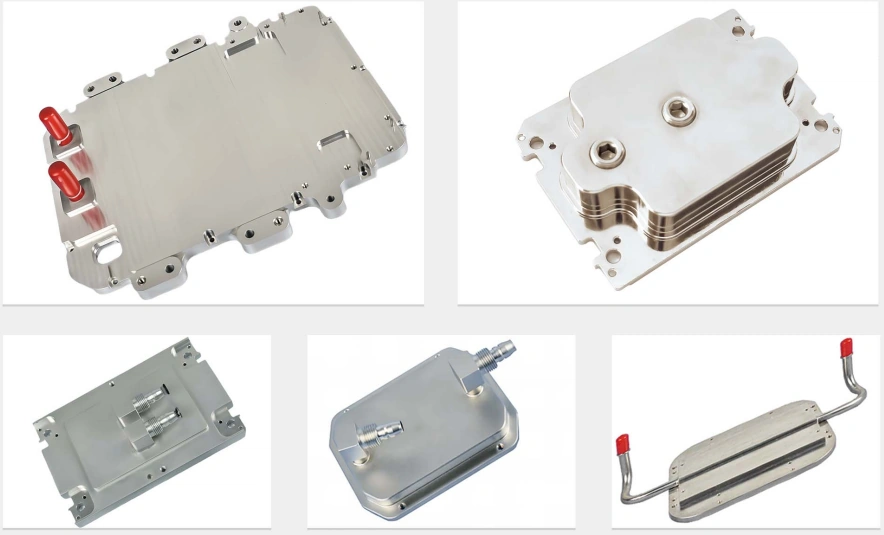
What is in the catalogue — and where we come in
| What you need | In the catalogue? | What we do about it |
|---|---|---|
| Standard cold plate, standard footprint, ports on the usual side | Yes — stocked in depth by several suppliers | Buy it off the shelf — it will be cheaper than anything we quote. Or ask us: if the catalogue part fits, we say so instead of quoting. |
| PC watercooling block for a consumer CPU or GPU | Yes — retail market with its own makers | Not our market, and retail pricing wins there. |
| Ports leaving on a side the catalogue plate does not offer | No — port position is fixed | Ports machined where your installation allows, face-sealed |
| Outline that has to clear a bracket, a connector or a rail | No — catalogue plates are rectangles | Outline cut to your envelope, mounting pattern to your frame |
| Channels concentrated under one hot device, coarse elsewhere | No — one channel pattern per part number | Channel density placed against your actual heat map |
| Plate a machine was designed around, now discontinued | No | Measured from the old plate and rebuilt, ports and all |
| A plate that can be opened and flushed in the field | Rare — most are sealed | Bolted lid on an O-ring, deliberately serviceable |
| 10,000-piece programme with CFD sign-off and thermal guarantees | The big thermal houses — FSW and vacuum brazing lines | Their lane. They beat us on price and on paperwork at that scale. Go there. |
What we need to quote
- Heat load and where it sits on the plate — a rough heat map beats a single wattage number.
- Coolant and its temperature, plus the flow rate or pump curve you have available. This is what sets the channel scale.
- Allowed pressure drop. The number people forget, and the one that decides whether microchannel is even sensible.
- Outline, thickness and mounting pattern, plus where the ports have to leave.
- The rest of the loop — pump, pipework and fitting materials, so we can keep the wet circuit to one metal.
- Quantity and whether the plate must be serviceable in the field.
No CAD needed. A dimensioned sketch with the hot devices marked is a normal starting point, and we redraw it into CAD at no charge. Related: the general custom cold plate page covers the three constructions and the flatness question in more detail.
Frequently Asked Questions
By hydraulic diameter. Below about 1.00 mm is generally called microchannel, roughly 1.00 to 3.00 mm is mini-channel, and above 3.00 mm is a conventional milled channel. The labels matter less than what they cost you. Going finer packs more wetted area into the same volume and raises heat transfer, but pressure drop climbs far faster than the channel shrinks, so the pump has to work much harder for each step down. Most instrument plates land in the mini-channel band because that is where the thermal gain is still worth the pumping power, and true microchannel is reserved for concentrated flux — laser diodes, power semiconductors, that class of problem.
Because thermal performance is the part everyone gets right and blockage is the part that comes back. In a closed loop, every particle stays in the loop: shredded PTFE tape from tapered threads, braze flux residue, machining swarf that was never flushed out, corrosion product from a mixed-metal circuit. All of it migrates to the narrowest passage, and in your system that is the inside of the cold plate. The symptom is not a leak. It is one device running a few degrees hotter each month until it trips, months after commissioning, which makes it one of the hardest faults to attribute. Designing the plate is straightforward; designing the loop so the plate stays open is the actual engineering.
Face-seal, never tapered-thread-with-tape. A tapered thread such as NPT seals on the thread flanks, so it needs PTFE tape or liquid sealant, and both shed debris on make-up and again on every service disturbance. In a closed loop that debris circulates until it finds the narrowest passage. A parallel BSPP thread with a bonded washer, or an O-ring in a machined seat, seals on a face instead: nothing consumable sits in the flow path, and the joint can be broken and remade for service without adding anything to the circuit. We machine the ports that way as standard and will say so on the drawing.
Three options with an honest ranking. A bolted lid sealing on an O-ring in a machined groove keeps the plate serviceable, which on an instrument that may need flushing in the field is often worth more than the last few percent of performance. A soldered or brazed lid removes the gasket from the maintenance list and takes higher pressure, at the cost of never opening it again. A welded lid goes highest on pressure and is the least forgiving of a mistake in the channel layout. For quantity one to ten on an instrument, bolted is usually the right answer and we will say so even though the sealed versions bill more.
It matters more than the plate material itself. Aluminium 6061 is the default: light, machines cleanly, conducts about 167 W/m·K. Copper roughly doubles that and earns its cost where flux is concentrated under a small device. 316L stainless is for aggressive or contaminated coolants. But the deciding question is the circuit: an aluminium plate in a loop containing copper or brass is a galvanic pair, and once the glycol inhibitor ages, the aluminium dissolves to protect the copper — corroding from the inside, which also generates exactly the particles that block the channels. Keep the wet circuit to one metal, or nickel-plate the aluminium, or run properly inhibited coolant and change it on schedule. 7075-T6 at about 130 W/m·K buys nothing thermally, and 304 at about 16 W/m·K is a structural choice rather than a thermal one.
Cleanliness is a deliverable here, not housekeeping, because the passages that catch tape debris in service catch swarf in manufacture just as easily. Cross-drilled intersections are deburred, bores are flushed, and ports are capped before packing. Pressure or leak testing is available on request, with the method and hold time agreed at quotation rather than assumed. If your loop has a filtration specification, tell us and we will match the flush to it — there is no point flushing to a coarser standard than the filter you intend to run.
No, and it is the same answer we give on the cold plate page. Volume programmes with CFD sign-off, friction stir welding lines and vacuum brazing furnaces are what the large thermal houses sell, and they will beat us on both price and paperwork at that scale. Our lane is ones and tens to your geometry: the plate your instrument needs, the plate that replaces one nobody makes any more, or the prototype that has to work before the volume decision is taken. When your programme reaches the size where a thermal house makes sense, we will tell you.
Related: all fin processes compared · custom cold plates · custom liquid cooling manifolds · liquid cooling fittings & manifolds · heat pipe heat sinks · skived fin heat sinks · cooling plate case study · copper machining
Get a Free Quote
Send the heat map, the coolant and flow, and — the one people forget — the pressure drop you can afford. We reply within 12 hours.
// Channel scale
>3 mm
Conventional
Flushes easily
1–3 mm
Mini-channel
Usual answer
<1 mm
Micro
Needs a designed loop
- →We say when mini-channel meets your number for less
- →Face-seal ports and flushed bores as standard, not extras
Response within 12h · Drawings kept confidential