EKINSUN LTD is a custom parts manufacturer, and the weld-in trailer spindle is honest work with an honest boundary: for standard imperial sizes the trailer aftermarket sells finished spindles for less than any one-off can cost, so those buyers should not be here. Who should: the owner of a boat trailer whose seal surface salt ate to lace, the farm with a hay-wagon axle no catalogue ever listed, the imported trailer whose metric bearing stack has no counterpart on the imperial shelf, and anyone whose axle tube was made by a welder, not a factory.
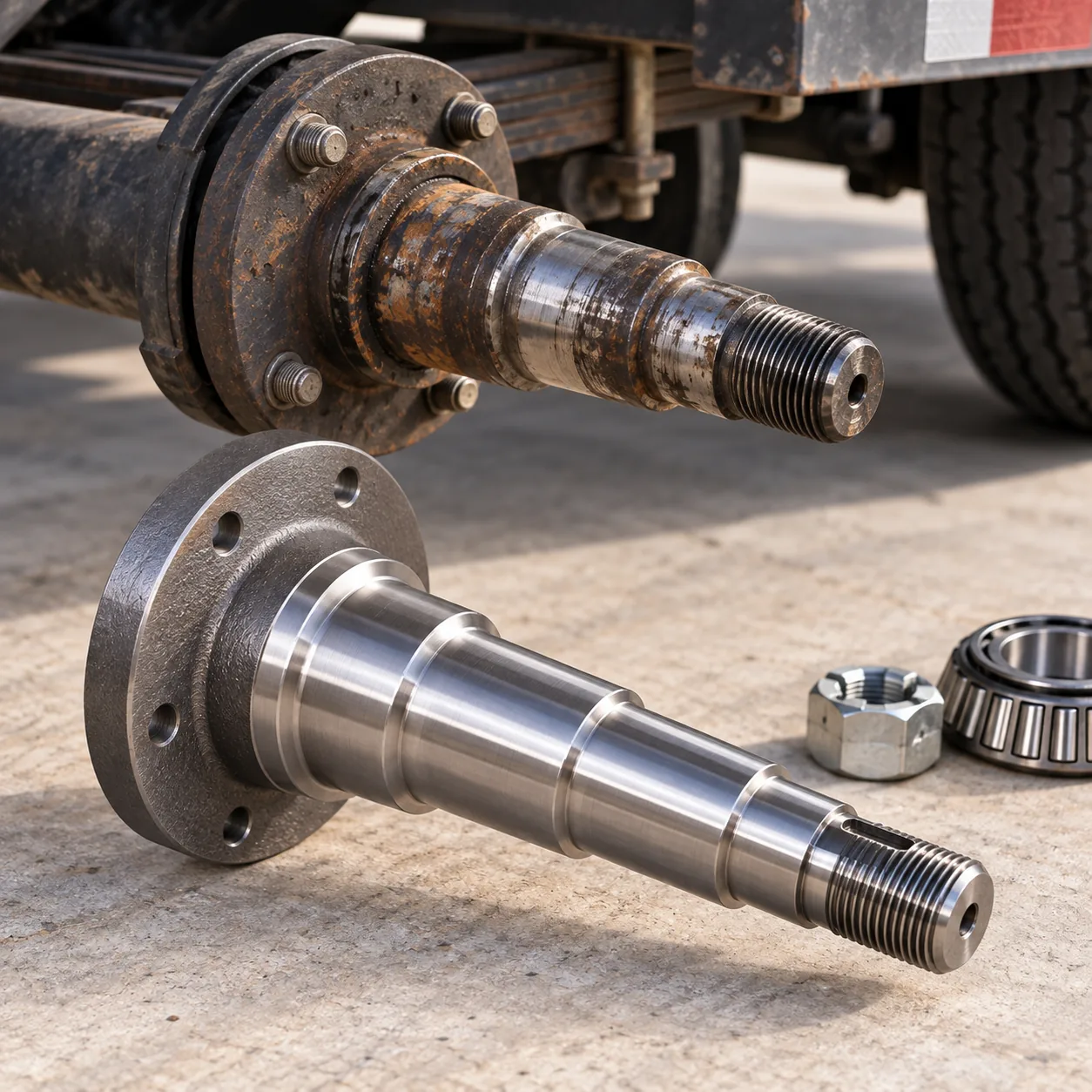
A Spindle Is Its Bearing Stack
The single most useful fact about trailer spindles: you never need to measure the worn surfaces, because the numbers on the parts that ran on them are the specification. The two tapered-bearing cones carry etched numbers; the seal carries one more. Those three numbers fix both journal diameters and the seal surface exactly — unworn by definition. Add three more figures anyone can take — tube outer diameter, tube bore or wall, spindle overall length — and the spindle is defined. Wear is the disease, and it never enters the drawing; the same doctrine runs through all our from-sample work.
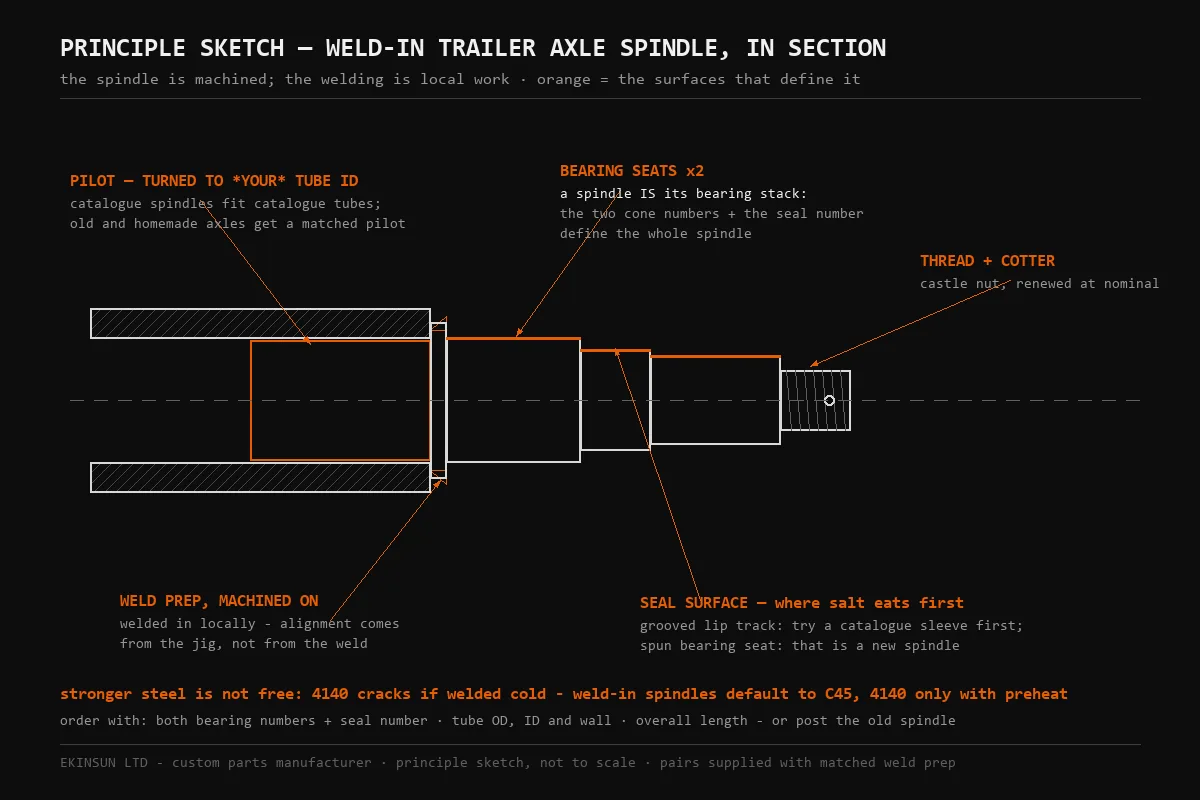
The Fit No Catalogue Sells: Your Tube
Catalogue spindles are made for catalogue tubes — a handful of round and square sections in standard walls. Old, imported and homemade axles rarely are one. The custom spindle's real product is therefore not the bearing seats — those are standard numbers, obeyed — but the back end: a pilot turned to your tube's actual bore, snug enough to centre itself while the tacks go in, and the weld prep machined on so the local shop that welds it needs to bring nothing but the jig.
And the welding is local work, said plainly: we machine the spindle, we do not weld your axle. What keeps a trailer towing straight is not the weld anyway — camber and toe come from the alignment jig holding both spindles while they are tacked, which is why pairs are supplied matched, with identical geometry, so the jig has something honest to hold.
Steel, Stated Honestly
| Material | The honest position |
|---|---|
| C45 / 1045 medium-carbon | The default, and for a reason that outranks strength: it welds cold, and a weld-in part lives or dies at its weld |
| 4140 / 42CrMo4 | Stronger — and it cracks if welded cold. Supplied only with a stated preheat procedure; stronger steel is not free. Details on the 4140 page |
| 304 / 316 stainless | Possible for salt water, at a strength cost and with castle-nut threads that gall — we say it rather than sell it quietly. Usual better answer: C45 spindle, stainless hardware, rinse habit |
| 6061 / 7075 aluminium | Belongs in light boat-trailer hubs, machined when yours is obsolete — never in the spindle itself |
What to Buy, and What to Have Machined
| What you need | Stocked? | The honest route |
|---|---|---|
| Standard imperial spindle — the common 2,000–7,000 lb sizes | Yes — trailer aftermarket, finished and cheap | Buy it. No one-off beats a stocked spindle on price, no argument from us |
| Grooved seal track, seats still true | Yes — catalogue seal-saver sleeves | Press a sleeve over the track — the ten-dollar fix comes first |
| Bearings, seals, dust caps, castle nuts | Yes — consumables, by their numbers | Buy locally; the numbers on your old parts identify them |
| A whole standard axle | Often — stock lengths are mass-produced | Sometimes cheaper than repairing one spindle — when it is, we say so instead of quoting |
| Spindle for an odd, old or homemade tube | No — catalogue pilots fit catalogue tubes | Machined with the pilot turned to your bore, weld prep on, from 1 piece |
| Metric bearing stack in imperial-parts country — Knott / AL-KO / Indespension pattern imports | No — two catalogue worlds that never meet | Machined to the metric numbers; the bearings stay the ones you can buy |
| Obsolete camper, boat-trailer or implement spindle | No — dropped decades ago or never listed | From the old spindle in a box or the numbers; matched pairs with identical geometry |
| Hub studs, spacers, drum pilots to suit | Model-specific only | Turned to the same job — the fastener side lives at custom fasteners |
"Boat trailer, kept on a slip ramp for twenty years — the seal surface is pitted to lace and one bearing seat has spun. It's some French-built trailer, the bearings are metric, and nobody here lists the spindle. Can you make two if I post one?"
That is a complete enquiry, and the metric-import case is this page's strongest: the bearings themselves are still catalogue parts anywhere in the world — it is only the machined steel between them that has no Western listing. One old spindle in a box defines both new ones; they arrive as a matched pair with the weld prep cut, and the bearings, seals and caps come from the local motor factor by their numbers. If your axle steers — a vertical spindle in bushings, not a straight welded stub — you want the tractor front spindle page instead; the suspension around these axles has its own page at shackles & hangers.
The other trailer part that goes missing rather than wearing out is the hitch or tailgate pin. Sizes, clips and retaining chains for those are in lock pins with a retaining chain.
How to Order
- The three numbers: both bearing cones + the seal — photographed where they are etched is enough
- The tube: outer diameter, bore or wall thickness, round or square
- Overall spindle length, and whether it is a straight or drop configuration
- Or post the old spindle — cut off with an inch of tube is ideal; it defines the pilot exactly, and it comes back with the new pair
- Say it lives in salt water — it decides the material conversation
- Quantity: pairs are the normal order; a spare for the sister trailer joins the same price ladder
A dimensioned approval drawing comes back before machining. Quote within 12 hours; production typically 5 working days after approval.
Will it fit? Trailer spindle checks before you order
The bearing numbers decide the spindle, and two spindles that look alike are not. A #84 spindle carries an L68149 inner cone (1.375″ journal) and an L44649 outer (1.0625″); a #42 spindle carries L44649 at both ends. A hub with the wrong pair will not seat, or seats and runs loose. On the axle side, the weld-in pilot has to match your tube — a 2″ tube and a 3″ tube take different pilots — so the tube outer diameter and bore go on the order with the three numbers off the cones and the seal.
What do I need to order a weld-in spindle for an odd axle tube?
The two cone numbers and the seal number from the old hub, the tube outer diameter and bore or wall, and the spindle overall length. Six figures, no drawing; the bearing numbers fix the journals unworn by definition.
Same trailer spindle, but a longer pilot, for a 3″ tube, or with a grease hole
A longer pilot for a thin-wall tube, a pilot for a 3″ or square tube, a lube-through hole and cap thread, or a 4140 body for a heavier hub — each is a variant of the same drawing, one piece and up, quoted in 12 hours.
Frequently Asked Questions
Read the numbers, not the surfaces: a trailer spindle is its bearing stack, so the two cone numbers etched on the old bearings plus the seal number define every journal diameter exactly. Add the axle tube's outer diameter, wall or inner diameter, and the spindle's overall length, and the spindle is fully specified — worn surfaces never enter the measurement.
Yes — that is this page's whole lane: spindles for homemade and farm-implement axles, obsolete camper and boat-trailer sizes the aftermarket dropped, and European metric bearing stacks on trailers imported into imperial-parts countries. The pilot is turned to your tube's actual bore and the weld prep is machined on, so the spindle fits the axle you have, not the axle the catalogue assumes.
Try the catalogue first. If only the seal's lip track is grooved and both bearing seats still measure round and true, a stock seal-saver sleeve pressed over the track is a ten-dollar fix and the right one. A new spindle is the answer when a bearing seat has spun, galled or gone undersize — a sleeve cannot rescue a seat, and a seat that spun once will spin again on the same damaged metal.
No — same word, different part. A trailer spindle is a straight stub welded into the axle tube; it does not steer, it just carries the wheel bearings. A tractor front spindle is a vertical steering shaft that turns in bushings in the axle eye, with the stub axle at right angles to it. Both are machinable one-offs, and each has its own page here — if yours steers, you want the tractor spindle page.
Weld-in spindles default to C45 medium-carbon, and the reason is welding: stronger 4140 cracks if welded cold, so it is only supplied under a stated preheat procedure. Stainless is possible for boat trailers, but it costs strength and the castle-nut thread galls — we say that instead of hiding it. The usual better answer in salt water is a C45 spindle, stainless hardware around it, and a freshwater rinse; aluminium belongs in light boat-trailer hubs (6061 or 7075), never in the spindle itself.
No — and it is better that way. The spindle arrives machined with the pilot turned to your tube bore and the weld prep already cut; any competent local shop welds it in. What matters is that camber and toe come from the alignment jig holding both spindles, not from the weld itself. Matched pairs are supplied with identical geometry so the jig has something honest to hold.
EKINSUN — a custom parts manufacturer machining weld-in spindles, matched pairs and hub hardware from the old spindle or the bearing numbers, MOQ 1, quote in 12 hours. Honest boundaries first: standard imperial sizes are stocked by the trailer aftermarket and cost less than any one-off — buy those; bearings, seals and dust caps are catalogue consumables identified by their numbers; and sometimes a complete standard axle is cheaper than repairing one spindle, in which case that is what we tell you.
Get a Quote
Three numbers + the tube size — or post the old spindle. Reply in 12 hours.
// In short
- →Standard size? Buy aftermarket
- →Odd tube, metric, obsolete? We machine it
- →Spec = 2 bearing numbers + seal
- →Pairs matched, weld prep on
- →Quote in 12 hours
or email: [email protected]