EKINSUN LTD is a custom parts manufacturer, and this page exists because of how people search: not "flange yoke" but "part that connects driveshaft to differential". A dictionary gives you the name and stops. A parts store needs the name before it will talk to you. This table does both jobs — behaviour in, name out, and for every row an honest verdict: buy it, or have it machined. This page is about cars and machines; the same phrasing about pipes under a sink or parts of the body belongs to other trades.
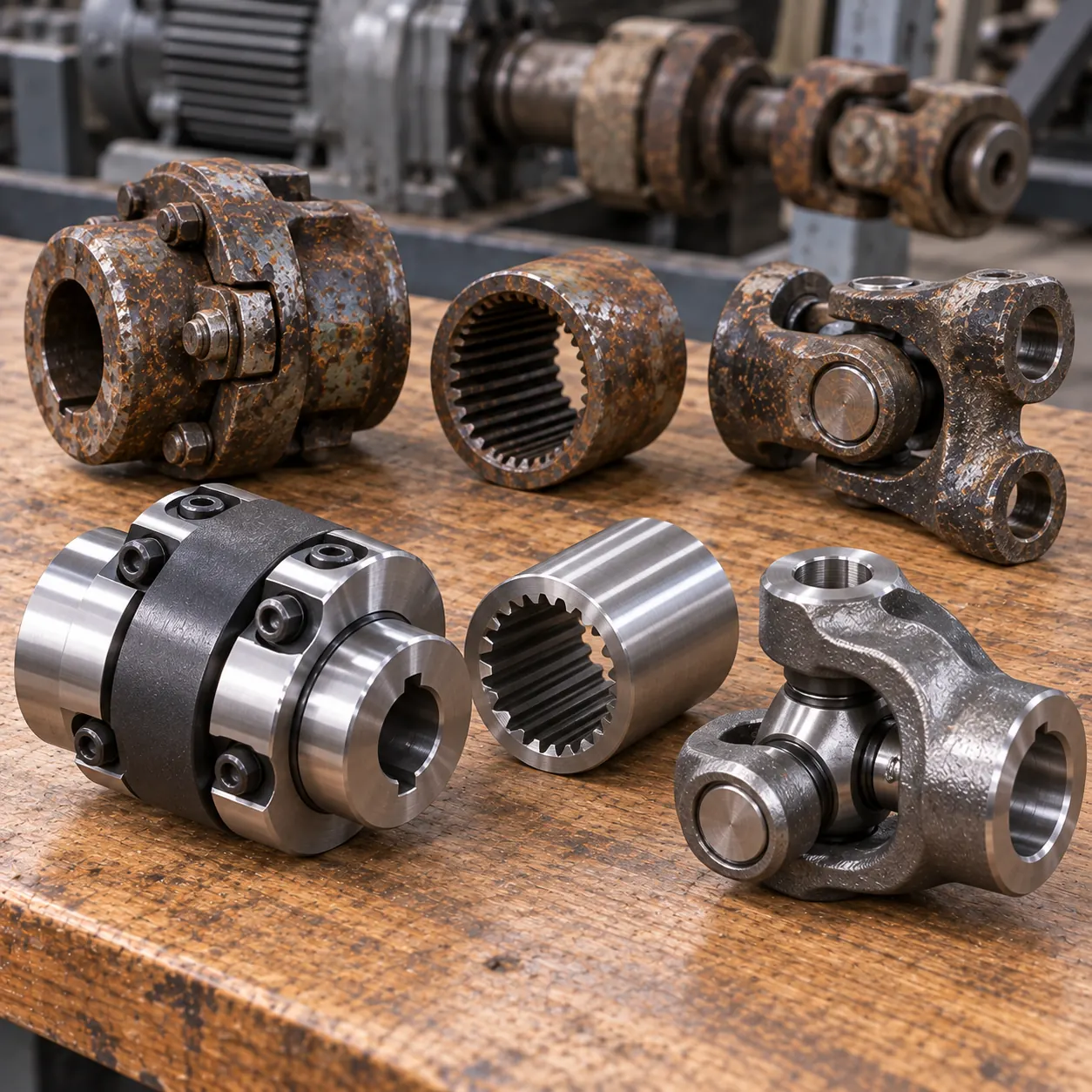
Say It in Your Words — the Name Table
| You said | It is called | What it does | Buy it, or machine it? |
|---|---|---|---|
| "connects the driveshaft to the differential" | Flange yoke, bolted to the pinion (companion) flange — a U-joint between yoke and shaft | Turns spinning shaft into axle input across an angle that moves | Listed car: buy. Odd or obsolete driveline: machined — see the broken drive-shaft case |
| "connects the gearbox to the driveshaft" | Slip yoke, sliding on the output splines | Lets the shaft change length as the axle moves | Spline work — machinable when no listing exists |
| "connects the engine to the transmission" | Bellhousing; inside it a flywheel + clutch (manual) or flexplate (auto) | Carries the structure and passes the torque | Stock pairings: buy. Engine swaps: a machined adapter plate, dowel positions carried over |
| "connects the piston to the crankshaft" | Connecting rod, with a wrist (gudgeon) pin at the piston | Turns reciprocation into rotation | Rods: buy forged, specialist product. Wrist pins & small-end bushings for dead engines: machinable |
| "connects the axle to the wheel" | Wheel hub and studs; spacers and adapters between | Bolts the rim to the rotating axle | Hubs & bearings: buy. Odd studs, spacers to your PCD: machined — see the wheel spacer case |
| "connects the engine to the exhaust" | Manifold studs and the exhaust flange | Clamps a joint that bakes and rusts solid | Gaskets: buy. Studs to length and flanges: machined — see double-end studs |
| "connects the shifter to the transmission" | Shift linkage: rods or cables, with clevises, pivot pins, bushings | Your hand's motion, delivered to the selector | Sloppy shifter = wallowed bushings; oversize pins & bushings machined — see worn holes, the fixes |
| "connects the engine to the frame" | Engine mounts — rubber isolators on mount brackets, sometimes a clevis mount | Holds the engine, eats the shake | Rubber isolators: buy. The brackets and clevis plates around them: machinable |
| "connects the leaf spring to the frame" | Shackle and hanger, with pins and bushes | Lets the spring change length as it flexes | Listed truck: buy. Vintage or odd: machined — see shackles & hangers |
| "connects the sway bar to the suspension" | Drop links (stabilizer links), with bushings | Ties the anti-roll bar to the moving arm | Buy them — cheap retail parts for nearly every car; not a machining job |
| "connects two shafts in line" (machine, pump, conveyor) | Coupling — rigid, jaw, bellows or chain type | One shaft drives the other | Catalogue sizes: buy. Odd bores, keyways, 316: machined — see rigid shaft couplings and the one-off coupling case |
| "connects a sensor or fitting to a thread that doesn't match" | Thread adapter — reducer or metric-imperial, one thread each end | Lets an M10×1 sensor live in a 1/8-NPT boss; a gauge in the wrong port | Common pairs: fitting suppliers stock them. Odd pairs, sealing styles, materials: machined — see thread adapters and sensor adapters; not sure what threads you have? start here |
| "connects the steering wheel to the rack" | Steering shaft with U-joints / coupler (the rubber one is the "rag joint") | Column rotation into the rack, around obstacles | Common splines: buy couplers. Custom length or spline: quoted case by case |
| "connects the handlebars to the forks" (bike / motorcycle) | Stem (bicycle) · triple clamp / yokes (motorcycle) | Clamps bars to steerer, sets your riding position | Listed model: buy. Custom offset or one-off: machined — see the billet triple clamp case |
| "connects the tractor to the implement" (mower, tiller, chipper) | PTO shaft — splined both ends; between mismatched ends, a PTO adapter | Carries engine power out of the tractor at 540 or 1000 rpm | Standard splines: farm stores stock shafts and adaptors. Odd, metric or discontinued ends: machined — see PTO shaft adapters |
Reading the last column: green means the aftermarket does it cheaper than any one-off ever will — buy it. Red means the moment your machine left the catalogue (obsolete, converted, odd combination), the part became machinable geometry: measured from the worn original or your photo, drawn, approved, made. From 1 piece.
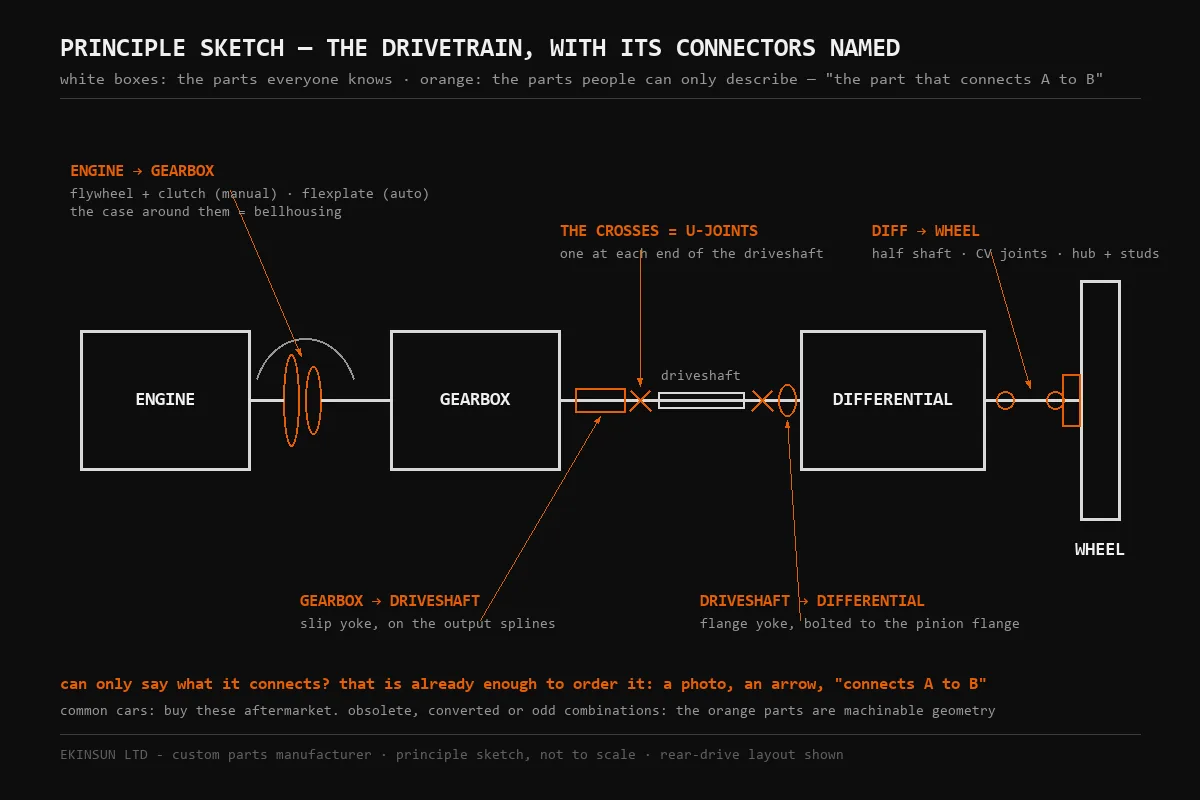
Why a Name Table on a Machining Site?
Because the person typing "part that connects driveshaft to transmission" is usually holding the broken one. For a listed car the story ends at a parts store, and the table says so in green. But the same search comes from the owner of a 1960s tractor, a machine whose importer vanished, a boat drive with one odd flange, an engine swap that no catalogue ever anticipated — and for them the name is only step one, because knowing the name of a part nobody sells doesn't produce the part. Machining it does. That second step is this site's entire business: obsolete parts, gearbox hardware, bushings and sleeves, clevis pins — the vocabulary of the orange rows above.
"I don't know what it's called — the piece that connects the gear lever to the box on a '70s loader. Splined hole one end, clevis the other, worn egg-shaped. Photo attached, arrow on it."
That is a complete enquiry, and close to word-for-word how the real ones arrive. The reply names the part on a dimensioned approval drawing — a selector arm, in that shape of story — you confirm the geometry against the machine, and only then is metal cut. The name is our job, not your homework; the process is the same order-with-no-CAD route every sketch and photo takes.
Buy It or Machine It — the Split, Stated Once
- Buy when the vehicle is listed and the part is stocked: hubs, ball joints, drop links, rubber mounts, common-size U-joints. Aftermarket beats any one-off on price, full stop.
- Buy from specialists what is metallurgy, not geometry: forged connecting rods, friction linings, rubber isolators.
- Machine when the catalogue has no row for you: obsolete drivelines, engine/gearbox swaps, odd spline counts and flange patterns, imperial-metric collisions, and worn joints where the honest fix is boring true and bushing — the geometry lanes above. Machined from what the joint needs: 4140 steel for yokes and pins, 304 or 316 stainless for corrosion, 6061 or 7075 aluminium billet for brackets and adapter plates, bearing bronze for pivot bushings.
- One boundary: geometry we did not design keeps its designer's loads. We machine to your dimensions and say so plainly on the drawing.
What "machined" looks like in practice has a worked example on this site: one rigid coupling in 316 stainless, machined to the customer's own drawing at quantity one, in about 5 working days — the full story is in the one-off coupling case. Small connector parts are quoted from their own drawing, and the quote itself costs nothing and arrives within 12 hours.
How to Order a Part You Can't Name
- A photo with an arrow on the part, in place if possible
- The sentence you searched with — "connects A to B" tells us its job
- Machine make, model, year — it dates the threads and standards
- A caliper across the mating features if the part is out: bores, splines, bolt circles
- Or post the broken original — it comes back with the new one
A dimensioned approval drawing comes back with the part named and measured, before anything is machined. Quote within 12 hours; production typically 5 working days after approval, from 1 piece.
Frequently Asked Questions
The flange yoke. It bolts to the pinion flange — also called the companion flange — on the nose of the differential, with a universal joint between the yoke and the driveshaft tube. On listed cars all three are aftermarket parts; on obsolete or converted drivelines the yoke and flange are machinable geometry, measured from the worn originals.
The bellhousing carries the structure; inside it a flywheel and clutch make the connection on a manual, a flexplate and torque converter on an automatic. When two units were never meant to meet — an engine swap with no bellhousing listed anywhere — the connection becomes a machined adapter plate, drilled to both bolt patterns with the dowel positions carried over, because the dowels, not the bolts, do the aligning.
The connecting rod, with a wrist pin — gudgeon pin in British English — joining its small end to the piston. Forged rods for performance engines are a specialist product to buy, not to machine. The machinable lane is the vintage-rebuild hardware around them: wrist pins to an odd diameter and small-end bushings for engines whose maker disappeared decades ago.
The shift linkage: rods or cables, with clevises, pivot pins and bushings at every joint. A sloppy shifter is usually not the gearbox — it is wallowed linkage bushings and worn clevis pins, a few grams of metal. Those are machined as oversize pins and bushings when no listing exists, which is a routine one-off job.
Describe it exactly the way you searched: a photo with an arrow on the part, the words connects A to B, and the machine's make, model and year. Add a caliper across the mating features if you can. That is a complete enquiry — we put the correct name on the dimensioned approval drawing, you confirm it is the right part, and only then is anything machined. No CAD is required at any point.
Split it: if the vehicle is listed and the part is stocked — hubs, ball joints, drop links, rubber mounts, U-joints for common sizes — buy it; aftermarket is cheaper than any one-off. The machined lane is everything the catalogue cannot list: obsolete drivelines, engine and gearbox swaps, odd spline or flange combinations, and worn geometry that needs boring true and bushing rather than replacing.
EKINSUN — a custom parts manufacturer machining one-off and low-volume drivetrain hardware from a photo, a sketch or the worn original: yokes, adapter plates, linkage clevises and bushings, shackles, studs and couplings, MOQ 1, quote in 12 hours. Honest exclusions: rubber isolators, friction linings and forged rods are bought from their specialist makers, and geometry we did not design keeps its designer's loads — we machine to your dimensions.
Get a Quote
Don't know the name? A photo and "connects A to B" is enough. Reply in 12 hours.
// In short
- →Listed car, stocked part? Buy it
- →Obsolete, converted, odd? We machine it
- →Name unknown — photo + arrow works
- →From 1 piece, no tooling charge
- →Quote in 12 hours
or email: [email protected]