A hose, gauge, valve or sensor with a G3/4, 3/4 NPT or SAE -12 end has to go into an M27×1.75 port, and it starts by hand then jams? All three inch threads sit within 0.6 mm of 27 mm and none of them is M27×1.75. We machine the adapter with each end cut to its own standard and sealed its own way. No drawing needed: a photo with a rule, the measurements in a message, the old part or its part number is enough; we draw it, you approve, we machine. Get a quote →
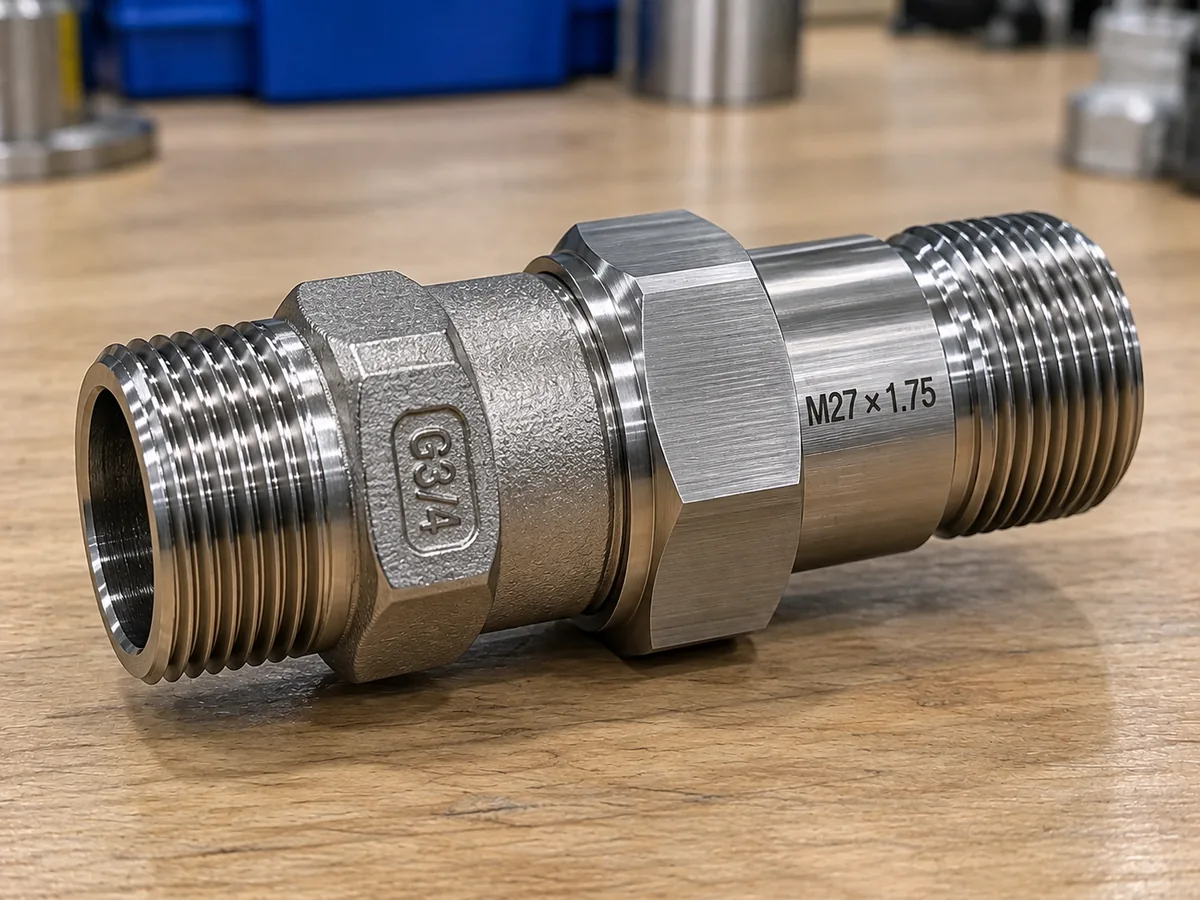
Three inch threads that almost fit an M27×1.75 port
EKINSUN LTD is a custom parts manufacturer that turns special-pitch threads from two callouts, one piece up. The problem on the bench is that G3/4, 3/4 NPT and 1-1/16-12 UN all start into an M27×1.75 port. The numbers below are why they bind, and why an adapter rather than force is the answer.
| Inch thread | Major diameter | Pitch | Flank | Form | Against M27×1.75 |
|---|---|---|---|---|---|
| G3/4 (BSPP, ISO 228) | 26.441 mm | 1.814 mm (14 TPI) | 55° | Parallel | −0.56 mm on diameter, +0.064 mm per pitch; binds after 2–3 turns |
| 3/4 NPT (ASME B1.20.1) | 26.670 mm | 1.814 mm (14 TPI) | 60° | Tapered 1:16 | Wedges within a turn; never seats |
| 1-1/16-12 UN (SAE -12 ORB / JIC) | 26.988 mm | 2.117 mm (12 TPI) | 60° | Parallel | Diameter matches to 0.01 mm; pitch off by 0.367 mm, crosses on turn one |
| M27×1.75 (the port) | 27.000 mm | 1.750 mm | 60° | Parallel | — |
Each end seals its own way
An adapter between an inch fitting and an M27×1.75 port has two seals, one per standard, and neither is on the metric thread.
| End | Where it seals | What the adapter carries |
|---|---|---|
| M27×1.75 (parallel metric) | Under the hex or at the port face | Bonded washer seat, O-ring groove at the shoulder, or a machined face; the thread itself does not seal |
| G3/4 / G1/2 (BSPP) | Under the hex or on a cone (BS 5200 / ISO 8434-6) | Flat washer face, or 60° cone for a hose tail |
| 3/4 NPT / 1/2 NPT | On the tapered thread | Taper cut on the lathe; sealant or tape by the installer |
| SAE -12 / -10 / -8 O-ring boss (J1926) | O-ring at the boss chamfer | O-ring groove and 12° or 15° chamfer on the male, chamfer on the female |
| -12 JIC 37° flare (J514) | On the 37° cone | Cone on the male; the swivel nut belongs to the hose |
Body forms we machine
Every pairing near 27 mm goes in series along a hex body: the female thread of each pair has a larger diameter than the male minor diameter of the other, so neither can be cut inside the other. Reducing pairings to G1/2, 1/2 NPT, -8 and -10 are stepped bodies.
| Body | One end | Other end | Seal on the inch end | Hex |
|---|---|---|---|---|
| Male–female | M27×1.75 male | G3/4 female | Washer under the mating fitting | 36 mm |
| Male–female | M27×1.75 male | 3/4 NPT female | Sealant on the mating taper | 36 mm |
| Male–female | M27×1.75 male | -12 ORB female (1-1/16-12) | O-ring of the mating fitting | 36 mm |
| Female–male | M27×1.75 female | G3/4 male | Bonded washer under the hex | 41 mm |
| Female–male | M27×1.75 female | 3/4 NPT male | Tapered thread with sealant | 41 mm |
| Female–male | M27×1.75 female | -12 ORB or -12 JIC male | O-ring at the boss / 37° cone | 41 mm |
| Reducing, male–male | M27×1.75 male | G1/2 or 1/2 NPT male | Washer / taper | 32 mm |
| Reducing, male–male | M27×1.75 male | -8 (3/4-16) or -10 (7/8-14) ORB male | O-ring at the boss | 32 mm |
Confirm both ends before ordering
Ten threads on the port measure 17.5 mm for M27×1.75; ten threads on the inch fitting measure 18.14 mm for 14 TPI or 21.17 mm for 12 TPI. If the fitting is tapered, calipers at the first and the sixth thread differ by about 0.5 mm; a parallel thread reads the same at both. Send both readings with the two callouts and the medium, and the drawing comes back with the seal face designed in.
Material by medium
| Medium | Material | Note |
|---|---|---|
| Water, glycol, washdown | 316 stainless (1.4404) or brass CW614N | Passivated stainless; brass for potable water where permitted |
| Hydraulic oil | Carbon steel, zinc plated, or 42CrMo4 | Plated after threading; -12 ORB end to J1926 |
| Compressed gases | 316 stainless or brass | O-ring on the metric end, no thread sealant |
| Chemicals, marine | 316 stainless | Or 304 (1.4301) where chlorides are absent |
| Instrument air, low pressure | Aluminium 6061 or brass | Light bodies; 7075 where a wrench will be used often |
Price, lead time, delivery
There is no list price for a special-pitch part; a single piece starts from €65 and is quoted within 12 hours. One to a few dozen pieces ship in 5 working days, 50 to 500 in 15 working days, delivered DDP to your door with duties in the quote. The first piece is the sample; repeat orders run to the same drawing, with 500-piece and 1,000-piece runs priced lower per piece.
Where the fitting catalogue stops
| What you need | In the catalogue? | What to do |
|---|---|---|
| G3/4 to 3/4 NPT adapter | Yes | Stock item at any fittings supplier: buy it there, or ask us — we may have it in stock |
| M27×2 or M27×1.5 to G3/4 adapter | Sometimes | Hydraulic and heating suppliers list the common metric fine pitches |
| M27×1.75 to G3/4, 3/4 NPT or -12 | No | Machined to order, each end to its own standard, MOQ 1 |
| M27×1.75 with an O-ring shoulder seal | No | Groove and shoulder designed in from the port face |
| M27×1.75 to -12 JIC 37° flare | No | Cone cut on the lathe; swivel nut supplied by the hose |
| Reducing M27×1.75 to G1/2, 1/2 NPT, -8, -10 | No | Stepped body, 32 mm hex |
| 316 stainless rather than plated steel | Rare at these pairings | Our default for wet and chemical lines |
Related M27×1.75 pages and inch-to-metric adapters
Frequently asked
Will a G3/4 fitting screw into an M27×1.75 port?
It starts and binds after two or three turns. G3/4 is 26.441 mm across with 14 threads per inch (1.814 mm pitch) and a 55° flank; M27×1.75 is 27.000 mm, 1.75 mm pitch, 60°. The diameters differ by 0.56 mm and the pitches by 0.064 mm per thread, 0.64 mm over ten. An adapter with a true M27×1.75 end and a true G3/4 end is the fix.
What about 3/4 NPT into M27×1.75?
Worse. 3/4 NPT is tapered at 1 in 16 with 14 threads per inch; it enters the parallel M27×1.75 port for a turn and wedges. The adapter carries the taper on its NPT end, cut on the lathe, and seals there with tape or sealant while the M27×1.75 end seals on a washer or O-ring.
Is 1-1/16-12 UN (SAE -12) the same as M27×1.75?
No, although the diameters match to 0.01 mm: 1-1/16-12 is 26.988 mm across at 12 threads per inch, 2.117 mm pitch. The pitch difference of 0.367 mm crosses threads on the first turn. A -12 O-ring boss (SAE J1926) or -12 JIC 37° flare end on an adapter is the right connection.
How does each end of the adapter seal?
Each to its own standard. G (BSPP) parallel ends seal on a bonded washer or an O-ring under the hex; NPT ends seal on the tapered thread with sealant; SAE O-ring boss ends seal on the O-ring at the boss chamfer; JIC ends seal on the 37° cone. The M27×1.75 end is a parallel metric thread and seals on a washer, O-ring or face, not on the thread.
Which body forms can you make?
Male M27×1.75 to female G3/4, 3/4 NPT, -12 ORB or -12 JIC; female M27×1.75 to male G3/4, 3/4 NPT or -12 ORB; and the reducing versions to G1/2, 1/2 NPT, -8 (3/4-16) and -10 (7/8-14). Every pairing near 27 mm is built with the two threads in series along a hex body, because neither thread can sit inside the other.
What does an M27×1.75 to BSP or NPT adapter cost?
No list price; a single piece starts from €65, quoted within 12 hours from the two callouts and the medium. Small quantities ship in 5 working days, DDP to your door, in 316 stainless, brass or plated steel.
Send the two callouts and the medium. "M27×1.75 male to G3/4 female, water, 316" is enough; ten-thread readings on both parts remove any doubt. Quote in 12 hours, MOQ 1. Get a quote →