Holding a part with an M27×1.75 thread and finding that nothing on any shelf mates with it? The pitch is real, it is just not an ISO size, so no tap, gauge or catalogue adapter was ever made for it. We single-point cut M27×1.75 to order and have already built the adapter shown below. No drawing needed: a photo with a rule, the measurements in a message, the old part or its part number is enough; we draw it, you approve, we machine. Get a quote →
We have made this exact part: M27×2 male to M27×1.75 female
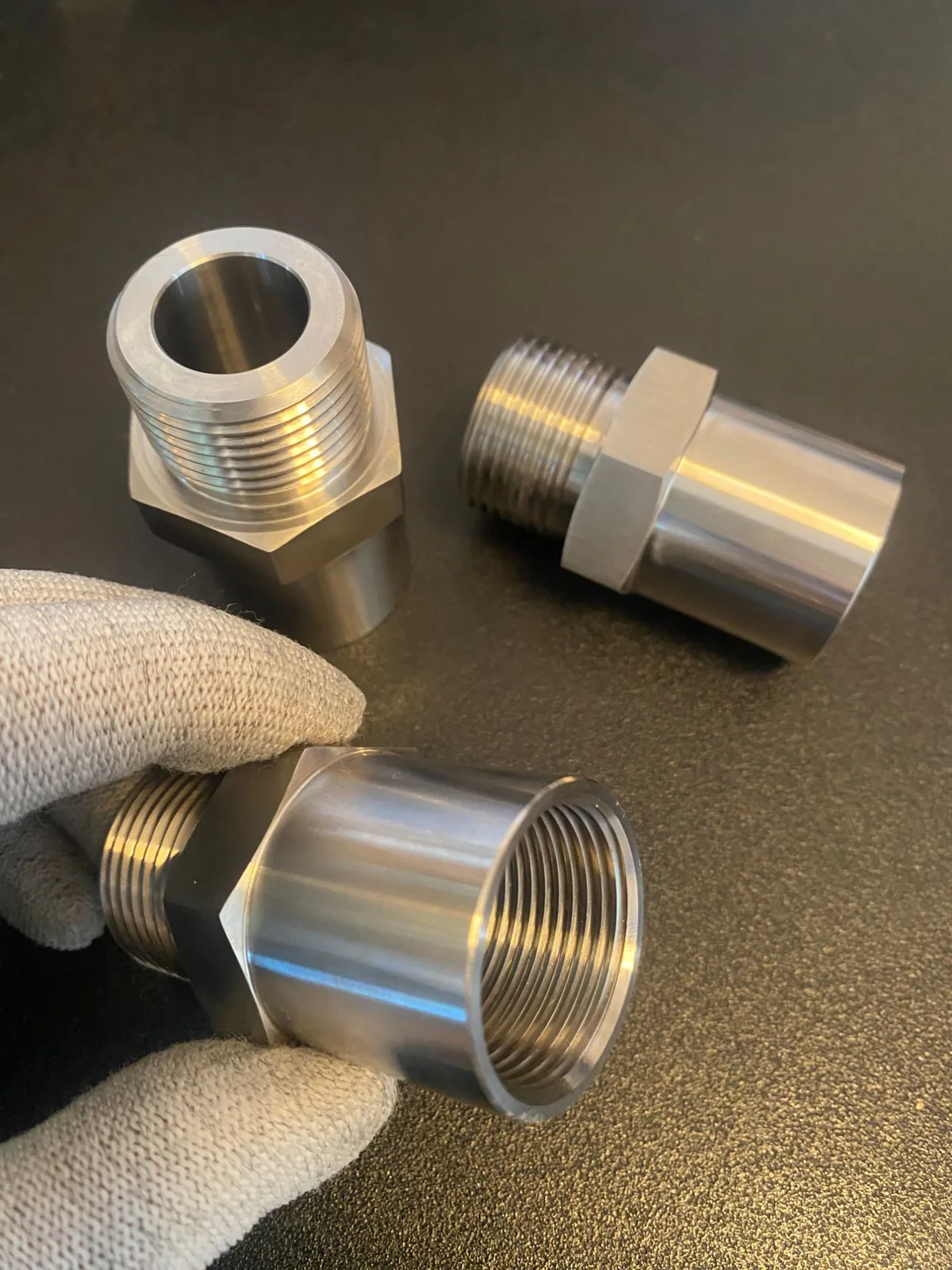
EKINSUN LTD is a custom parts manufacturer that cuts special-pitch threads on a lathe from two callouts, one piece up. The three adapters in the photo are the delivered parts. Each one carries an M27×2.0-6g male thread on one end and an M27×1.75-6H female thread in the long body, joined by hex flats, with a 16 mm through bore.
| Feature | As built |
|---|---|
| Male end | M27×2.0-6g, 18.5 mm thread length |
| Female end | M27×1.75-6H, full thread depth 23.2 mm minimum |
| Bore | 16 mm through, both ends |
| Body | Hex flats for a spanner; the two threads are in series, never overlapping |
| Material | 316 stainless steel, passivated |
| Edges and threads | Deburred, no sharp edges, threads cleaned and checked before packing |
| Thread check | Female M27×1.75-6H gauged go/no-go with our own plug gauge; male M27×2-6g gauged with a ring gauge |
| Quantity | 3 pieces, one-off order |
Because the female thread has the larger diameter, the male M27×2 section (minor diameter 24.55 mm) cannot sit under a 27 mm female thread. The two threads follow each other along the body, and the overall length works out from 18.5 mm of male thread plus 23.2 mm of female thread plus an undercut between them; the hex adds its own height on top.
Materials for an M27×1.75 adapter
| Material | When it is the right choice |
|---|---|
| 316 stainless (1.4404) | Default for air, water, chemical and outdoor lines; the part above is 316 |
| 304 stainless (1.4301) | Dry air and indoor water where chloride is absent; lower cost than 316 |
| Carbon steel, zinc plated | Mechanical joints and dry pneumatics; plated after threading |
| 42CrMo4 (1.7225), quenched and tempered | Loaded joints, tie-rods and spindle extensions |
| Brass CW614N (C360) | Water and low-pressure gas fittings; free-cutting, no plating needed |
| Aluminium 6061 / 7075 | Light-duty air, instrument and enclosure bosses where weight matters |
Why M27×1.75 is on no shelf
ISO 261 gives M27 four pitches: 3 mm coarse, and 2, 1.5 and 1 mm fine. A 1.75 mm pitch exists in the ISO tables only at M12. Tool catalogues follow the standard, so M27 taps, dies and go/no-go plug gauges are listed at ×3, ×2, ×1.5 and ×1 and stop there. A thread outside that list is made only one way: cut on a lathe with a single-point tool that can be set to any pitch. That is what makes it a machined part rather than a catalogue part.
Special pitches like this turn up on equipment where the maker chose a proprietary thread, on instrument and gauge bosses, and on parts that were designed around an inch thread and then converted. Which of these applies to your part does not change what we make; it only changes what you should send us: the callout if you have a drawing, or the part itself if you do not.
Read the pitch over ten threads before you order
One thread of 1.75 mm and one thread of 1.5 mm look the same in the hand; over ten threads the difference is 2.5 mm, which a steel rule shows at once. Lay the rule along the thread, put zero on one crest, and read the crest ten threads along.
| Ten threads measure | Pitch | What it is at 27 mm diameter |
|---|---|---|
| 30.0 mm | 3.0 | M27×3 coarse; taps, nuts and adapters on every shelf |
| 20.0 mm | 2.0 | M27×2 fine; stocked at this diameter |
| 18.1 mm | 1.814 (14 TPI) | Not metric: G3/4, 3/4 NPT or a 14 TPI inch thread of similar size |
| 17.5 mm | 1.75 | M27×1.75 special pitch; nothing stocked, we cut it |
| 15.0 mm | 1.5 | M27×1.5 fine; the pitch most often confused with 1.75 |
| 10.0 mm | 1.0 | M27×1 extra fine; stocked by fine-thread suppliers |
Threads that look like M27×1.75 and do not mate
Three inch threads sit within 0.6 mm of 27 mm diameter, and two other M27 pitches share the diameter exactly. All five start into an M27×1.75 port by hand and all five bind. The table gives the numbers that separate them.
| Lookalike thread | Major diameter | Pitch | Ten threads | What happens in an M27×1.75 port |
|---|---|---|---|---|
| G3/4 (BSPP) | 26.44 | 1.814 (14 TPI) | 18.14 | Starts by hand, binds after two or three turns; 55° flank against 60° |
| 3/4 NPT | 26.67 | 1.814 (14 TPI) | 18.14 | Tapered; jams within a turn or two and never seats |
| 1-1/16-12 UN (SAE -12 ORB / JIC) | 26.99 | 2.117 (12 TPI) | 21.17 | Same diameter to 0.01 mm; the 0.37 mm pitch difference crosses threads on the first turn |
| M27×2 | 27.00 | 2.0 | 20.00 | The other end of the part shown above; 0.25 mm per pitch, 2.5 mm over ten |
| M27×1.5 | 27.00 | 1.5 | 15.00 | The fine pitch most often written down in place of 1.75 |
Female M27×1.75 paired with other threads — pre-planned bodies
The tables below are worked out from the ISO basic profile (male minor diameter d3 = d − 1.2269 P, female minor diameter D1 = d − 1.0825 P). They tell you which body form each pairing needs and how much wall it leaves. The female M27×1.75 thread has a minor diameter of 25.11 mm in every case.
Same diameter, different pitch — male M27 to female M27×1.75
Every M27 male thread has a minor diameter smaller than the 27 mm female major diameter, so the two threads cannot overlap. The body is a nipple with the male thread, a hex, then the female thread, as in the part above. Wall thickness is given for a 16 mm through bore.
| Male end | Male minor d3 | Wall over a 16 mm bore | Ten threads on the male end |
|---|---|---|---|
| M27×3 (coarse) | 23.32 mm | 3.66 mm | 30 mm |
| M27×2 (fine) | 24.55 mm | 4.27 mm | 20 mm |
| M27×1.5 (fine) | 25.16 mm | 4.58 mm | 15 mm |
| M27×1 (fine) | 25.77 mm | 4.89 mm | 10 mm |
Reducing — female M27×1.75 to a smaller popular thread
The common request: a machine port or instrument boss in M27×1.75 has to take a fitting or sensor with an ordinary thread. These are stepped bodies; the male end can sit beside or partly under the female thread, and the bore is chosen to suit the male end.
| Male end | Male minor diameter | Bore | Wall at the male thread | Body |
|---|---|---|---|---|
| M24×2 | 21.55 mm | 14 mm | 3.77 mm | Standard stepped body |
| M24×1.5 | 22.16 mm | 14 mm | 4.08 mm | Standard stepped body |
| M22×1.5 | 20.16 mm | 12 mm | 4.08 mm | Standard stepped body |
| M20×1.5 | 18.16 mm | 12 mm | 3.08 mm | Standard stepped body |
| M18×1.5 | 16.16 mm | 10 mm | 3.08 mm | Standard stepped body |
| M16×1.5 | 14.16 mm | 8 mm | 3.08 mm | Standard stepped body |
| M14×1.5 | 12.16 mm | 8 mm | 2.08 mm | Thin; check the pressure |
| M12×1.5 | 10.16 mm | 6 mm | 2.08 mm | Thin; check the pressure |
| M12×1.25 | 10.47 mm | 6 mm | 2.23 mm | Standard stepped body |
| M10×1 | 8.77 mm | 5 mm | 1.89 mm | Thin; check the pressure |
| G1/2 (BSPP) | 18.73 mm (approx.) | 10 mm | 4.36 mm (approx.) | Inch male end; state BSPP or NPT |
| 1/2 NPT | 19.11 mm (approx.) | 10 mm | 4.56 mm (approx.) | Inch male end; state BSPP or NPT |
| 7/8-14 UNF (SAE -10) | 20.00 mm (approx.) | 12 mm | 4.00 mm (approx.) | Inch male end; state BSPP or NPT |
| 3/4-16 UNF (SAE -8) | 17.10 mm (approx.) | 10 mm | 3.55 mm (approx.) | Inch male end; state BSPP or NPT |
Stepping up — female M27×1.75 inside a larger male thread
This is the thread-repair case: a damaged M27×1.75 port is bored out, tapped larger, and a bushing with the original female thread goes in. The bushing only exists if the larger male minor diameter leaves wall around the 27 mm female thread. Below 2 mm of wall the bushing is not made; the two threads go in series instead.
| Male outside | Male minor d3 | Wall around the 27 mm female thread | Result |
|---|---|---|---|
| M30×1.5 | 28.16 mm | 0.58 mm | No bushing; threads in series |
| M30×2 | 27.55 mm | 0.27 mm | No bushing; threads in series |
| M30×3.5 | 25.71 mm | -0.65 mm | No bushing; threads in series |
| M33×2 | 30.55 mm | 1.77 mm | No bushing; threads in series |
| M36×2 | 33.55 mm | 3.27 mm | Bushing possible |
| M36×3 | 32.32 mm | 2.66 mm | Bushing possible |
| M39×2 | 36.55 mm | 4.77 mm | Bushing possible |
| G1 (BSPP) | 30.29 mm | 1.65 mm | No bushing; threads in series |
Hex size around an M27 female thread
The hex has to leave metal around the 27 mm thread. Across-flats of 32 mm leaves 2.5 mm at the flats, which is thin for a 316 body that will see a spanner; 36 mm leaves 4.5 mm and is the size we start from. If you already own the spanner, tell us the across-flats and we size the body to it.
| Across flats | Wall at the flats over 27 mm | Use |
|---|---|---|
| 32 mm | 2.50 mm | Only when the envelope forces it |
| 34 mm | 3.50 mm | Acceptable in steel |
| 36 mm | 4.50 mm | Our default for M27 female bodies |
| 41 mm | 7.00 mm | When the body is also a wrench flat for a large fitting |
Checking the M27×1.75 thread: go/no-go gauge in house
Gauge makers do not list an M27×1.75 plug gauge, which is the usual reason a special pitch gets refused or shipped unchecked. We hold a go/no-go plug gauge for M27×1.75-6H, so the female thread is accepted the same way a standard thread is: the go end runs through the full thread depth, the no-go end stops within the allowed turns. A male M27×1.75 thread is measured over three wires for pitch diameter, and the pitch is confirmed over ten threads at 17.5 mm. If you send your mating part, it is screwed on as the final check before packing.
Sealing a straight M27 thread
Straight metric threads locate; they do not seal on the flanks. If the adapter carries a fluid or gas, something other than the thread has to seal: an O-ring in a groove at the shoulder, a bonded washer under the hex, or a machined face against the port. Tell us the medium and pressure with the two callouts and the seal face is designed in; if the mating port already has a seal, tell us which so the adapter matches it.
Price, lead time, delivery
There is no list price for a special-pitch adapter; a single piece starts from €65 and is quoted within 12 hours from the two callouts, a sketch or a photo of the mating parts. One to a few dozen pieces ship in 5 working days, 50 to 500 pieces in 15 working days. Delivery is DDP to your door, duties and taxes included in the quote. The first piece is the sample: approve it, and repeat orders are made to the same drawing, with 500-piece and 1,000-piece runs priced lower per piece. If your current supplier has stopped making the thread, the drawing we make from your part serves as the second source.
| Quantity | Price | Production |
|---|---|---|
| 1 piece | From €65, quoted in 12 hours | 5 working days |
| 10 pieces | Setup shared across ten; lower per piece | 5 working days |
| 100 pieces | Volume price on the same drawing | 15 working days |
| 500 / 1,000 pieces | Tiered lower per piece; blanket order with call-offs | 15–25 working days |
Where the M27 catalogue stops
Three M27 pitches can be bought as taps, nuts and stock adapters; one cannot. The table separates what to buy from what we machine.
| What you need | In the catalogue? | What to do |
|---|---|---|
| M27×3 coarse nut, tap or adapter | Yes | A coarse M27 part is on every fastener shelf: buy it there, or ask us — we may have it in stock |
| M27×2 or M27×1.5 fine-pitch adapter | Yes, at the common pairings | Buy the standard pairing; we make the odd one |
| M27×1 extra-fine | Rare | Fine-thread specialists stock taps; adapters are made to order |
| M27×1.75 anything — adapter, bushing, nut, stud | No | Special pitch; single-point cut here, MOQ 1 |
| M27×1.75 go/no-go plug gauge | No | We hold one; every female M27×1.75 thread is gauged before packing |
| Female M27×1.75 bushing inside M30 or M33 | No | Cannot exist as a thin bushing (0.27–1.77 mm wall); made as a series-thread adapter instead |
| M27×1.75 male to G3/4 or 3/4 NPT female | No | The correct fix for the lookalike problem; both ends cut to their own standard |
| 316 stainless, deburred, threads cleaned | Rare at this size | Our default finish for air, water and chemical lines |
Other M27×1.75 pages and thread adapters we machine
Frequently asked
Is M27×1.75 a standard thread?
No. ISO 261 lists M27 at 3 mm coarse and 2, 1.5 and 1 mm fine; 1.75 mm appears in the ISO tables only at M12. An M27×1.75 thread is a special pitch: no catalogue lists a tap, die, plug gauge or adapter for it, so it is single-point cut on a lathe to order and checked with a go/no-go gauge held for this pitch.
Have you actually made an M27×1.75 adapter?
Yes. The part in the photo is an M27×2-6g male to M27×1.75-6H female adapter in 316 stainless: 18.5 mm of male thread, at least 23.2 mm of full female thread, 16 mm through bore, hex flats, deburred. Three pieces were made and shipped.
How do you check an M27×1.75 thread when no catalogue sells a gauge?
With a go/no-go plug gauge we hold for M27×1.75-6H. The female thread is gauged the same way a standard thread is: the go end must run through the full 23.2 mm depth, the no-go end must not enter more than the allowed turns. A male M27×1.75 thread is measured over three wires for pitch diameter, and the pitch itself is confirmed over ten threads at 17.5 mm.
Can you pair a female M27×1.75 with a different thread on the other end?
Yes. Same-diameter pairings (M27×3, M27×2, M27×1.5, M27×1) go in series because the 27 mm female major diameter is larger than any M27 male minor diameter. Reducers to M24×2, M20×1.5, M16×1.5, G1/2 or 1/2 NPT are stepped bodies. A step-up to M30 or M33 cannot be made as a thin bushing; it needs M36×2 or larger to leave 2.66 mm of wall or more.
What does an M27×1.75 adapter cost and how long does it take?
There is no list price; a single piece starts from €65 and is quoted within 12 hours from the two callouts. One to a few dozen pieces ship in 5 working days, 50 to 500 in 15 working days, delivered DDP to your door. The first piece is the sample; repeat orders at 500 and 1,000 pieces are priced lower per piece.
Will a G3/4 or 3/4 NPT fitting screw into an M27×1.75 port?
It will start, then bind. G3/4 is 26.44 mm across at 14 threads per inch (1.814 mm pitch) with a 55° flank, so it enters an M27×1.75 port for two or three turns and jams. 3/4 NPT is tapered and jams sooner. An adapter with a true M27×1.75 male end and a G3/4 or NPT female end is the right part.
Send the two callouts. "M27×1.75 female, M27×2 male, 316, 16 mm bore" is enough; a photo of the mating parts helps if the pitch is uncertain. Quote in 12 hours, MOQ 1. Get a quote →