You have an M30 male on one side and an M10 female on the other, and every reducer you can find jumps one size at a time. Big-step adapters like this are not a stock item at any size — they get turned from solid for the job. Send us the two callouts and we'll draw it. Get a quote →
Three sizes down in one part
Most reducers on the market step down once: M12 to M10, M10 to M8, M8 to M6. Search for those and you will find dozens, priced in single dollars, because they sell by the thousand. Search for M30 down to M10 and the results quietly change size on you — you get M10-to-M6 listings, M12-to-M10 sleeves, and size charts. Nothing at the size you asked for.
That is not an oversight. A three-step reduction has no volume market because each one is specific to a machine. Somebody has an M30 boss, a mount, a spindle end or a leveling foot on one side, and an M10 accessory, eye bolt, sensor or handle on the other. There is no reason for a distributor to guess that combination, so it only exists when it is made.
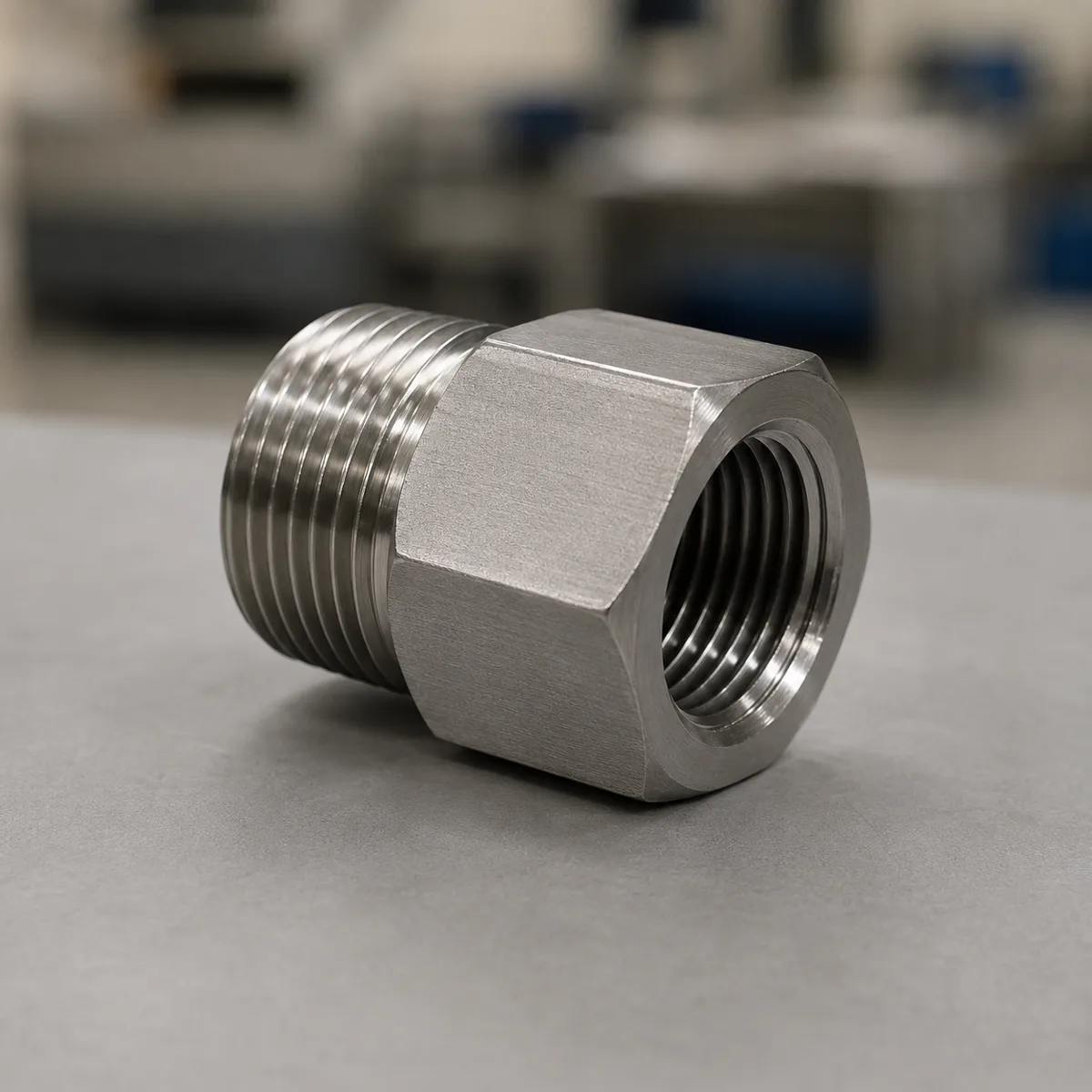
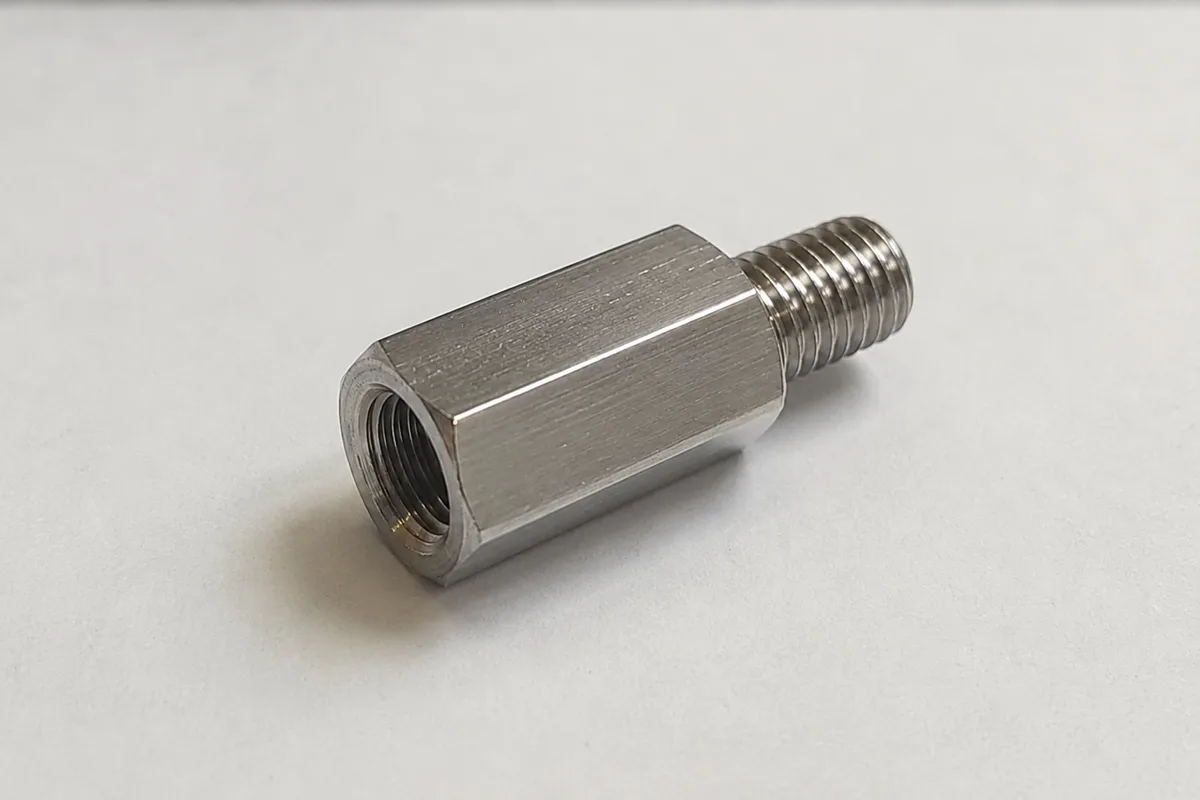
You have more wall than you think
The first question buyers ask about a big step is whether it has to be two parts welded together. It doesn't, and it shouldn't be.
An M30 coarse thread has a minor diameter of roughly 26.2 mm. An M10 female thread starts from an 8.5 mm tapping drill. Subtract, halve, and you have about 8.8 mm of wall all the way round the M10 hole — thicker than the entire wall of most stock reducers. There is no structural reason to weld, and every reason not to: a one-piece part has no joint to fatigue and no concentricity error stacked between the two threads.
Ask a supplier how they'd make it. If the answer involves welding a nut into a boss, the two threads will not end up on the same axis. On a load-bearing joint that shows up as side loading on the M10 screw.
The M10 end is the weak end — design around that
This is the part that catches people out. Because the adapter looks massive at the M30 end, it is easy to assume the joint is strong. The joint is only as strong as its smallest thread.
An M10 coarse thread has a tensile stress area of about 58 mm². M30 coarse is around 561 mm². That is close to a ten-fold difference. Whatever grade of steel you pick, the M30 end and the adapter body will never be the limiting factor in an M30-to-M10 assembly — the M10 screw will be, long before anything else yields.
Two practical consequences:
- Size the joint on the small end. Work out what the M10 fastener can carry, and treat the M30 end as a mounting interface rather than as extra capacity.
- Buy engagement, not bulk. Because the failure mode is at the M10 thread, depth of engagement matters far more than making the body heavier. Aim for at least 1.5× diameter — about 15 mm of usable M10 thread — and 2× in aluminium. There is plenty of length inside an M30 body, so there is no reason to run it shallow.
Drive features go on the big end
A big-step reducer has an awkward geometry problem: the end you need to grip is not the end with room. Once an M10 thread and its relief are in the small end, there is nothing left to put a hex on. So the drive feature goes on the M30 diameter, where material is abundant.
| Feature | Options | When to choose it |
|---|---|---|
| Hex across flats | Typically 46 mm on an M30 body | Default. Matches standard sockets and open-end wrenches |
| Two spanner flats | Milled on opposite sides | Where the adapter must sit inside a recess or close to a face |
| Pin-wrench holes | 2 or 4 holes in the end face | Where nothing may project past the outside diameter |
| Knurled band | Straight or diamond knurl | Hand-tightened accessories, no tool wanted |
| M30 end pitch | M30×3.5 coarse · ×2.0 · ×1.5 | State which — coarse is the default but far from universal |
| M10 end pitch | M10×1.5 coarse · ×1.25 · ×1.0 | Fine M10 is common on sensors and instruments |
Materials — and where aluminium stops making sense
Because the M10 thread governs, material choice is mostly a question of what that small thread has to survive:
- 12L14 / free-machining steel — lowest cost, fine for dry indoor joints with modest load.
- 42CrMo4 alloy steel — when the M10 fastener is a high-grade bolt and you want the adapter to outlast it.
- 304 stainless — the usual choice for outdoor and general corrosion resistance.
- 316 stainless — marine, chemical and washdown service.
- 6061 aluminium — good where the assembly must be light and the M10 joint is lightly loaded. Run the engagement to 2× diameter, because aluminium threads strip long before steel ones do.
- 7075 aluminium — noticeably stronger than 6061 for the same weight, worth the cost when an aluminium part still has to carry something. Same engagement advice applies.
If the adapter will be tightened and loosened repeatedly, a steel threaded insert in an aluminium body is usually a better answer than a stronger alloy — tell us the duty cycle and we will suggest it.
Other pairings built the same way
This construction is not specific to M30 and M10 — it is how any large-to-small metric pair gets made. Below roughly M20 to M16 you can usually buy a stock reducer more cheaply than we can machine one, and we will tell you so.
Will it fit? M30 to M10 checks before you order
The M10 end is the one that decides whether the part fits and how much it carries. An M10×1.0 fine sensor thread will not go into an M10×1.5 coarse female end, and the load on the joint is whatever an M10 thread carries, not what the M30 body suggests. On the M30 side, an M30×2.0 fine port will not take an M30×3.5 coarse male end. Both pitches go on the enquiry; the 46 mm hex or the spanner flats follow from the M30 body.
What do I need to mount an M10 sensor in an M30 port?
An M30 male × M10 female adapter, through-bored if the sensor tip has to reach the fluid, with the sealing face on the M30 shoulder. To fit an M30 part onto an M10 stud — rare, and weak at the stud — the reverse: M10 female × M30 male.
Same M30 to M10 reducer, but with a through-bore, an M10×1.0 end, or in 316
A bore for the sensor tip, a fine M10 end, 316 stainless instead of steel, or pin-wrench holes instead of a hex — each is a variant of the same drawing, one piece and up, quoted in 12 hours.
Where the Catalogue Stops for This Size Pair
If a plain reducer in this step exists on a stockist's shelf, buy it. These are the versions that do not exist as a part number.
| What you need | In the catalogue? | How we machine it |
|---|---|---|
| A plain coarse-to-coarse reducer in this size step | Sometimes stocked | If a stockist lists it, buy it off the shelf. We are worth calling when the pitch, length, material or form is not on their page. |
| A two-size jump like M30 down to M10 | No | Skipping this many sizes leaves a thick body and a thin bore — it is a turned part, not a bush. |
| Different pitch on each end | No | Each thread single-pointed to its own pitch on the same bar. |
| Double-male stud instead of a bush | Thin | Male on both ends; far fewer sizes stocked and almost none in mixed pitch. |
| Female-female coupling | Thin | Joins two studs rather than reducing a hole. Any pitch pair. |
| Hex flats sized to a spanner you already own | No | Cut to your wrench, not to a catalogue table. |
| Through-bore for a shaft, cable or fluid | No | Bore and both threads cut in one setup so they stay concentric. |
| Shortened body for a crowded plate | No | Catalogue parts come in one length. State the space you have. |
| Left-hand thread on either end | No | Not stocked at any size. |
| 316 stainless or alloy steel instead of plated mild steel | Rare | Material is open; no tooling cost at these sizes. |
Frequently asked
Does an M30 male to M10 female adapter have to be welded from two parts?
No. About 8.8 mm of wall remains between an M30 minor diameter and an M10 tapping hole, so the whole adapter is turned from one piece — no weld to fatigue, no concentricity error between the ends.
Which end limits the strength?
The M10 end, by roughly ten to one on stress area. Design the joint around what the M10 fastener can carry and treat the M30 end as an interface.
How deep should the M10 thread be?
At least 1.5× diameter — around 15 mm — and 2× in aluminium. Tell us the screw length and we set the depth and add a relief so it bottoms cleanly.
Where do the wrench flats go?
On the M30 end, typically a 46 mm hex. The small end has no room once the thread and relief are in. More on male-female forms →
Can you match an existing part instead?
Yes — send the part you are replacing and we take the threads, pitches and engagement straight off it. That is the safest route when you are unsure of a callout. From a physical sample →
What is the minimum order?
One piece, no tooling cost, no CAD required. The two callouts, an overall length and a material are enough to draw it and confirm before machining. Low-MOQ custom parts →
Two callouts is all we need. For example: "M30×3.5 male → M10×1.5 female, 304 stainless, 55 mm overall, 18 mm M10 depth, 46 mm hex". Free drawing, quote in 12 hours. Get a quote →