What Is a Thread Reducer Insert?
A thread reducer insert changes a threaded hole to a smaller size without changing the part. It has no head and no hex, so it sits flush in the hole, and the screw goes straight into its bore. You will also find it sold as a thread adapter sleeve or a reducing nut. Size is given as outer thread and inner thread, so an M10 / M8 insert has an M10 thread outside and an M8 thread inside.
There are two usual jobs for it. The first is fitting a smaller screw to a hole that already exists, for example when a mounting pattern changes and the new bracket uses M6 in a part tapped M8. The second is repair: a stripped M6 hole is drilled and tapped larger, then an insert brings it back to the original M6 screw. Going up to M10 / M6 instead of M8 / M6 leaves 1.08 mm between the thread grooves instead of 0.23 mm, if the part has room.
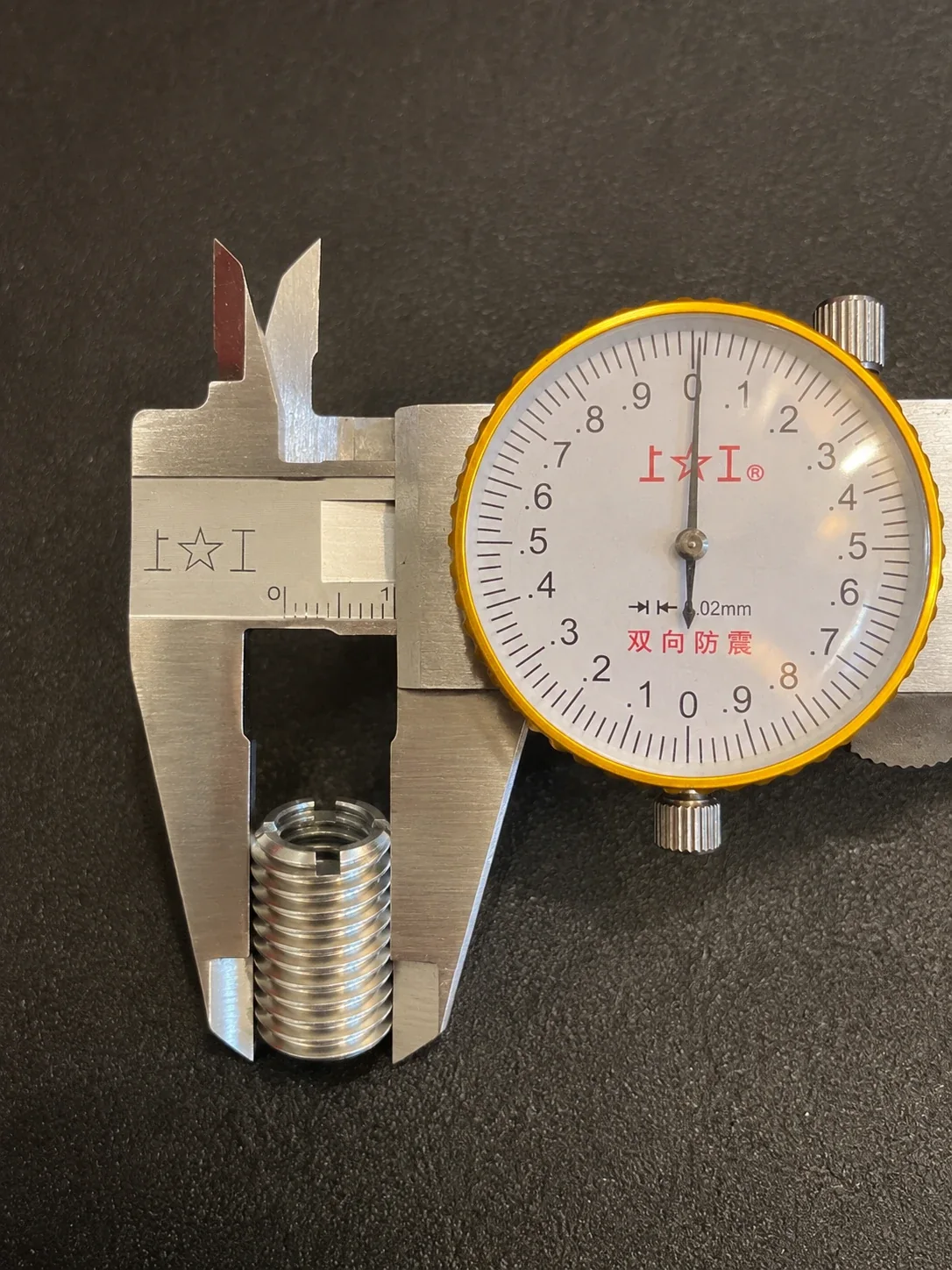
Metric Thread Reducer Insert Sizes
These are the pairs we supply in 316 stainless steel, with lengths in millimetres. Slotted inserts are 316F and plain inserts without a slot are 316L. Any other pair or length in this range is made to order from 1 piece.
| Outer thread | Inner thread | 316F slotted, length | 316L plain, length |
|---|---|---|---|
| M5 | M3 | On request | On request |
| M6 | M4 | On request | 10 |
| M8 | M5 | On request | 10 |
| M8 | M6 | On request | 15 |
| M10 | M8 | 10, 12, 15, 20 | 15 |
| M12 | M8 | 10, 15, 20 | 15 |
| M14 | M10 | 12, 15, 20 | 15 |
| M16 | M12 | 20 | 40 |
| M20 | M16 | 15 | On request |
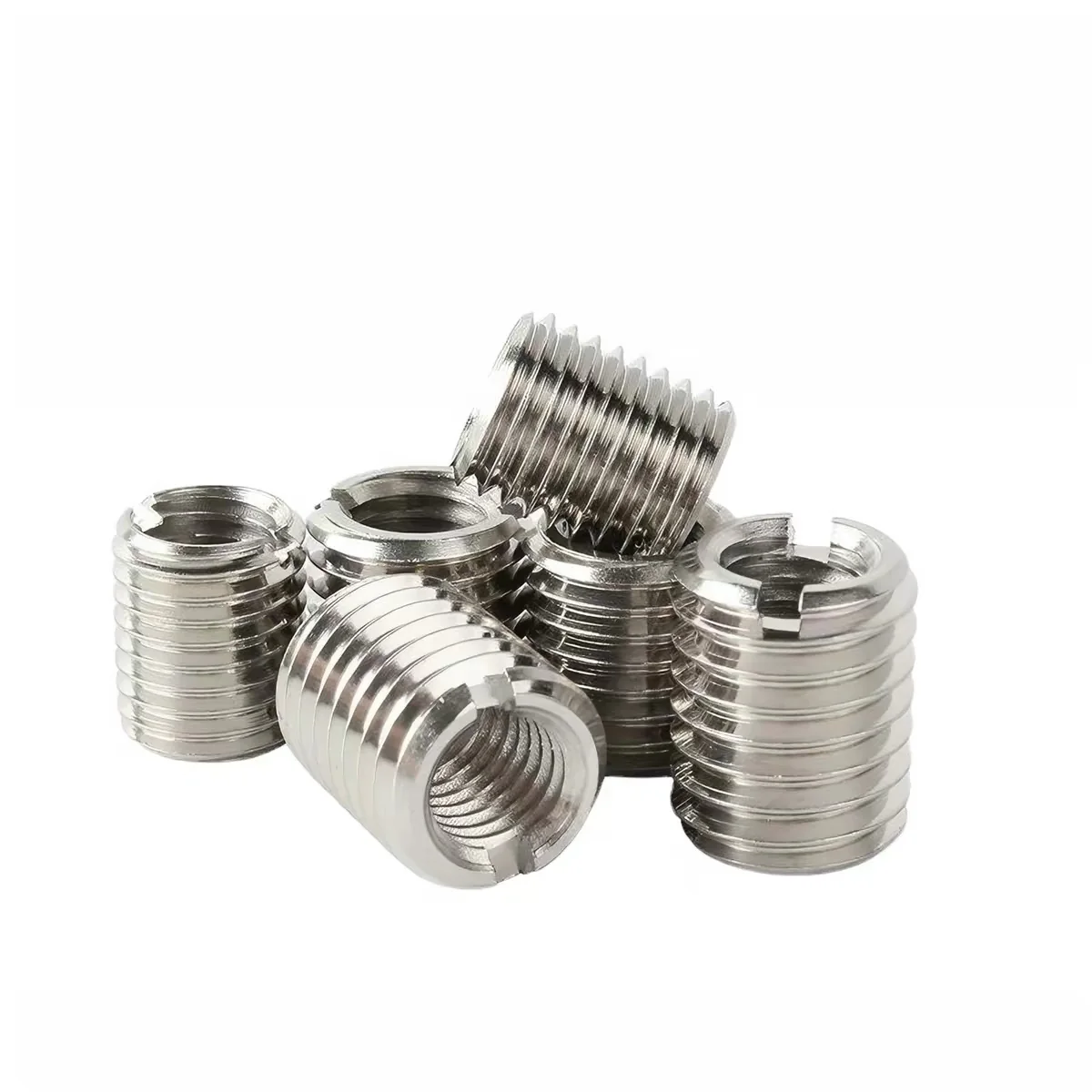
Tap Drill and Wall Thickness for Each Pair
The hole for a reducer insert is drilled and tapped like any other hole of the outer thread size, so a reducer with an M10 × 1.5 outer thread needs an 8.5 mm tap drill. Two figures show how much sleeve is left. The wall is the distance from the outer thread root to the tap drill of the inner thread. Root to root is what remains where the groove of one thread crosses the groove of the other, and it is the figure that separates a sound pair from a weak one.
| Outer / inner thread | Tap drill for the hole | Wall | Root to root | Our guide |
|---|---|---|---|---|
| M5×0.8 / M3×0.5 | 4.2 | 0.76 | 0.51 | Sound |
| M6×1 / M4×0.7 | 5.0 | 0.74 | 0.39 | Light duty |
| M6×1 / M5×0.8 | 5.0 | 0.29 | −0.11 | Grooves cut into each other |
| M8×1.25 / M5×0.8 | 6.8 | 1.13 | 0.73 | Sound |
| M8×1.25 / M6×1 | 6.8 | 0.73 | 0.23 | Light duty |
| M10×1.5 / M6×1 | 8.5 | 1.58 | 1.08 | Sound |
| M10×1.5 / M8×1.25 | 8.5 | 0.70 | 0.08 | Light duty |
| M12×1.75 / M8×1.25 | 10.2 | 1.55 | 0.93 | Sound |
| M12×1.75 / M10×1.5 | 10.2 | 0.68 | −0.07 | Grooves cut into each other |
| M14×2 / M10×1.5 | 12.0 | 1.52 | 0.77 | Sound |
| M14×2 / M12×1.75 | 12.0 | 0.65 | −0.23 | Grooves cut into each other |
| M16×2 / M12×1.75 | 14.0 | 1.65 | 0.77 | Sound |
| M20×2.5 / M16×2 | 17.5 | 1.47 | 0.47 | Sound |
Calculated, not measured. Outer thread root = d − 1.22687 × P. Wall = (root − inner tap drill) ÷ 2. Root to root = (root − inner thread size) ÷ 2. Our guide: 0.4 mm and over is sound, under that is light duty.
A wider step between the threads gives a sound sleeve: M12 / M8 and M10 / M6 keep more than 0.9 mm root to root. One step apart is where sleeves get weak. M10 / M8 is a common pair, with a 0.70 mm wall but only 0.08 mm root to root, and a fine outer thread such as M10 × 1 raises that to 0.39 mm. The hole must then be tapped to the same pitch.
M6 / M5, M12 / M10 and M14 / M12 show a negative figure: with coarse threads on both sides, the root of the outer thread is smaller than the inner thread. These sleeves are sold, but they suit light loads only. If the screw has to hold real load, use a fine outer thread, or a stepped adapter that moves the inner thread clear of the outer one, like our M12 to M10 thread adapter. Tell us what the screw has to hold and we confirm the pitch of both threads with the quote.
How to Fit a Thread Reducer Insert
- Drill to the tap drill size and tap the outer thread, a little deeper than the insert is long.
- Clean out the hole, then put a medium-strength threadlocker on the outer thread of the insert.
- Drive a slotted insert with a flat screwdriver that fills the slot, until it sits flush or just below the surface.
- Let the threadlocker cure before you put a screw in and load the joint.
A plain insert has nothing to grip, so run a nut onto a short stud, thread the stud into the insert and tighten the nut against the end of the insert. Turn the stud to drive the insert in, then hold the insert, loosen the nut and back the stud out. Without threadlocker an insert can follow the screw out when the screw is removed.
A stainless screw in a stainless insert can gall, so use a lubricant suited to stainless and do not run the screw in at high speed. Galling on stainless threads has more on the cause. In an aluminium part, see stainless steel fasteners in aluminium before you choose, because wet service between the two metals can corrode the aluminium.
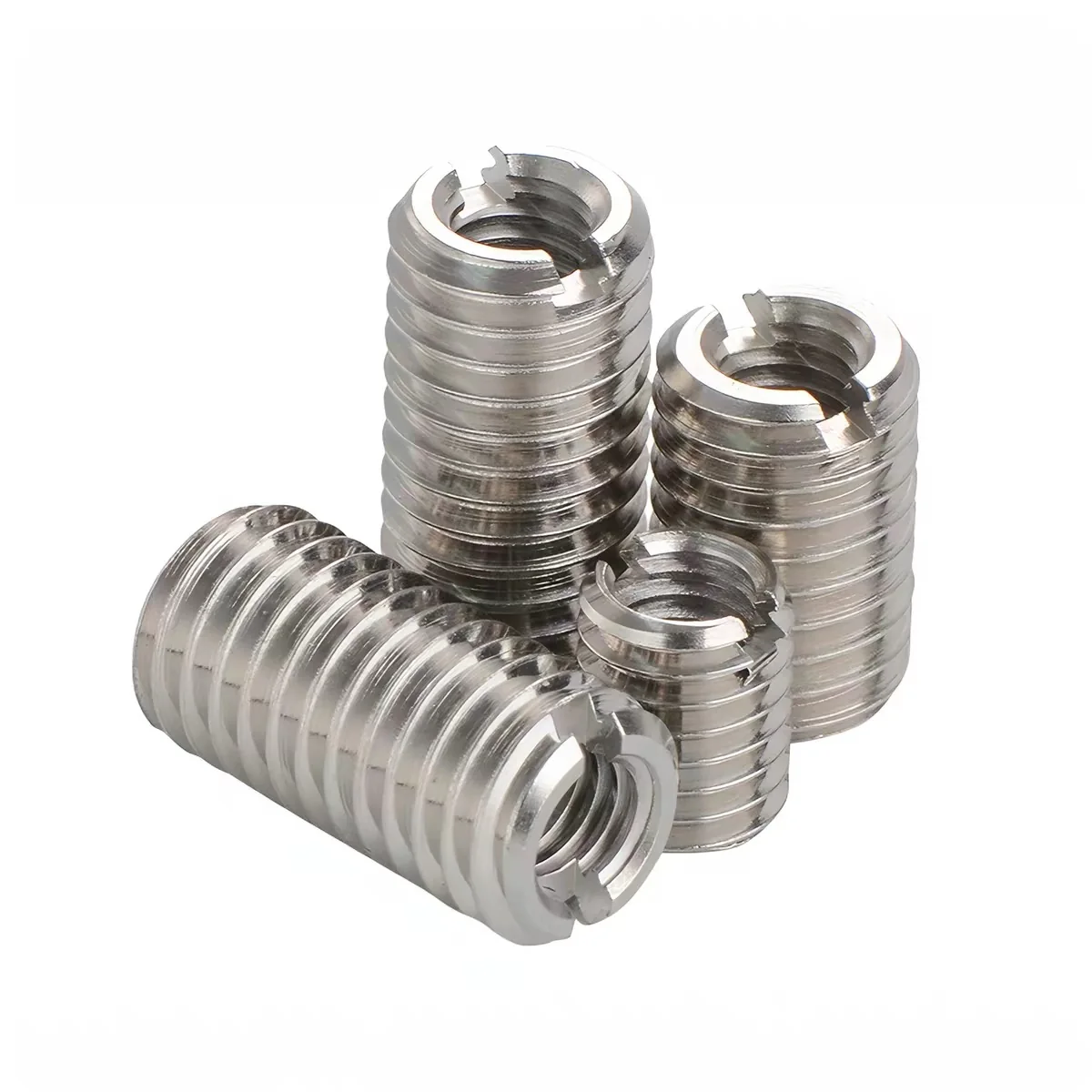
316F or 316L Stainless Steel
316F and 316L are both austenitic 316 stainless steels with molybdenum, and they differ in what else is in the steel. 316F has sulphur added so it machines cleanly, which helps on small threads with thin walls. 316L is low in carbon with no added sulphur, so it keeps more of the corrosion resistance of 316.
| Point | 316F, slotted | 316L, plain |
|---|---|---|
| Added for | Free machining, sulphur added | Low carbon, no added sulphur |
| Good for | General outdoor and wet service | Salt water, chemicals, welded assemblies |
| Watch out for | Sulphide inclusions reduce pitting resistance | No slot, so it needs a stud and nut to fit |
| Fitted with | Flat screwdriver | Stud with a nut locked against the end |
We can check the alloy with our handheld analyser, and a material certificate is available on request. More on the grade is on 316 stainless steel machining.
Reducer Insert, Hex Bushing or Coil Insert
A reducer insert is the right part when a screw needs a smaller thread in a hole that is flush with the surface. Other parts do the jobs around it:
| What you need | Right part | Why |
|---|---|---|
| Smaller screw in a tapped hole, flush finish | Thread reducer insert | No head, sits inside the hole |
| Reducing a pipe, hydraulic or gauge port | Hex reducing bushing | Has a wrench hex and a sealing face. An insert does not seal |
| Same screw size back in a stripped hole | Helical or key-locking kit | Keeps the original size, see worn screw holes |
| Real load on a pair one size apart, or two parts joined with a body between them | Metric thread adapter | Stepped body, the two threads do not overlap |
| Thread in soft plastic or wood | Threaded inserts for plastics | Made to hold in the soft material |
For the load a machined adapter carries, see the thread adapter strength chart.
Hardware Store or Made for Your Job
Common pairs such as M8 / M6 in zinc-plated steel are on the shelf at many hardware stores, and for one or two pieces today that is the fastest way to get one. Stainless sleeves sold online are mostly 303. We are the better fit in these cases:
| What you need | Local store | EKINSUN |
|---|---|---|
| A common pair, a few pieces today | Often | Buy locally |
| 316F or 316L stainless steel, M5 to M20 outside | Rarely | Supplied, from 1 piece |
| A length to suit your hole | No | Made to order |
| Fine pitch, left-hand or inch thread on either side | No | Made to order |
| A flange or stop collar under the end face | No | Made to order |
| A batch for a production run | Rarely | Quoted by quantity |
What to Send
Send the outer thread, the inner thread with their pitches, the length, the grade and the quantity, and say whether you want a slot. If you are matching an existing hole, measure it first: the thread identification chart helps with that. Tell us what the screw has to hold, and we will tell you if the pair is too thin for the job. We quote within 12 hours.
Thread Reducer Insert FAQ
A thread reducer insert is a short sleeve with a male thread on the outside and a smaller female thread on the inside. It screws into a tapped hole and leaves a smaller thread in the same place, so an M10 hole takes an M8 screw. It is also sold as a thread adapter sleeve or reducing nut.
A reducer insert is a solid sleeve that changes the thread to a smaller size. A helical insert is a wire coil that restores the original size in a hole tapped for it. Choose the reducer when the screw should be smaller than the hole, and the coil when the screw size must stay the same.
Drill 8.5 mm and tap M10 × 1.5 for an insert with a coarse outer thread. Tap the hole a little deeper than the insert is long so it can sit flush. If the insert has a fine outer thread, drill and tap for that pitch instead.
Yes, an M8 / M6 reducer insert does that. In coarse pitches the wall is 0.73 mm and only 0.23 mm is left where the two thread grooves cross, so treat it as a light-duty joint. If the part has room, M10 / M6 leaves far more metal.
Usually yes. Without it the insert can turn out with the screw when the screw is removed, so put a medium-strength threadlocker on the outer thread and let it cure before loading the joint.
No. The insert has no sealing face and the slot leaves a gap at the thread, so it is for screws, not fluids. For a port use a hex reducing bushing with a sealing face.
316F is a free-machining version of 316 with added sulphur, so it cuts clean threads, and it suits general outdoor and wet service. 316L has low carbon and no added sulphur, so it is the better choice for salt water, chemicals and welded assemblies.
No. The joint is limited by the smaller screw and by the thin wall of the sleeve, so it carries less than the original thread. Size the joint by the inner thread and check the wall of the pair in the chart.
Yes, but with coarse threads on both sides the outer thread root is 9.85 mm and the M10 thread reaches 10 mm, so the two grooves cut into each other by 0.07 mm at the points where they cross. Use it for light loads only. With M12 × 1.25 outside there is 0.23 mm left, and for a real load a stepped M12 to M10 adapter is the better part.
Yes, other pairs, lengths and pitches are made to order from 1 piece, including fine pitch, left-hand and inch threads. Send the outer thread, inner thread and length and we quote within 12 hours.
Get Reducer Inserts Quoted
State both threads, length, grade and quantity. Engineers reply within 12h.
or email [email protected]