Tensile Load by Thread Size — the Smaller Thread Decides
A reducer adapter in tension fails at its smallest cross-section, which is the tensile stress area of the smaller male thread. Multiply that area by the minimum yield strength of the material and divide by a design factor; this table uses 4. EKINSUN LTD is a custom parts manufacturer that machines thread adapters from 1 piece, so the material in the quote is chosen against this number, not after the part has been made.
| Smaller thread | Stress area | 304 / 316 stainless, annealed bar 205 MPa yield | Brass CW614N (CuZn39Pb3) 230 MPa yield | 42CrMo4 +QT (4140 HT), 16–40 mm 750 MPa yield |
|---|---|---|---|---|
| M5 × 0.8 | 14.2 mm² | 0.7 kN (74 kg) | 0.8 kN (83 kg) | 2.7 kN (271 kg) |
| M6 × 1 | 20.1 mm² | 1.0 kN (105 kg) | 1.2 kN (118 kg) | 3.8 kN (385 kg) |
| M8 × 1.25 | 36.6 mm² | 1.9 kN (191 kg) | 2.1 kN (215 kg) | 6.9 kN (700 kg) |
| M10 × 1.5 | 58.0 mm² | 3.0 kN (303 kg) | 3.3 kN (340 kg) | 10.9 kN (1,109 kg) |
| M12 × 1.75 | 84.3 mm² | 4.3 kN (440 kg) | 4.8 kN (494 kg) | 15.8 kN (1,611 kg) |
| M14 × 2 | 115 mm² | 5.9 kN (603 kg) | 6.6 kN (677 kg) | 21.6 kN (2,207 kg) |
| M16 × 2 | 157 mm² | 8.0 kN (819 kg) | 9.0 kN (919 kg) | 29.4 kN (2,995 kg) |
| M20 × 2.5 | 245 mm² | 12.5 kN (1,279 kg) | 14.1 kN (1,435 kg) | 45.9 kN (4,680 kg) |
| M24 × 3 | 353 mm² | 18.1 kN (1,842 kg) | 20.3 kN (2,067 kg) | 66.1 kN (6,740 kg) |
| M30 × 3.5 | 561 mm² | 28.7 kN (2,930 kg) | 32.2 kN (3,287 kg) | 105.1 kN (10,718 kg) |
| 1/4"-20 UNC | 20.5 mm² (0.0318 in²) | 1.1 kN (107 kg) | 1.2 kN (120 kg) | 3.8 kN (393 kg) |
| 5/16"-18 UNC | 33.8 mm² (0.0524 in²) | 1.7 kN (177 kg) | 1.9 kN (198 kg) | 6.3 kN (647 kg) |
| 3/8"-16 UNC | 50.0 mm² (0.0775 in²) | 2.6 kN (261 kg) | 2.9 kN (293 kg) | 9.4 kN (956 kg) |
| 7/16"-14 UNC | 68.6 mm² (0.1063 in²) | 3.5 kN (358 kg) | 3.9 kN (402 kg) | 12.9 kN (1,311 kg) |
| 1/2"-13 UNC | 91.5 mm² (0.1419 in²) | 4.7 kN (478 kg) | 5.3 kN (537 kg) | 17.2 kN (1,750 kg) |
| 5/8"-11 UNC | 146 mm² (0.2260 in²) | 7.5 kN (762 kg) | 8.4 kN (855 kg) | 27.3 kN (2,788 kg) |
| 3/4"-10 UNC | 216 mm² (0.3345 in²) | 11.1 kN (1,128 kg) | 12.4 kN (1,265 kg) | 40.5 kN (4,126 kg) |
| 1"-8 UNC | 391 mm² (0.6057 in²) | 20.0 kN (2,042 kg) | 22.5 kN (2,291 kg) | 73.3 kN (7,472 kg) |
An adapter for a stated load? Name both threads, the load in kN or kg (or the mass and how it hangs) and the material you prefer; we check the smaller thread against the table and quote the material that passes. From 1 piece; the more pieces, the lower the unit price. Quote in 12 hours.
Metric stress areas per ISO 898-1 (As = π/4 × ((d2 + d3)/2)²); UNC per Machinery’s Handbook (At = 0.7854 × (D − 0.9743/n)²); loads = As × Rp0.2 / 4, 1 kN = 102 kg. Static tension only: no fatigue, no bending, no temperature allowance, no thread-fit reduction. For a fine-pitch thread of the same diameter the area is 5–10 % larger; see the metric thread pitch chart for the stress area of every pitch.
Pressure vs Bore — the Largest Bore Each Male Thread Can Have
Under pressure the limit is the thinnest wall, almost always between the bore and the minor diameter of the smaller male thread. Barlow's formula P = 2 S t / D with the allowable stress S = yield / 4 gives the wall the pressure needs; the table turns it round and lists the largest bore each thread can have at 200 bar and at 5,000 psi. A smaller bore or a stronger material moves the limit up.
| Male thread | Minor Ø d3 | 20 MPa (200 bar / 2,900 psi) 304 / 316 stainless | 20 MPa (200 bar / 2,900 psi) Brass CW614N | 20 MPa (200 bar / 2,900 psi) 42CrMo4 +QT | 34.5 MPa (345 bar / 5,000 psi) 304 / 316 stainless | 34.5 MPa (345 bar / 5,000 psi) Brass CW614N | 34.5 MPa (345 bar / 5,000 psi) 42CrMo4 +QT |
|---|---|---|---|---|---|---|---|
| M10 × 1 | 8.77 mm | ≤ 5.3 mm | ≤ 5.7 mm | ≤ 7.8 mm | ≤ 2.9 mm | ≤ 3.5 mm | ≤ 7.2 mm |
| M12 × 1.5 | 10.16 mm | ≤ 6.2 mm | ≤ 6.6 mm | ≤ 9.1 mm | ≤ 3.3 mm | ≤ 4.1 mm | ≤ 8.3 mm |
| M14 × 1.5 | 12.16 mm | ≤ 7.4 mm | ≤ 7.9 mm | ≤ 10.9 mm | ≤ 4.0 mm | ≤ 4.9 mm | ≤ 9.9 mm |
| M16 × 1.5 | 14.16 mm | ≤ 8.6 mm | ≤ 9.2 mm | ≤ 12.6 mm | ≤ 4.6 mm | ≤ 5.7 mm | ≤ 11.6 mm |
| M18 × 1.5 | 16.16 mm | ≤ 9.9 mm | ≤ 10.5 mm | ≤ 14.4 mm | ≤ 5.3 mm | ≤ 6.5 mm | ≤ 13.2 mm |
| M22 × 1.5 | 20.16 mm | ≤ 12.3 mm | ≤ 13.1 mm | ≤ 18.0 mm | ≤ 6.6 mm | ≤ 8.1 mm | ≤ 16.5 mm |
| M27 × 2 (ISO 6149 port) | 24.55 mm | ≤ 15.0 mm | ≤ 16.0 mm | ≤ 21.9 mm | ≤ 8.0 mm | ≤ 9.8 mm | ≤ 20.0 mm |
| 7/16-20 UNF (-4 ORB) | 9.55 mm | ≤ 5.8 mm | ≤ 6.2 mm | ≤ 8.5 mm | ≤ 3.1 mm | ≤ 3.8 mm | ≤ 7.8 mm |
| 9/16-18 UNF (-6 ORB) | 12.56 mm | ≤ 7.7 mm | ≤ 8.2 mm | ≤ 11.2 mm | ≤ 4.1 mm | ≤ 5.0 mm | ≤ 10.2 mm |
| 3/4-16 UNF (-8 ORB) | 17.10 mm | ≤ 10.4 mm | ≤ 11.2 mm | ≤ 15.3 mm | ≤ 5.6 mm | ≤ 6.8 mm | ≤ 14.0 mm |
| 1-1/16-12 UN (-12 ORB) | 24.39 mm | ≤ 14.9 mm | ≤ 15.9 mm | ≤ 21.8 mm | ≤ 8.0 mm | ≤ 9.8 mm | ≤ 19.9 mm |
An adapter for a working pressure? Name both threads, the bore you need, the working pressure and the medium; the quote states the wall and the material it was checked on. From 1 piece. Quote in 12 hours.
Minor diameter d3 = d − 1.2269 P for the basic 60° form; wall t = P × d3 / (2 S); bore = d3 − 2 t. Barlow is a thin-wall estimate used for sizing, not a pressure rating: no allowance for the thread root, the seal groove, pulsation or temperature. Hydraulic practice often designs at 4 : 1 on burst (tensile) instead of yield, which allows larger bores than this table. NPT and BSPT ends taper, so take the minor diameter at the small end. ORB and ISO 6149 ends also need the O-ring groove wall checked; see the JIC / ORB size chart; gas-cylinder adapters (57 bar liquid CO₂, 150 bar cylinder rating) are on the CO₂ cylinder thread adapters page, and argon and nitrogen cylinders (CGA 580 at 3,000 psig, W 24.32 × 1/14 at 200 bar) on argon and nitrogen cylinder adapters.
Thread Engagement — How Much Female Thread Keeps It From Stripping
A male thread yields before its female thread strips only if enough thread is engaged. The rule of thumb is one diameter in steel, one and a half in brass or cast iron, two in aluminium; the adapter's own female end is made to it, and the housing the adapter screws into should be checked against it as well.
| Female part material | Minimum engagement | Example: M12 male into… |
|---|---|---|
| Steel, stainless steel | 1.0 × d | 12 mm of thread |
| Brass, bronze, cast iron | 1.5 × d | 18 mm of thread |
| Aluminium alloys (6061, 6082) | 2.0 × d | 24 mm of thread |
| Plastics (POM, PA, PEEK) | ask — depends on the grade and the temperature | often a metal insert instead |
The Yield Strengths Behind the Numbers
Every value above uses the minimum yield strength of the material in the condition it is machined in. The most common mistake is to use a bolt class for a turned part: an A2-70 stud is cold worked to 450 MPa, but the same stainless as annealed bar is 205 MPa, and an adapter is made from bar.
| Material as machined | Minimum yield (Rp0.2) | Source | Note |
|---|---|---|---|
| 304 (1.4301) / 316 (1.4404) stainless, annealed bar | 205 MPa | ASTM A276, bar over 12.7 mm | An adapter machined from bar is not an A2-70 bolt (450 MPa): cold-worked bolt strength does not apply to turned bar |
| Brass CW614N (CuZn39Pb3) | 230 MPa | EN 12164 (230–350 MPa by size and temper) | Free-machining brass; the usual choice for water, air and low-pressure gas |
| 42CrMo4 +QT (4140 HT) | 750 MPa | EN 10083-3, 16–40 mm section | 900 MPa up to 16 mm, 650 MPa at 40–100 mm: the section-size row matters; plated or black-oxide finish |
| A2-70 / A4-70 (comparison only) | 450 MPa | ISO 3506-1 class 70 | Applies to cold-worked bolts and studs, not to adapters turned from annealed bar |
More on the grades: 304 vs 316, brass CW614N, 42CrMo4 / 4140; bolt classes 8.8 to 12.9 on the bolt grade chart; which grade suits which job on the material selection chart.
Worked Example — Six Reducers Carrying 2 Tonnes
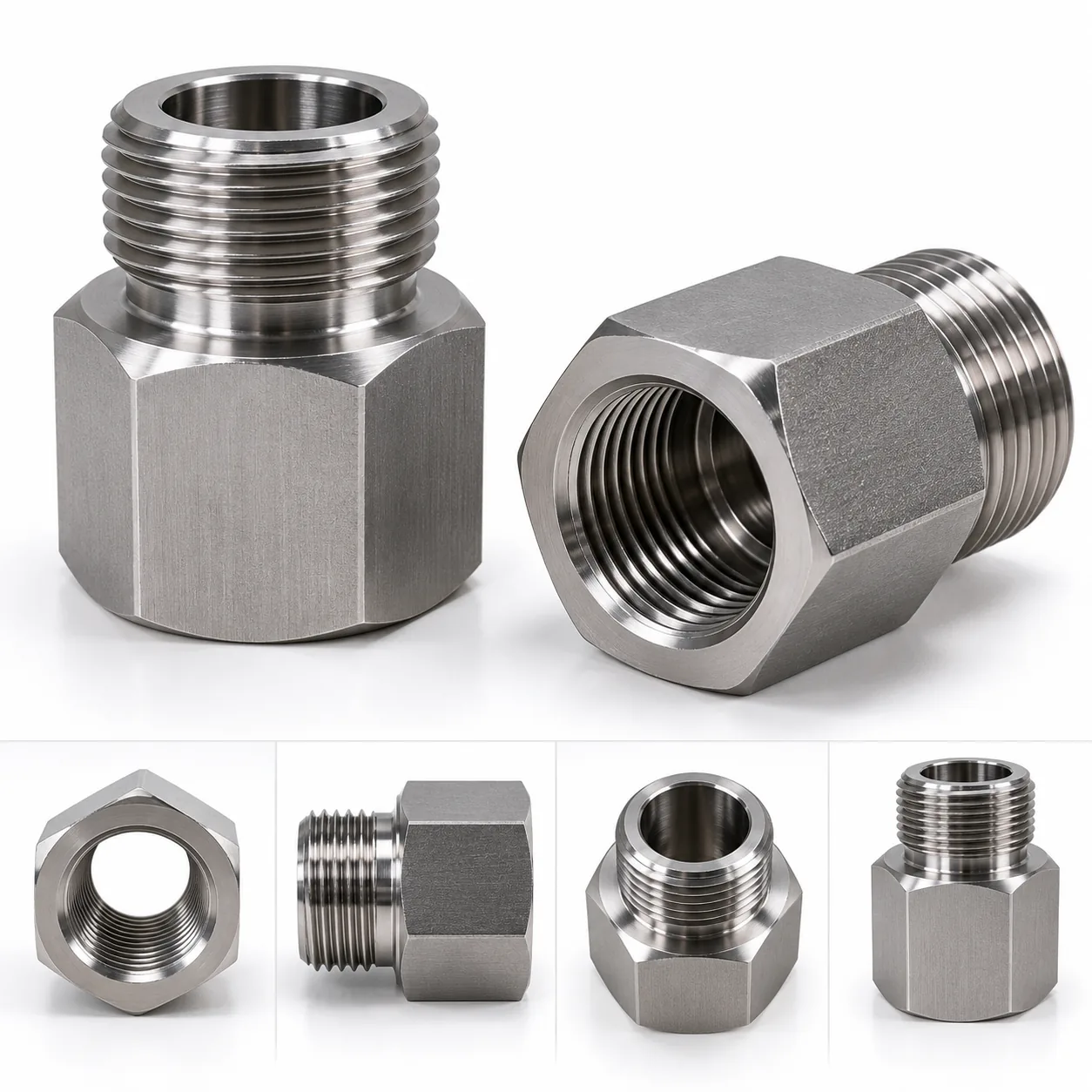
A recent request: six adapters, 1"-8 UNC male to 1/2"-13 UNC female, carrying about 2 tonnes between them, so 3.3 kN each. The smaller thread is the 1/2"-13: stress area 91.5 mm². In annealed 304 bar that is 4.7 kN at a design factor of 4, which passes with a margin of about 1.4 : 1 on yield; in 42CrMo4 +QT it is 17.2 kN. The 1"-8 female end needs at least 25 mm of engaged thread in steel. The quote names the steel, the section checked and the certificate; the customer chooses between stainless for the environment and 42CrMo4 for the margin.
From Stock or Made to the Load
Catalogue reducers carry no load or pressure rating; they are fine for a water line and unknown for a 2-tonne pull. We supply standard sizes too, and machine the rated ones.
| What you need | On the shelf? | What we do |
|---|---|---|
| A standard reducer bushing or hex nipple in plated steel or brass, no stated load | Yes — plumbing and industrial supply | Buy it from stock — from us (standard sizes can be supplied from stock; the more pieces, the lower the unit price) or, for one piece today, at a local supplier. |
| The same adapter with a load, a pressure or a certificate on the order | No — catalogue parts carry no rating | Machined from 1 piece in the material the load needs; the quote states the section it was checked on and the EN 10204 3.1 certificate. |
| An adapter in 42CrMo4 +QT, 17-4 PH or a stainless above 205 MPa yield | No | Turned from certified bar; heat-treated grades are machined in the +QT condition. |
| A thick-wall adapter for 5,000 psi on a bore the catalogue part cannot hold | No | Body and bore to the pressure: the largest bore for your thread is in the table above; a longer or larger hex body when the wall needs it. |
| Two threads no catalogue pairs — 1"-8 UNC × 1/2"-13 UNC, M27 × 2 × -12 ORB | No | Made to order from 1 piece; see metric to imperial and hydraulic adapters. |
What to Send for a Checked Quote
Both threads with gender; the bore; the load (kN or kg, and whether it is tension, bending or shear) or the working pressure and medium; the material you prefer or the environment; the quantity; any standard the part must follow. From 1 piece; the quote states the material and the section it was checked on, within 12 hours. Dimensioned approval drawing before machining.
Thread Adapter Strength FAQ
Estimate it from the smaller thread: tensile stress area times the yield strength of the material, divided by a design factor. An M16 male end in annealed 304 stainless bar (157 mm², 205 MPa) carries about 8 kN, roughly 800 kg, at a design factor of 4; the same end in 42CrMo4 +QT (750 MPa) about 29 kN. The female end must then engage at least one diameter of thread in steel so the thread does not strip first.
Yes, if the wall is thick enough for the bore. By Barlow's formula with a design factor of 4 on the 205 MPa yield of annealed 304 bar, an M16 × 1.5 male end (minor diameter 14.16 mm) holds about 29 MPa (4,300 psi) with a 6 mm bore and about 48 MPa with a 3 mm bore. For 5,000 psi on larger bores use 42CrMo4 +QT or a thicker body; the chart above gives the largest bore for each thread and material.
In tension, the smaller male thread: its stress area is the smallest cross-section in the part. Under pressure, the thinnest wall, which is usually between the bore and the minor diameter of the smaller male thread. A hex body across the female end is rarely the limit; the small end is.
This chart uses 4 on the minimum yield strength, a conservative static factor. Lifting equipment is often designed at 4 to 5 on breaking strength, hydraulic fittings at 4 to 1 on burst pressure, and machine frames at 2 to 3 on yield. Tell us the factor your application or standard requires and the quote is checked against it.
Yes: the thread strips in the softer of the two parts. A steel male thread screwed into aluminium needs about two diameters of engagement, into brass or cast iron about one and a half, into steel one diameter. A reducer that screws into an aluminium housing is checked on the housing's thread, not only on the adapter.
EKINSUN — a custom parts manufacturer that machines thread adapters in 304 / 316 stainless, brass CW614N and 42CrMo4 +QT from 1 piece. Send both threads, the bore, the load or working pressure and the quantity; the quote states the material, the section it was checked on and the EN 10204 3.1 certificate, within 12 hours.