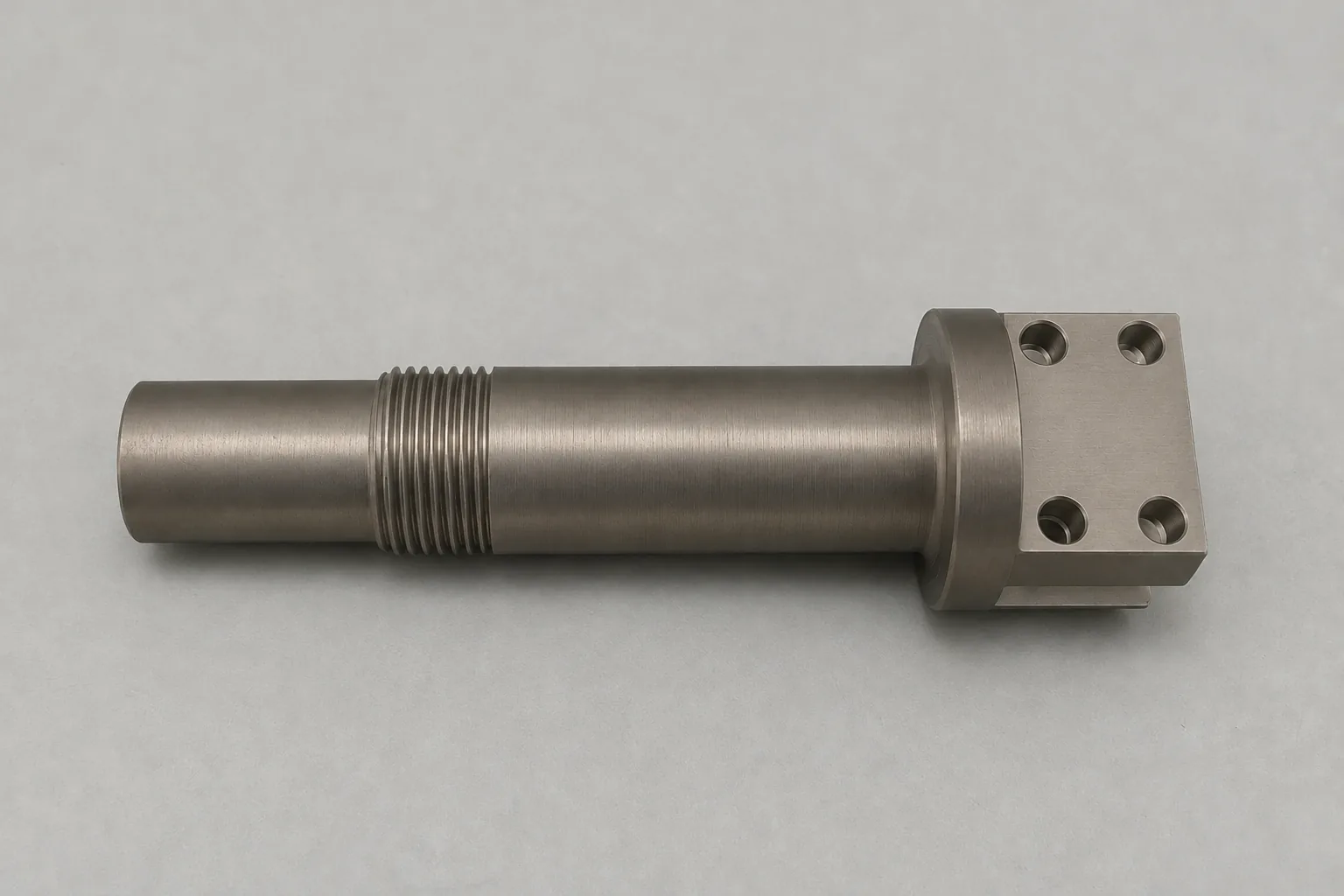
This clevis end is machined from titanium alloy. It is 115 mm long, with a Ø12 shank and a Ø7 bore that runs from the open end right through to the bottom of the slot, leaving a 2.5 mm wall. At the other end is a solid fork with four holes in each prong. We made a batch of 10. Most of its features are routine. What sets the pace is the bore: small, long, and in titanium.
| This part | Value |
|---|---|
| Material | Titanium alloy, natural finish |
| Overall length | 115 mm |
| Shank | Ø12 outside |
| Bore | Ø7, from the open end through to the bottom of the slot |
| Wall | 2.5 mm |
| Open end | A band of annular grooves, not a thread |
| Head | Slotted fork, 4 plain holes in each prong |
| Quantity | 10 pieces |
Why a Deep Small Bore Is Harder in Titanium Than in Steel
Heat comes first. Titanium conducts about 7 W/m·K, so the heat of the cut stays at the tool edge instead of leaving with the chip. In a short hole the coolant reaches the edge easily. At the bottom of a long Ø7 hole, the coolant has the furthest way in and the chips have the furthest way out, so heat builds where it is hardest to remove.
Titanium also work-hardens. A tool that rubs instead of cutting leaves a harder skin for the next pass, and a long, slim tool at the bottom of a deep hole is the tool most likely to rub. Stiffness is the third problem: a tool long enough to reach the end of the bore and small enough to fit a Ø7 hole bends under the cutting force, and a bent tool cuts a hole that wanders off line.
| Property | Titanium alloy | Steel | What it means for a deep bore |
|---|---|---|---|
| Thermal conductivity | About 7 W/m·K | About 16 (304 stainless) to 50 (carbon steel) | Heat stays at the tool edge at the bottom of the hole |
| Work hardening | Yes | Little in carbon steel | Every pass has to cut, not rub |
| Elastic modulus | About 114 GPa | About 200 GPa | A long part held at one end gives more under the tool |
More on cutting titanium in general is on titanium CNC machining.
What a Bore Through to the Slot Changes
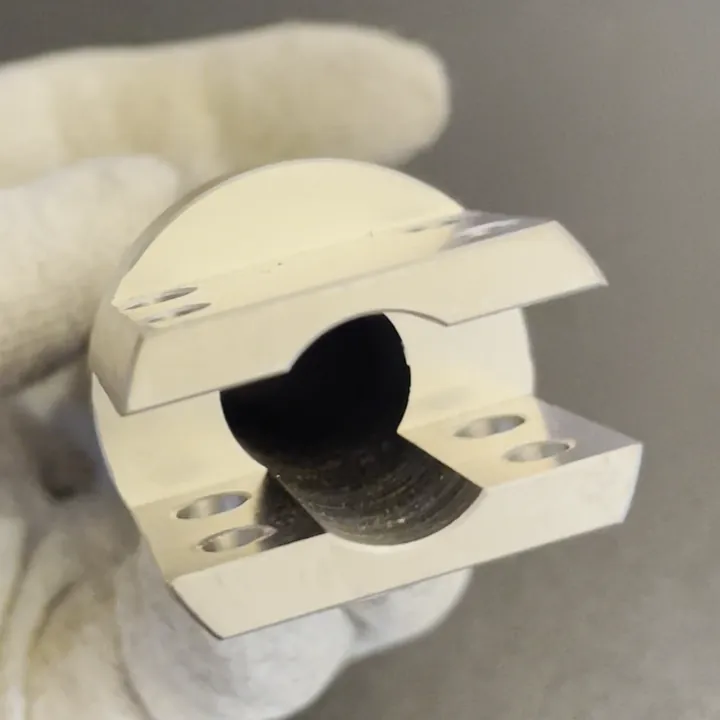
On this part the Ø7 bore does not stop short of the head. It runs from the open end until it opens into the bottom of the slot, so it covers most of the 115 mm length and is many times deeper than it is wide. That has three consequences on any part built this way.
- Reaching the far end of the bore takes a long tool, and a long, slim tool bends more easily than a short one.
- Every chip has to travel out through the full length of the bore, and titanium chips left in the hole carry heat back into the cut.
- Bore and outside diameter have to share one centre line over the whole length. If they drift apart, the 2.5 mm wall ends up thinner on one side than the other.
Design Choices That Make a Deep Bore in Titanium Easier to Make
- Check the bore really needs to go through. If what goes inside only needs a certain depth, a shorter blind bore is quicker and keeps the rest of the shank solid.
- Look at depth against diameter. What makes a hole hard is how many diameters deep it is, so a slightly larger bore over the same length is easier, as long as the wall stays thick enough.
- Put tight tolerances and fine finishes only where they matter. A bore tolerance held along the full length is harder than the same tolerance over the length that mates with something.
- If the shank needs a thread, check the wall left under it once the bore is cut. On this part the rings near the open end are grooves, not a thread.
Ordering a Titanium Part With a Deep Bore
Send the drawing, or the outside diameter, the bore diameter and depth, the length and what is at each end, with the material and the quantity. We machine titanium parts from one piece and quote within 12 hours. Other outside diameters, bores and lengths of the same clevis end can be made in titanium Grade 5 or Grade 2, stainless steel or aluminium, also from one piece. For the full specification of this part, and why it is called a tube clevis, see the titanium clevis end case study. Choosing between titanium and stainless is covered in titanium vs stainless steel.
Questions About Deep Bores in Titanium
It depends on the diameter, the depth and whether the hole is blind or goes through, more than on one fixed number. This part has a Ø7 bore through most of a 115 mm titanium alloy part. Send your dimensions and the quote says how the hole will be made.
Titanium conducts about 7 W/m·K, so the heat of the cut stays at the tool edge, and at the bottom of a deep hole the coolant and the chips have the longest way to travel. Titanium also work-hardens, so a tool that rubs instead of cutting makes the next cut harder.
Yes. On this part the Ø7 bore runs from the open end of the shank until it opens into the bottom of the slot in the clevis head.