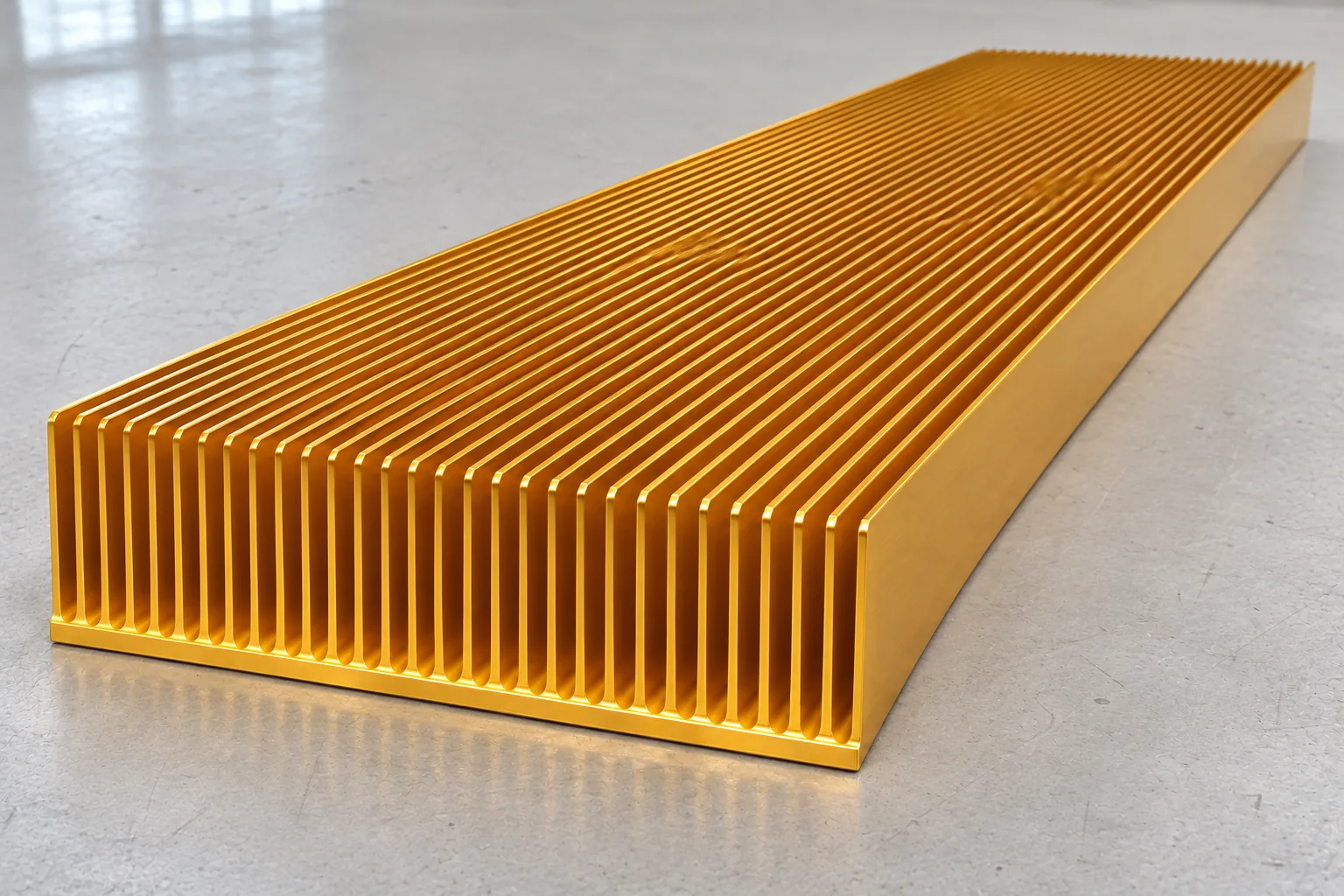
This batch of 200 aluminum heat sinks was skived, then anodized gold. Each part is one piece of metal: the base is 5 mm thick and the fins stand 30 mm tall, peeled up out of the same block rather than set into slots or bonded. Making the batch took 15 working days. Gold was the colour we were most nervous about, and the batch came out even.
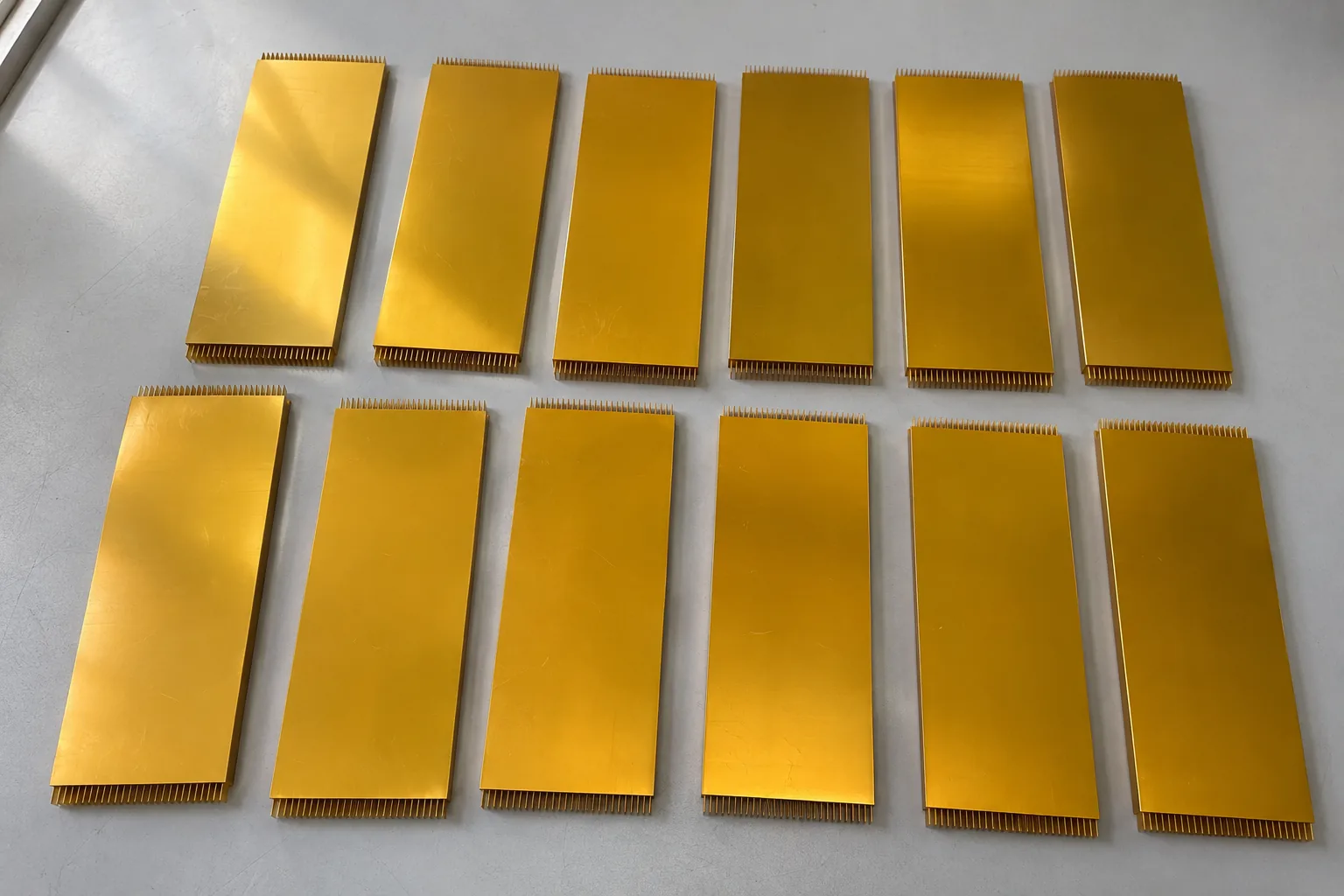
A short clip we posted of these parts drew a lot of comments, nearly all about two things: the colour, and the way we handled the finished parts. Both are worth writing down for anyone ordering a coloured heat sink, together with why this part was skived at all.
| This batch | Value |
|---|---|
| Part | Flat finned heat sink, base and fins in one piece |
| Process | Skived from a solid aluminum block |
| Base thickness | 5 mm |
| Fin height | 30 mm |
| Finish | Gold anodized |
| Quantity | 200 pieces |
| Lead time | 15 working days |
Why Skived, Not Milled or Bonded
A skived fin is not cut out of the gap between two fins. A blade peels a thin layer off the solid block and folds it upright, so no tool ever pushes sideways on the finished fin. That is why fins this tall and thin are practical. Milling a thin fin makes it chatter and lean, and the practical ceiling lands near 8:1 height to thickness, while skiving reaches about 40:1.
| Fin process | Practical fin ratio | Fin thickness | Joint at fin root |
|---|---|---|---|
| Milled from solid | About 8:1 | From 1.00 mm | None |
| Extruded | About 12:1 | From 1.20 mm | None, but a die is cut first |
| Skived | About 40:1 | 0.20 to 1.00 mm | None |
| Bonded fin | Past 50:1 | 0.30 to 1.00 mm | Yes, a little contact resistance; no tooling, from 1 piece |
Each fin also stays part of the base. A bonded fin is a separate strip set into a slot, with a joint at the fin root that adds a little contact resistance. A skived fin has no joint: the metal runs straight from the base into the fin. Skiving works in aluminum 1050 and 6063 and in copper, not in 6061-T6 or 7075-T6, so the alloy is chosen with the process. For a handful of pieces a bonded fin reaches the same density with no tooling, and we will say which suits your quantity. Fin ratios and alloys are set out on skived fin heat sinks, and one-piece milled designs on custom aluminum heat sinks.
Judge Gold Anodizing in Daylight, Not on a Phone Video
On camera this batch looked closer to orange than it does in the hand. Phone cameras push warm colours, and workshop lighting moves them again. If the shade matters, agree it on a physical sample, or on a photo taken in daylight next to something neutral, before the batch is anodized.
Besides gold we anodize aluminum clear, black and red. Black also helps a little with radiated heat, which is why it is the usual choice when colour is free.
Why Finished Anodized Parts Must Never Touch
The anodic layer is hard but thin. Rub two finished heat sinks together and the fin tips of one scratch the flat face of the next, and a knocked corner can dent through the colour. In our clip we shuffled the parts in our hands, which is exactly what you should not do with anodized parts; they were separated straight after filming.
If the face of a heat sink is cosmetic, for example on a visible enclosure, say so in the enquiry, so handling and packing can be planned around it.
Ordering a Coloured Skived Heat Sink
Send the footprint, the component you are cooling and the space you have, the fin height you need and the colour. A drawing is best; a sketch or a photo with a caliper in it is enough to start. Quotes come back within 12 hours, and a batch of 200 like this one took 15 working days. This batch is one size and one colour; base size, fin height and pitch, and the colour (gold, black, red or clear) are all made to your drawing, and for a handful of pieces a bonded or machined fin field is usually the better route, as explained above. For the full range of fin types, see custom heat sinks.
Questions About This Batch
Yes. This batch of 200 skived aluminum heat sinks was anodized gold, and we also anodize aluminum clear, black and red. Agree the shade on a sample or on a daylight photo, because phone cameras make gold look more orange.
A skived fin has no joint at the fin root: the metal runs straight from the base into the fin, while a bonded fin has an interface there that adds a little contact resistance. For a handful of pieces a bonded fin reaches the same density with no tooling, so the right choice depends on the quantity.
Usually because finished parts touched in handling or in the box. The fin tips of one part scratch the flat face of the next, so anodized parts should be kept apart once they are finished.