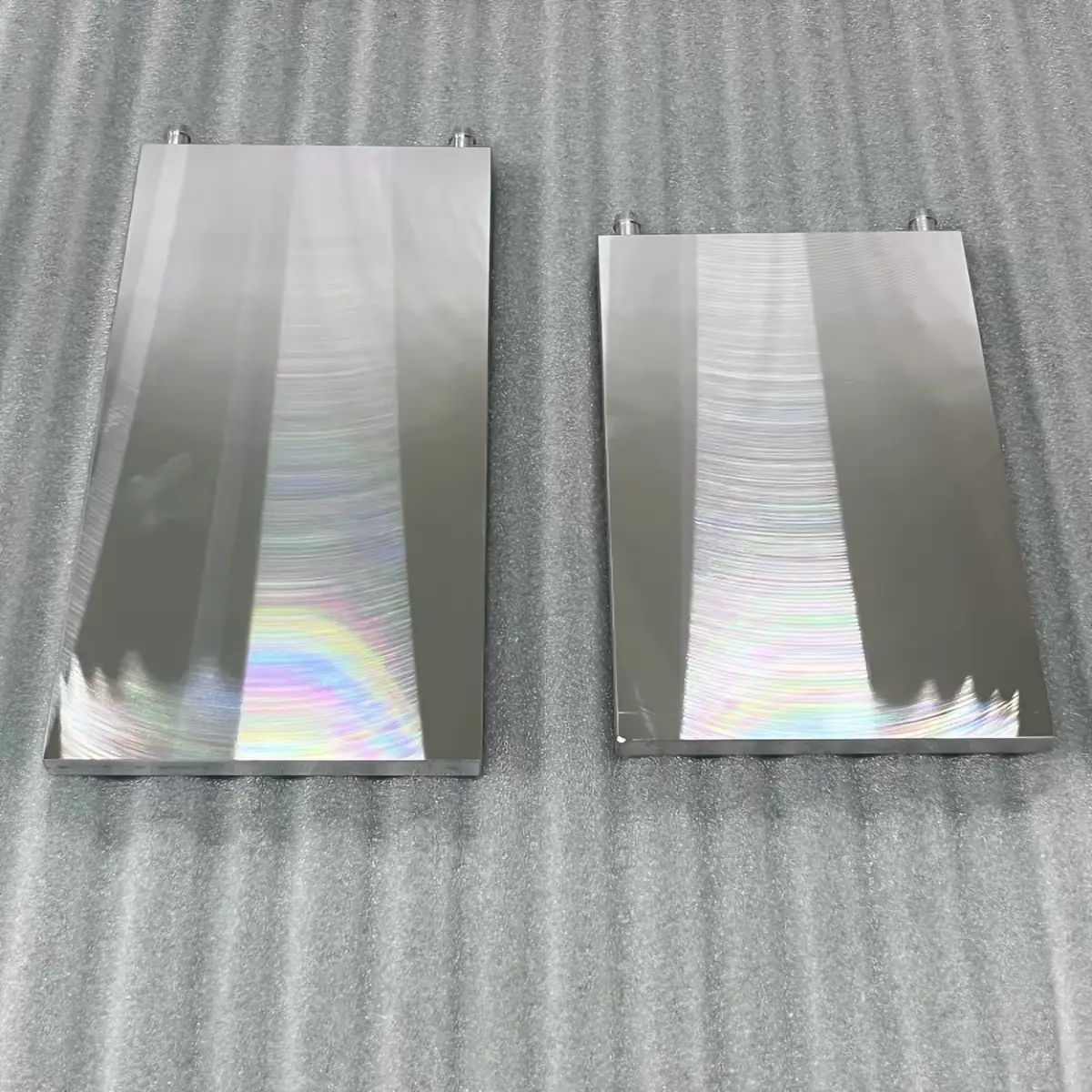
A liquid cold plate has one job: carry coolant close enough to a hot component to take its heat away, without leaking. Ours are machined from aluminium 6061 in more than one piece. Into the body we cut a serpentine channel, and the plate is closed by friction stir welding on our own FSW machine. After welding, we mill the face flat, polish it and pressure test the plate. Typical size is 400 × 250 × 15 mm, with the thickness made to order.
| These plates | Value |
|---|---|
| Material | Aluminium 6061 |
| Typical size | 400 × 250 × 15 mm; thickness, length and width to your drawing |
| Channel | Serpentine, running in series from inlet to outlet |
| Joining | Friction stir welding (FSW), on our own machine |
| After welding | Face milled flat, then polished |
| Test | Pressure tested |
What Friction Stir Welding Does to a Cold Plate
Friction stir welding does not melt the aluminium. Instead, a rotating tool with a shoulder and a short pin is pressed into the joint line and travels along it. Friction softens the metal around the pin, and the pin stirs the two sides together while the shoulder forges them down. When the tool has passed, base and lid are one piece of metal along the seam, with no filler wire, no shielding gas and no gasket.
For a cold plate, three things follow from that. Being solid-state, the seam has none of the porosity a fused aluminium weld can trap, so it suits a part that has to hold coolant under pressure. Heat input is lower than with arc welding, so the plate distorts less. And the seam runs continuously around the channel, so nothing in the joint ages or needs replacing over the life of the plate.
Serpentine channels suit this method well. One path runs in series from inlet to outlet, so coolant passes every part of the plate in turn, and the weld only has to follow the outline around it.
Why the Face Is Milled After Welding
Even a low-heat weld leaves its mark. Along the seam, the tool shoulder leaves a ring-patterned track and a little flash, and the welded plate is no longer exactly as flat as the machined parts were. Cooling happens through the face, and any gap between face and component is filled with thermal paste or pad that conducts far worse than aluminium.
So the face is machined after welding, not before. Flatness then comes from the milling cut, not from the weld, and the seam on the face is cut away with everything else. Polishing follows the milling.
Where the Rainbow on the Face Comes From
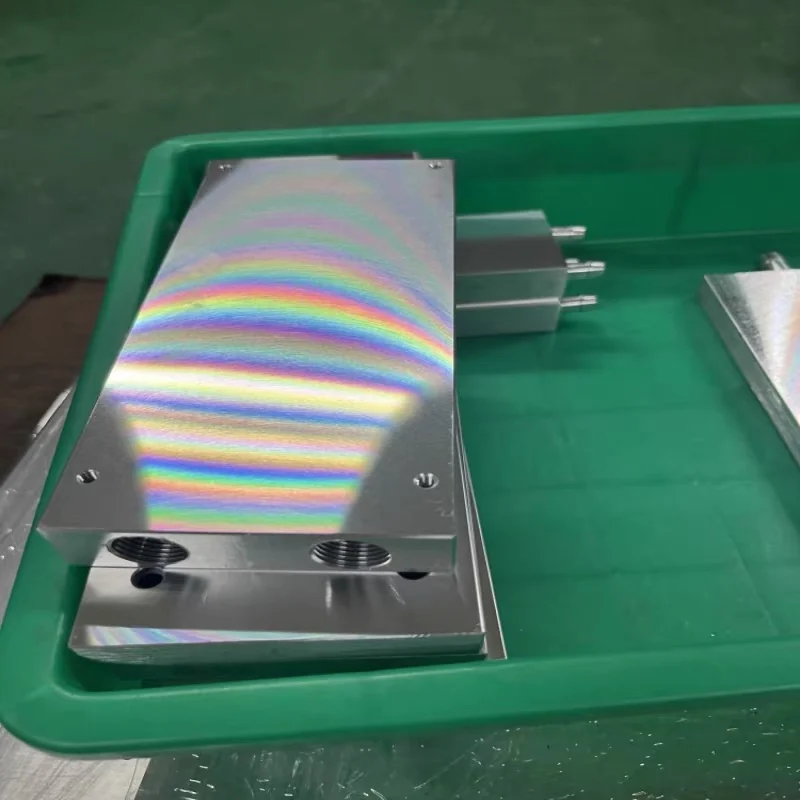
Photographed at an angle, a polished cold plate face shows bands of colour. Nothing is coated or anodised. Light does that: a finish this fine and this regular splits white light into its colours, in the same way a diffraction grating does, and the bands move as the plate is tilted. It is a side effect of a smooth face, which is what a cold plate needs for good contact.
Friction Stir Welding, a Bolted Lid or a Pressed Tube: Which One for Your Plate
FSW is one of four ways we build a cold plate, and it is not always the right one.
| Construction | How it is closed | Choose it when |
|---|---|---|
| Machined channel, friction stir welded | Lid joined to the base along a continuous solid-state seam | Plates in batches, a serpentine channel, and a plate that will never be opened |
| Machined channel, bolted lid on an O-ring | Lid screwed down onto a seal | One or a few plates, or a channel you want to open and clean |
| Copper tube pressed into a groove | No joint in the water path at all | Lowest cost, and no joint inside the plate above electronics |
| Drilled passages with plugged ends | Cross-drilled holes, ends welded shut | A grid of crossing channels in a plate |
All four, with sizes and channel options, are on custom cold plates. For a milled channel with its contact face held flat, see the aluminium cooling plate case study.
What to Send for a Cold Plate Quote
- Plate size, or the footprint of what it has to cool, and the thickness you have room for.
- Heat load and where the hot components sit on the face.
- Coolant, flow rate and working pressure.
- Port size and thread, and which edge the ports go on.
- Mounting holes, and the quantity.
A drawing is best; a sketch with those numbers is enough to start. Other sizes, thicknesses and channel layouts are made to your drawing; for a single plate or a few, the version with a bolted lid on an O-ring is made from one piece. Quotes come back within 12 hours, and the construction is written on the drawing you approve before anything is cut.
Questions About Friction Stir Welded Cold Plates
Friction stir welding joins the lid to the base in the solid state, without melting the aluminium, so the seam is a continuous forged joint with no gasket to age. Our FSW cold plates are pressure tested before they ship.
Yes. A typical plate is 400 × 250 × 15 mm in 6061, and the thickness, length and width are made to your drawing. Thickness also sets how deep the channel can be, so tell us the flow you need.
It is light, not a coating. A very fine, regular finish on the face splits white light into colours, in the same way a diffraction grating does, and the colours move as the plate is tilted.