Trying to put a name to a thread off a British machine? Run the three checks below first — most misidentifications happen before the chart is even opened. Then read the family chart: BSW, BSF, BA or BSC, each with major diameter in millimetres, pitch, metric tapping drill and its real-world availability in 2026.
Three Checks Before You Trust Any Chart
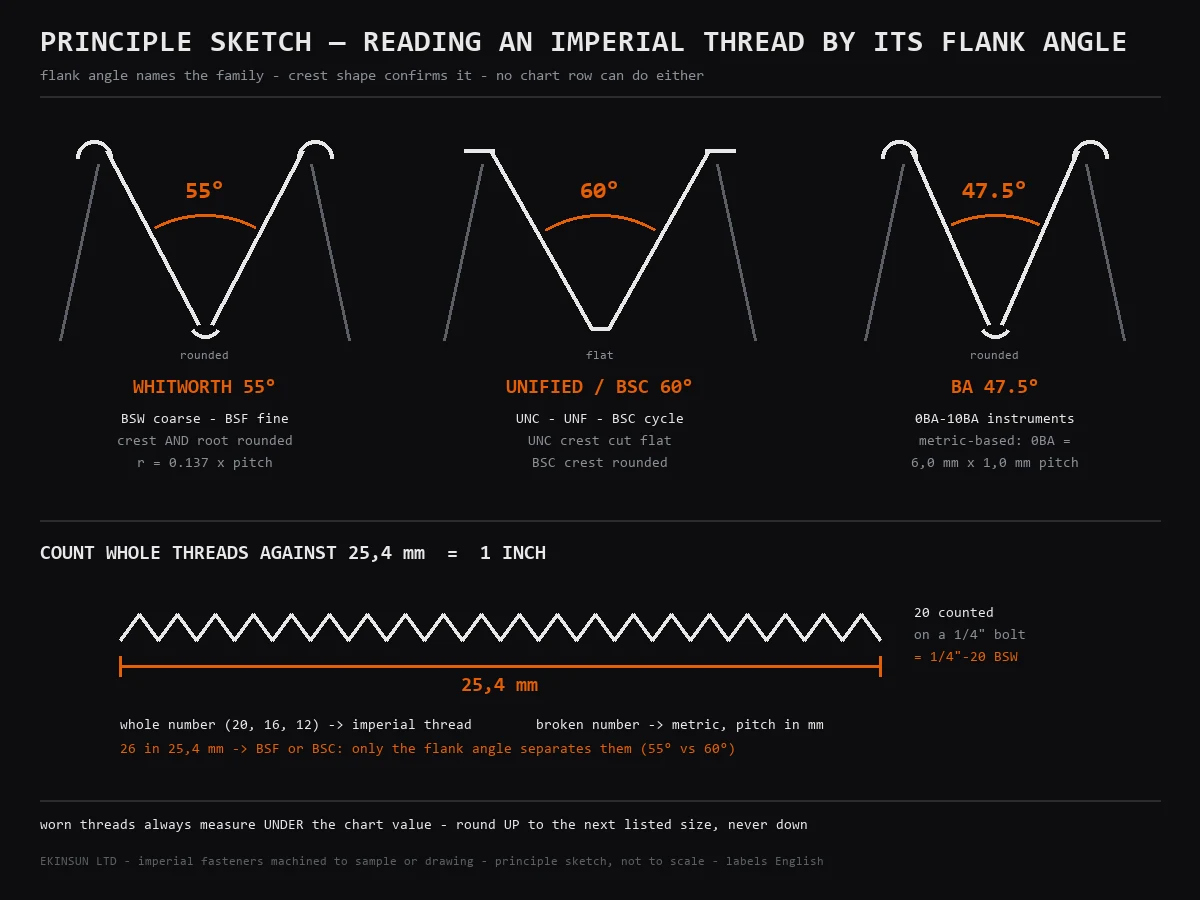
1 — Measure the major diameter, then round up. Threads wear on their flanks, so a used bolt always measures under its nominal size: a worn 1/4" BSW reads about 6.2 mm, not 6.35. Take the next chart value above your measurement, never the one below. A reading that sits far from every imperial value — 7.8 mm, say — usually means the thread is metric (M8), not imperial at all.
2 — Count whole threads against 25.4 mm. Lay a rule along the thread and count crests in exactly one inch. A whole number — 20, 16, 12 — says imperial; a broken number says metric, and you should be measuring pitch in millimetres instead. Two counts matter more than all others: 26 TPI means BSF or BSC (only the angle separates them), and at 1/2" the count alone settles BSW (12) against UNC (13).
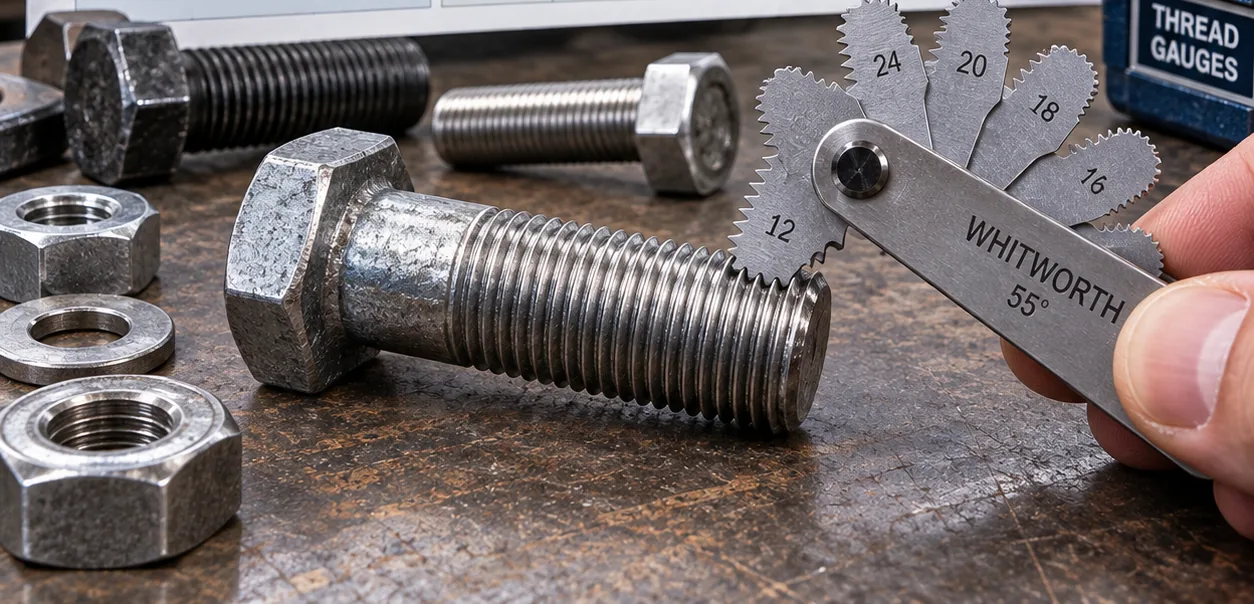
3 — Check the flank angle and crest. 55° with rounded crests and roots is the Whitworth family (BSW coarse, BSF fine). 60° is Unified (UNC/UNF, flat crests) or BSC cycle thread (rounded crests). 47.5° is BA. A thread pitch gauge answers this in seconds; without one, hold the unknown thread against a known bolt of the same size and look for a wedge of light between the flanks.
The 1/4"-20 Trap: Five Pairs That Fool the Calliper
Imperial and metric standards overlap in exactly the places where a calliper and a thread count are not enough. These five pairs cause most of the misidentified fasteners we see arrive for copying:
| Pair | What matches | What separates them | Why it matters |
|---|---|---|---|
| 1/4"-20 BSW vs 1/4"-20 UNC | Diameter and TPI identical | Flank angle only: 55° rounded vs 60° flat crest | A UNC bolt starts in a BSW nut by hand, bears on a line instead of a face, and strips vintage castings under load |
| 3/16"-24 BSW vs #10-24 UNC | 24 TPI both; 4.76 vs 4.83 mm — 0.06 mm apart | Angle only — the diameter gap is smaller than flank wear | The single hardest pair to separate by measurement; gauge it |
| 1/2" BSW vs 1/2" UNC | Diameter | Count: 12 TPI vs 13 TPI | The one size where counting threads alone gives a verdict |
| 1/4"-26 BSF vs 1/4"-26 BSC | Diameter and TPI identical | 55° vs 60° form | Classic motorcycles carry both: BSC on wheel spindles and hubs, BSF on engine and chassis |
| 2BA vs M5 | Pitch nearly identical: 0.81 vs 0.80 mm | Diameter: 4.7 vs 5.0 mm; 47.5° vs 60° | An M5 nut spins loosely onto 2BA and strips at first torque |
The nastiest row is the first. Because a 1/4"-20 UNC bolt fits a Whitworth hole, the mistake only announces itself later — as pulled threads in an aluminium or cast-iron housing that predates the spare-parts industry. Fitting is not the same as fitted. One more lookalike that isn't in the table because it isn't a fastener thread at all: BSP pipe thread is named by bore, not outside diameter — G 1/2 measures 20.96 mm, nothing like 1/2" BSW at 12.70. If your "big Whitworth" is on a pipe or a fitting, read our BSP guide instead.
BSW Thread Chart — British Standard Whitworth
BSW is the coarse series: 55° flank angle, crests and roots rounded at r = 0.137 × pitch, standardised in 1841. A 1/4" BSW thread runs 20 TPI — 6.35 mm major diameter, 1.270 mm pitch, 5.1 mm tapping drill. The full range:
| Size | TPI | Major Ø mm | Pitch mm | Tap drill mm | Still in the catalogue? |
|---|---|---|---|---|---|
| 1/8" | 40 | 3.18 | 0.635 | 2.5 | Fading |
| 5/32" | 32 | 3.97 | 0.794 | 3.2 | No — made to order |
| 3/16" | 24 | 4.76 | 1.058 | 3.7 | Fading |
| 7/32" | 24 | 5.56 | 1.058 | 4.5 | No — made to order |
| 1/4" | 20 | 6.35 | 1.270 | 5.1 | Yes — stocked |
| 5/16" | 18 | 7.94 | 1.411 | 6.5 | Yes — stocked |
| 3/8" | 16 | 9.53 | 1.588 | 7.9 | Yes — stocked |
| 7/16" | 14 | 11.11 | 1.814 | 9.3 | Fading |
| 1/2" | 12 | 12.70 | 2.117 | 10.5 | Yes — stocked |
| 9/16" | 12 | 14.29 | 2.117 | 12.1 | No — made to order |
| 5/8" | 11 | 15.88 | 2.309 | 13.5 | Yes — stocked |
| 3/4" | 10 | 19.05 | 2.540 | 16.4 | Fading |
| 7/8" | 9 | 22.23 | 2.822 | 19.3 | Fading |
| 1" | 8 | 25.40 | 3.175 | 22.1 | Fading |
| 1-1/8" | 7 | 28.58 | 3.629 | 24.9 | No — made to order |
| 1-1/4" | 7 | 31.75 | 3.629 | 28.0 | No — made to order |
| 1-1/2" | 6 | 38.10 | 4.233 | 33.8 | No — made to order |
| 2" | 4.5 | 50.80 | 5.644 | 45.0 | No — made to order |
Two rows in that table earn a warning. 9/16" BSW exists but was rarely used — a 9/16" thread off a British machine is far more likely BSF (16 TPI) than BSW (12), so count before ordering taps. And note that 9/16" shares its 12 TPI with 1/2": on a worn thread where the diameter is ambiguous, the count won't separate these neighbours — the diameter check, rounded up, has the final say.
BSF Thread Chart — British Standard Fine
BSF is the same 55° Whitworth form at finer pitches — the standard engineering and automotive thread of pre-1950s Britain, and the family hit hardest by discontinued ranges. A 1/4" BSF thread runs 26 TPI — 6.35 mm major diameter, 0.977 mm pitch, 5.3 mm tapping drill:
| Size | TPI | Major Ø mm | Pitch mm | Tap drill mm | Still in the catalogue? |
|---|---|---|---|---|---|
| 3/16" | 32 | 4.76 | 0.794 | 3.9 | No — made to order |
| 7/32" | 28 | 5.56 | 0.907 | 4.6 | No — made to order |
| 1/4" | 26 | 6.35 | 0.977 | 5.3 | Yes — stocked |
| 9/32" | 26 | 7.14 | 0.977 | 6.1 | No — made to order |
| 5/16" | 22 | 7.94 | 1.155 | 6.8 | Yes — stocked |
| 3/8" | 20 | 9.53 | 1.270 | 8.2 | Yes — stocked |
| 7/16" | 18 | 11.11 | 1.411 | 9.7 | Fading |
| 1/2" | 16 | 12.70 | 1.588 | 11.1 | Yes — stocked |
| 9/16" | 16 | 14.29 | 1.588 | 12.7 | Fading |
| 5/8" | 14 | 15.88 | 1.814 | 14.0 | Fading |
| 11/16" | 14 | 17.46 | 1.814 | 15.6 | No — made to order |
| 3/4" | 12 | 19.05 | 2.117 | 16.9 | Fading |
| 7/8" | 11 | 22.23 | 2.309 | 19.9 | No — made to order |
| 1" | 10 | 25.40 | 2.540 | 22.8 | No — made to order |
| 1-1/8" | 9 | 28.58 | 2.822 | 25.7 | No — made to order |
| 1-1/4" | 9 | 31.75 | 2.822 | 28.9 | No — made to order |
| 1-1/2" | 8 | 38.10 | 3.175 | 34.8 | No — made to order |
The in-between sizes are the ones that end restorations: 9/32"-26 and 11/16"-14 have effectively left the market — they appear on pre-war brake and steering hardware, and the answer from every stockist is the same. Those rows are why the catalogue column is on this page: a chart that only gives dimensions tells you what the thread is, not whether you can have one by Friday.
BA Thread Chart — 0BA to 10BA
BA (British Association) is the odd one out: a 47.5° flank angle on metric-based dimensions — 0BA is exactly 6.0 mm × 1.0 mm pitch, and each number down scales by about 0.9. It covered instruments, electrics and small mechanisms; 2BA and 4BA carried most of British switchgear and control equipment:
| BA No. | Major Ø mm | Pitch mm | ≈ TPI | Tap drill mm | Still in the catalogue? |
|---|---|---|---|---|---|
| 0BA | 6.0 | 1.00 | 25.4 | 5.0 | Fading |
| 1BA | 5.3 | 0.90 | 28.2 | 4.4 | No — made to order |
| 2BA | 4.7 | 0.81 | 31.4 | 3.9 | Yes — stocked |
| 3BA | 4.1 | 0.73 | 34.8 | 3.4 | No — made to order |
| 4BA | 3.6 | 0.66 | 38.5 | 3.0 | Yes — stocked |
| 5BA | 3.2 | 0.59 | 43.1 | 2.6 | No — made to order |
| 6BA | 2.8 | 0.53 | 47.9 | 2.3 | Yes — stocked |
| 7BA | 2.5 | 0.48 | 52.9 | 2.0 | No — made to order |
| 8BA | 2.2 | 0.43 | 59.1 | 1.8 | Fading |
| 9BA | 1.9 | 0.39 | 65.1 | 1.5 | No — made to order |
| 10BA | 1.7 | 0.35 | 72.6 | 1.4 | Fading |
The pattern in that column is not an accident: the odd numbers were never properly stocked. BS 93 recommended even sizes as first preference, so shelves carried 2, 4, 6 and 8BA — and an instrument built with 3BA or 5BA screws has been a made-to-order proposition for decades, not just since the ranges were discontinued.
BSC 26 TPI — the Cycle Thread That Isn't Whitworth
BSC (British Standard Cycle, historically CEI) is British and imperial — but not a Whitworth form: the angle is 60°, with rounded crests. Nearly every size runs a constant 26 TPI, which is exactly what makes it dangerous next to BSF at 1/4" and nowhere else:
| Size | TPI | Major Ø mm | Pitch mm | Where you meet it |
|---|---|---|---|---|
| 1/4" | 26 | 6.35 | 0.977 | The BSF lookalike — only the 60° angle separates them |
| 5/16" | 26 | 7.94 | 0.977 | BSF runs 22 here — the count separates |
| 3/8" | 26 | 9.53 | 0.977 | BSF runs 20 here — wheel spindles, hubs |
| 7/16" | 26 | 11.11 | 0.977 | Classic motorcycle axles and adjusters |
| 1/2" | 26 | 12.70 | 0.977 | BSW runs 12, BSF 16 — a 26 count here is unmistakably cycle |
| 9/16" | 20 | 14.29 | 1.270 | Pedal threads — sold as a left- and right-hand pair |
On a classic British motorcycle — Triumph, BSA, Norton — both families live on the same machine: BSC on the running gear, BSF on engine and chassis. The 9/16"-20 pedal row is the only left-hand thread most owners ever meet; if yours is stripped, the same one-off logic applies as for any left-hand thread: it can be cut to order when no catalogue lists it.
How to Read the Catalogue Column
Yes — stocked means plain hex heads in common lengths are still carried by vintage-fastener specialists — for those sizes, buy it off the shelf: cheaper and faster than having one made, and that is what you should do. Fading means the plain sizes survive but odd lengths, head forms and stainless have already gone. No — made to order means the size has effectively left the catalogue. Two honest notes on the boundaries: stock shifts supplier by supplier, so treat the column as a first expectation, not a promise of any one stockist's shelf — and within every size, including the stocked ones, a square head, a castle nut, an odd length or an A4 stainless version has been made-to-order territory for years.
Tapping drills: every value in these charts is metric, calculated as major diameter − 1.0245 × pitch and rounded to 0.1 mm — roughly 80% thread engagement in steel. The formula is given so you can recalculate any size we didn't list, and it is why one or two values differ by 0.1 mm from older wall charts. Open out slightly for stainless and work-hardening materials. On material: steel, brass and A2/A4 stainless all belong in these threads — aluminium — 6061 and 7075 alike — has no place in a load-bearing vintage fastener, which is why none of these charts offers it.
When the Part Is Too Worn to Measure
Every check on this page assumes the thread still has flanks to measure. A fastener that has been running loose for years may not — and a hole that has been helicoiled, re-tapped or chased oversize tells you even less. In that case, stop measuring the damage: the fix for the hole is covered in our worn screw holes guide (insert repairs versus bushing repairs), and the fastener itself is best identified from the machine's other, less abused examples of the same size. If nothing measurable survives, post one sample — reverse engineering an unknown thread from a worn original is routine work here, and identification is free with a quote.
Having the Missing Size Made
Everything marked made to order in these charts — and every odd variant of the stocked sizes — is single-piece territory for us: bolts, setscrews, studs, castle and slotted nuts in the correct 55°, 60° or 47.5° form, in EN-series steels, brass or A2/A4 stainless. Start on the custom Whitworth & BSF fasteners page, or go straight to a quote with photos and one measured dimension. If the thread has to meet a modern metric machine instead — a vintage spindle into a new fixture, say — the answer is usually not a rare fastener but one of our Whitworth-to-metric thread adapters; UK customers tend to ask for them as threaded adaptors, and both spellings land in the same place. For everything else that is obsolete rather than just imperial, the obsolete fasteners page covers the wider family. Metric coarse and fine pitches and the UNC / UNF / UNEF series are on the metric thread pitch chart.
Frequently Asked Questions
Diameter and count are identical — the flank angle is not: BSW is 55° with rounded crests, UNC is 60° with flat crests. Hold the two threads together against a light; mismatched flanks show a wedge of light along the profile. A UNC bolt starts in a BSW nut by hand, but it bears on a line instead of a face and will strip a vintage casting under load.
12 TPI. UNC runs 13 TPI at the same diameter, which makes 1/2" the one size where counting threads alone separates BSW from UNC. BSF runs 16 TPI at 1/2".
2BA is 4.7 mm major diameter, 0.81 mm pitch, 47.5° flank angle. M5 (5.0 × 0.80 mm) is close enough that an M5 nut spins loosely onto a 2BA screw — and strips as soon as torque is applied. The 0.3 mm of missing diameter is the giveaway.
Both standards use 26 TPI at 1/4", so the count cannot decide it. BSF is a 55° Whitworth form; BSC (British Standard Cycle) is 60°. On classic British motorcycles, wheel spindles and hub hardware lean BSC while engine and chassis fasteners lean BSF — but the flank angle, checked with a gauge, is the only hard evidence.
Yes — every tapping drill in these charts is metric. The values are calculated as major diameter minus 1.0245 × pitch, which gives roughly 80% thread engagement in steel. Open out slightly for stainless or work-hardening materials.
Round up. Threads wear on the flanks, so a used bolt always measures under its nominal size — a worn 1/4" BSW reads 6.2 mm, not 6.35. Take the next chart value above your measurement, never the one below. If it sits between sizes, post the part: identification is free with a quote.
Yes — that is the point of the catalogue column. Any size in these charts can be machined from one piece in the correct thread form: steel, A2 (304) or A4 (316) stainless, or brass, with period-correct head forms. Quote in 12 hours from a sample, photos or a hand sketch.
Thread Identified? Get It Made
Send photos and one measured dimension — identification is free with your quote.
// What we need
- →Major diameter, rounded up to the chart value
- →Threads counted against 25.4 mm
- →Or skip all three — post the sample, we gauge it free
- →From 1 piece, no tooling cost, quote in 12h