EKINSUN LTD is a custom parts manufacturer in Shenzhen that machines fixture, tooling and base plates to order from 1 piece, to the customer's machine, clamps and parts.
What a fixture plate carries: grid, dowels, datums and mounting
A fixture plate is defined by its threaded grid, its dowel holes, its datum edges and the holes that bolt it to the machine table; modular cast-iron plates use M12 on a 50 mm grid with 12 mm reamed holes, and any other grid is drawn to the clamps and parts you use.
| Element | Usual choices | What to send |
|---|---|---|
| Threaded grid | M12 on 50 mm on modular plates; M6 on 50 mm on measuring plates; M6 or M8 on a finer pitch for small parts | The clamps or the parts, or the grid you already use |
| Dowel holes | Reamed H7 to the dowel diameter, in the grid or two per nest | Dowel diameter; which hole is round, which a slot |
| Datum edges | Two machined edges at 90°, or two datum dowels | Which corner the grid is dimensioned from |
| Mounting to the machine | Counterbored holes or slots on the table's T-slot spacing | Table size, T-slot width and spacing, or the table drawing |
| Nests | One pocket per part, sized to the part with your clearance | The part, its drawing, or its outline and height |
| Lifting and handling | Tapped holes for eyebolts or handles on heavy plates | Plate weight if known; how it is lifted |
| Marking | Engraved grid letters and numbers | Your system, or ours |
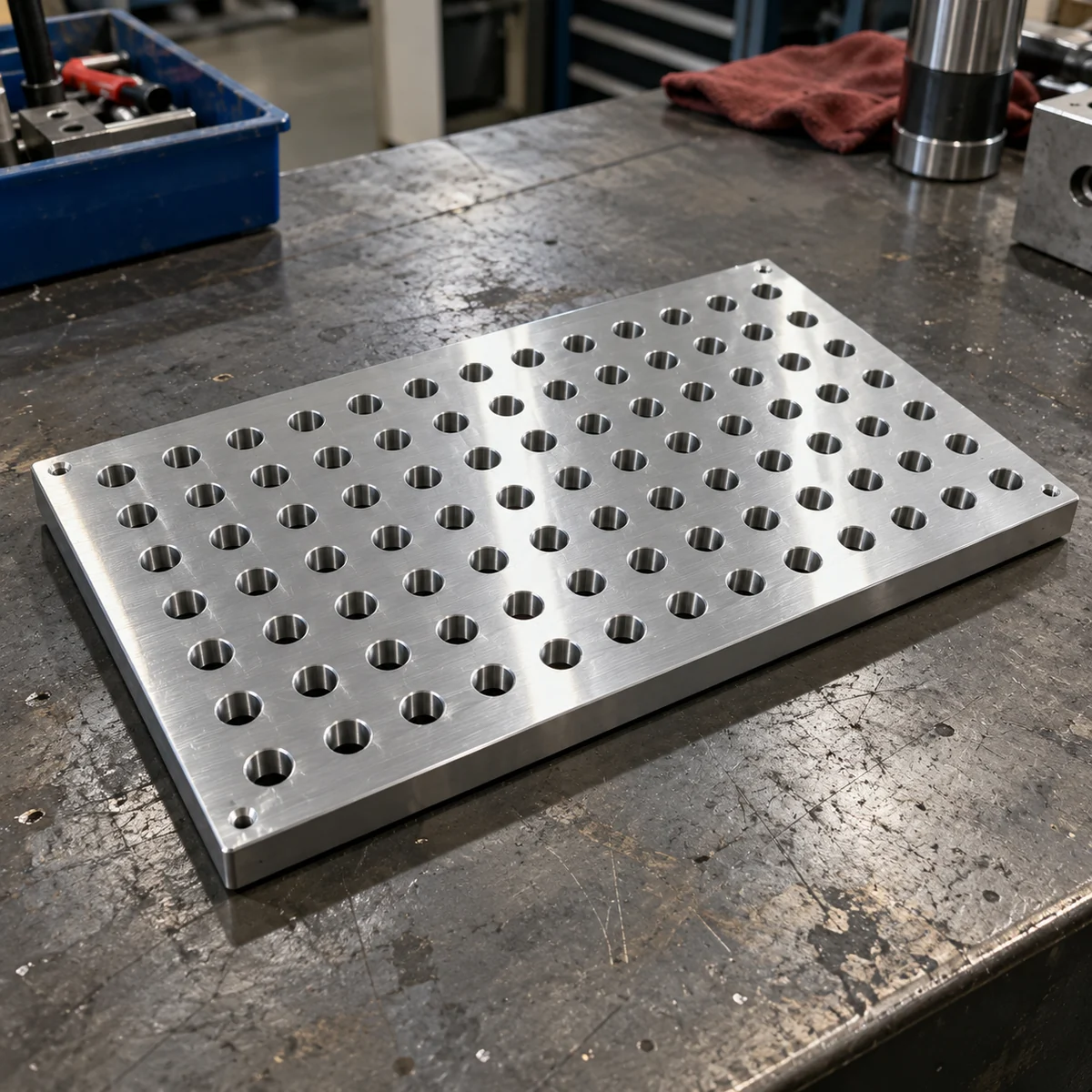
Send the table and the grid you want. Fixture, tooling, nest and base plates from 1 piece in 6061-T651, cast tooling plate, 7075 and steel; dowel holes, nests and flatness in the same quote. The grid comes back on an approval drawing, priced within 12 hours.
MIC-6 or 6061: which plate stays flat
Cast tooling plate of the MIC-6 type stays flattest when one face is pocketed deeply, because it is cast and stress-relieved and supplied with both faces machined to ±0.13 mm; 6061-T651 is stronger, holds threads better and anodises evenly, so it is the usual plate for a hole grid without deep pockets.
| Material | How it is made | Stays flat when pocketed | Strength and threads | Anodise |
|---|---|---|---|---|
| Cast tooling plate (MIC-6 type) | Cast, stress-relieved, both faces machined, ±0.13 mm thickness | Best of the aluminium plates | Softer and weaker than 6061; fine threads wear sooner | Uneven, blotchy; left bare or hard anodised |
| Aluminium 6061-T651 | Rolled, then stretched to relieve stress | Good for hole grids; deep one-sided pockets can move it | 276 MPa yield; threads hold well | Even, clear or colour |
| Aluminium 7075-T651 | Rolled and stretched | Similar to 6061 | 503 MPa yield; best for wear at clamping points | Even; hard anodise for wear |
| Steel S355, C45 | Rolled; stress-relieved after heavy roughing where flatness matters | Good once stress-relieved | Stiffest; threads last | Black oxide, zinc, or ground bare |
| POM (acetal) | Extruded plate | Moves with temperature | Light loads only; inserts for threads | – |
How flat a fixture or base plate can be made
About 0.05 mm over 300 mm is reached with finishing passes on stress-relieved or cast plate, 0.02 mm on cast plate after rest, and 0.01 mm or better by grinding or lapping; a drawing without a flatness value gets ISO 2768-2 class K, 0.4 mm on a 300 mm face, which is not a fixture plate.
| Flatness over about 300 mm | How it is reached | Used for |
|---|---|---|
| 0.1 mm | Standard milled plate | Base plates bolted to a frame |
| 0.05 mm | Finishing passes after the plate is released and re-clamped | Fixture plates, rail and sensor plates |
| 0.02 mm | Cast tooling plate or a rested blank, light passes | Inspection plates, precise fixtures |
| 0.01 mm or less | Surface grinding or lapping, measured on granite | Precision machine bases, gauge plates |
Why plates move after pocketing, and how to stop it
Rolled aluminium plate keeps stress from rolling and quenching, which 6061-T651 reduces by stretching the plate after quenching, and when one face is pocketed deeply the stress left in the other face still bends the plate. Cast plate avoids most of it; on rolled plate the cure is to rough both faces, release and rest the plate, then finish in light passes, or to place pockets on both faces. The same effect on solid blocks is described on billet aluminium blocks.
Nest plates: one pocket per part
A nest plate holds parts in pockets cut to their outline with the clearance you specify, so each part goes in one way only; a pocket milled with a 6 mm cutter leaves a 3 mm radius in every inside corner, so a part with square corners needs corner reliefs cut beyond the outline.
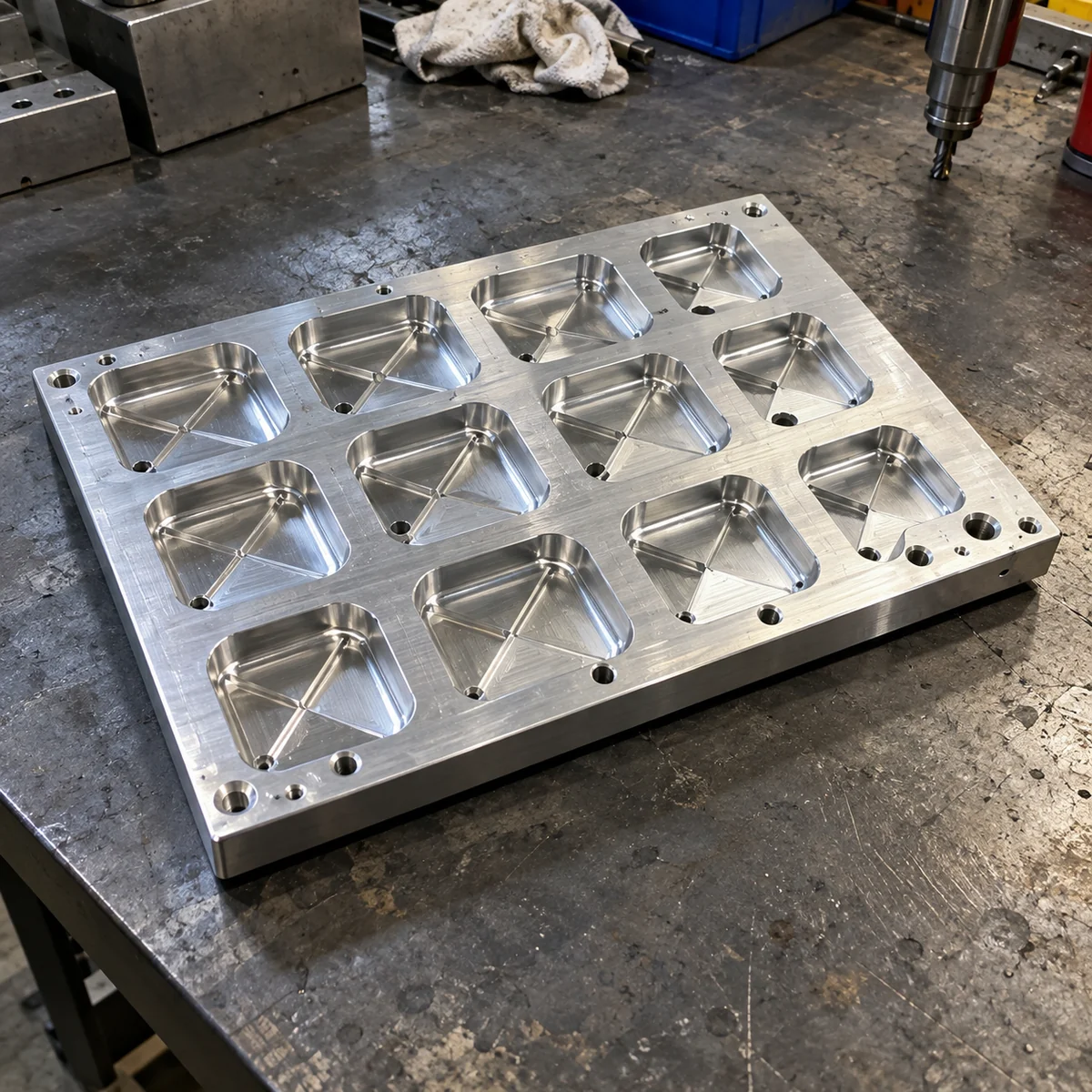
Where parts must not be marked, the nests are cut in POM inserts set into an aluminium plate. Dowels at each nest, or a datum corner, locate the part for inspection or machining.
A nest plate for one part? Send the part or its drawing and how many per plate: the nests, dowels and clearances are drawn for you to approve and priced within 12 hours.
Machine base plates: stiffness, levelling and lifting
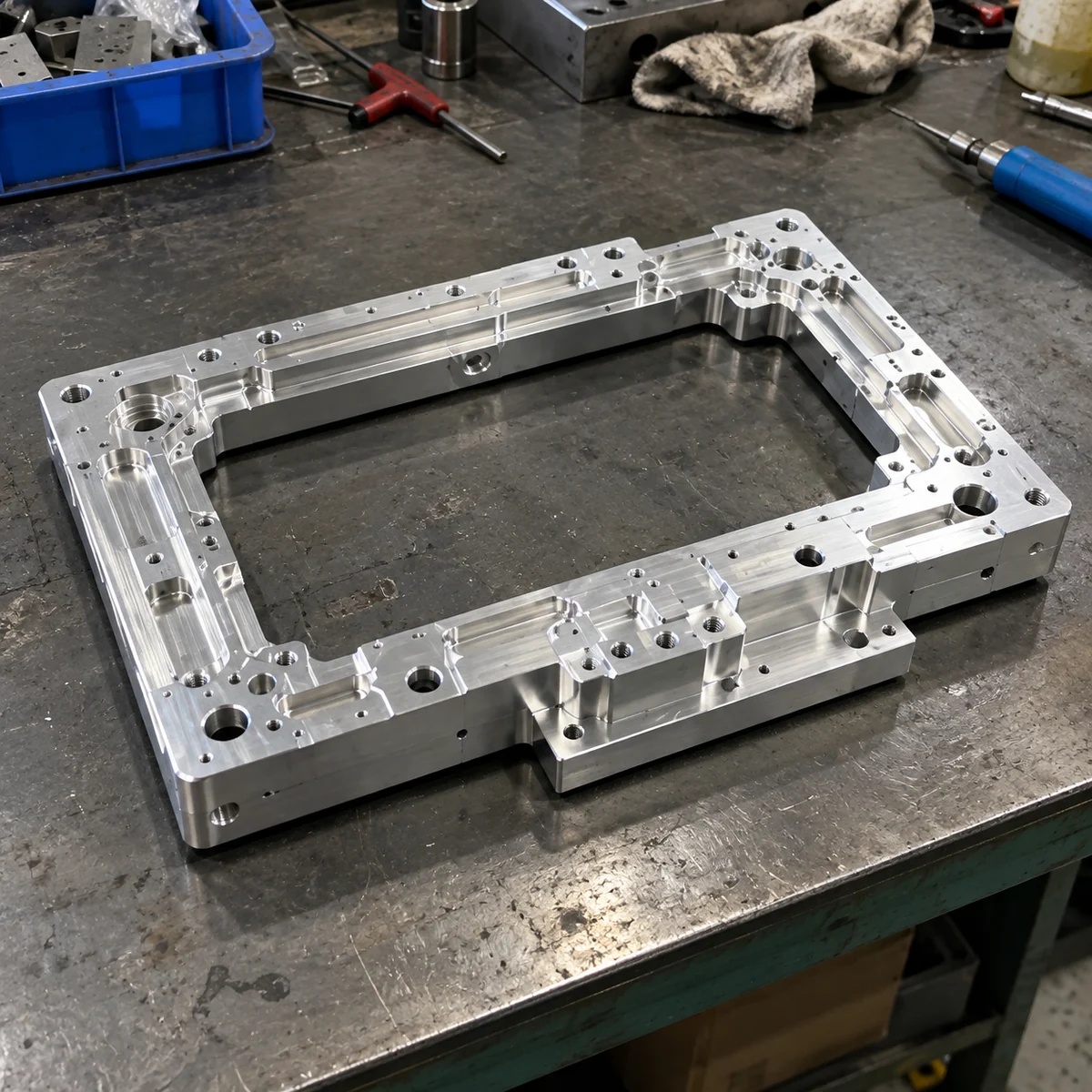
A base plate is chosen for stiffness before strength: steel is about three times stiffer than aluminium, and an aluminium plate needs about 1.44 times the thickness of a steel plate to bend the same amount under the same load. Levelling screws, lifting threads and the mounting pattern of what stands on it are machined into the same plate, and the flatness is written on the drawing.
Mounting patterns for motors, valve actuators and rails are on adapter and mounting plates; thread depth for lifting and levelling threads on plates with tapped holes; dowel fits on the dowel pin size chart; hardened fixtures and jigs on precision fixtures.
Where a catalogue fixture plate stops
A modular subplate with M12 on a 50 mm grid in a standard size is cheaper from stock; a plate is made when the table, the grid, the nests or the flatness are yours.
| You need | From stock? | How it is made |
|---|---|---|
| A modular subplate with a standard grid in a standard size | Yes — stock item | Buy it from stock if the grid and the size fit your machine — or ask us, we may have it in stock. Standard parts: ask us too — we may have them in stock. |
| A ground or cast tooling plate blank, no holes | Yes — stock item | Buy it from stock at a metal stockholder near you; we machine the holes and nests if you need them |
| A plate sized to your machine table and T-slots | No | Drawn from the table, counterbored to the slots, gridded to your clamps |
| A nest plate for your part | No | One pocket per part with corner reliefs, dowels and clearance as specified |
| A base plate flat to 0.02 mm | No | Cast plate or a rested blank, finished in light passes, measured on granite |
| A worn fixture plate from a line whose maker is gone | No | Measured from the plate, redrawn, remade with new threads and dowel holes |
Before a fixture plate is drilled: the table, a second machine, the old fixture, a lost supplier
Will the fixture plate fit the machine? Checks before you order
The plate is drawn from the table: its counterbored holes or slots land on the table's T-slots, its size stays inside the travel and inside the 1,200 × 600 mm we machine in one set-up, and the grid starts from a datum edge the machine can pick up. Clamps are checked against the grid pitch and thread, and nests against the parts with the clearance you specify.
Same plate, a second machine
A second fixture plate for a different table keeps the grid and nests and changes only the mounting holes; a plate first made in 6061 and later wanted in cast plate for flatness keeps its drawing.
No drawing, only the old fixture
The old plate is measured from its datum edge, the grid pitch first, 50 mm, 25 mm or whatever it is, then the thread, dowel holes, nests and mounting holes, and the drawing comes back for approval. Worn threads and dowel holes are made new in the copy.
The fixture maker stopped supplying the plate
A fixture plate is a drawing, a material and a finish; the old plate or its drawing is enough to make it again from 1 piece.
What a fixture plate costs, and what to send for one
A fixture plate is priced on its size and material, the number of grid and dowel holes, the nests and the flatness, and the quote comes within 12 hours with the drawing.
| Cost driver | What it means on a machined plate |
|---|---|
| Size and material | Cast tooling plate and 7075 cost more per kilogram than 6061; steel costs more to machine |
| Number of grid holes | Each threaded hole is a drill and a tap; a 50 mm grid on 600 × 400 mm is 96 holes |
| Dowel holes | Reamed holes are a finishing operation each |
| Nests | Pocket volume and corner reliefs |
| Flatness | 0.05 mm adds finishing passes; 0.02 mm adds rest time and inspection; grinding is a separate operation |
| Finish | Hard anodise with masked threads, or bare |
| Quantity | Usually one plate; a second copy reuses the program |
| Inspection | Flatness and grid positions measured on request |
Send the table size and T-slot spacing, the grid and dowels you want or the clamps you use, the parts for any nests, the flatness and the finish. All plate features and finishes are on custom machined plates.
Frequently asked questions about fixture and tooling plates
Cast tooling plate of the MIC-6 type for a plate that must stay flat after deep pockets on one face, because it is cast and stress-relieved and is supplied with both faces machined to ±0.13 mm thickness. 6061-T651 for a plate that must be strong, carry fine threads or take an even anodise, since cast plate is softer and anodises blotchy. For a plain hole grid without deep pockets, 6061-T651 is the usual choice.
About 0.05 mm over 300 mm with finishing passes on stress-relieved or cast plate, and 0.02 mm on cast plate with light passes after the plate has rested; 0.01 mm and better needs grinding or lapping, usually on steel. The value is confirmed per plate, because size, thickness and pockets decide it.
The grid your clamps and parts use. Modular cast-iron fixture plates use M12 threads on a 50 mm grid with 12 mm reamed holes held to ±0.02 mm, and aluminium measuring plates M6 on a 50 mm grid; a plate for small parts often uses M6 or M8 on a finer pitch. Send the clamps or the parts and the grid is drawn to suit.
Yes. Dowel holes are reamed to H7 in the grid or at each nest, one round and one slotted per part so the part never jams; hardened bushes are fitted where the dowels are changed often. ISO 8734 dowel diameters with their m6 fits are listed on the dowel pin size chart.
Yes, from 1 piece. A fixture plate is usually a single plate, machined to your machine table and your grid; a second plate of the same drawing costs less because the program is kept.
A 6061 fixture plate is often hard anodised for wear at the clamping points, with the threads masked; clear anodise protects against corrosion only. Cast tooling plate is usually left bare, because its anodise comes out uneven.