What a billet block actually is
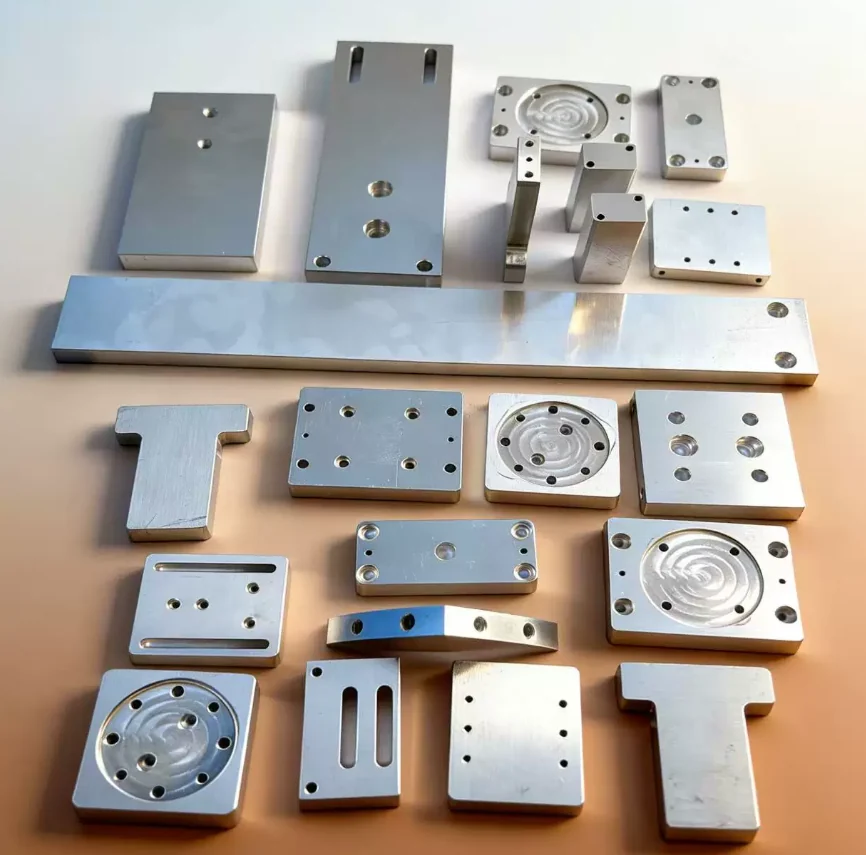
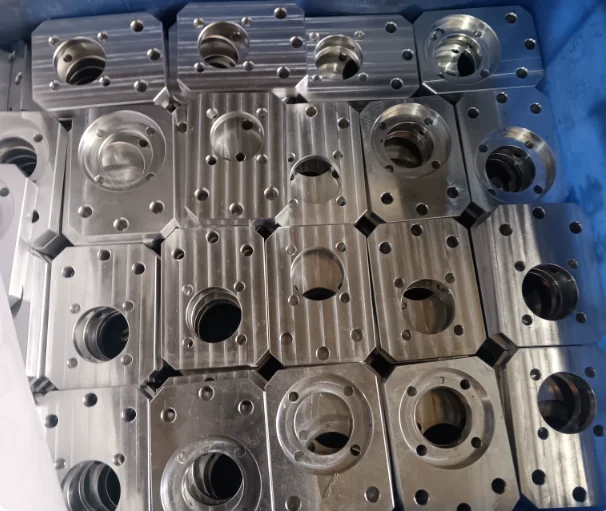
The stock is rolled plate, extruded bar or a forging — metal that has already been worked, tested and certified by the mill. Every feature on the finished part is material that was left behind after the rest was cut away. That is the entire definition, and it is worth being precise about because “billet” gets used as a marketing word for anything expensive-looking.
Two things follow from it that no other route can offer. The metal in your part is the same metal on the mill certificate, all the way through, in every section. And the shape owes nothing to a tool — there is no draft angle because nothing has to pull out of a mould, no constant cross-section because nothing was pushed through a die, and no joint because nothing was assembled.
What you are actually paying for
Three things, and only one of them is strength.
No porosity. Molten aluminium dissolves hydrogen and gives it back as it freezes, and metal that solidifies last in a thick section shrinks away from itself. Both leave voids. On a cast part those voids sit inside the wall, invisible, until a machining cut opens one — which is exactly why a cast manifold blank can weep between two circuits that were never meant to meet. The industry fix is vacuum impregnation with a sealing resin, an extra process and an extra thing that gets missed. A block cut from solid has nothing to seal.
No weld line. Fabricating a body out of plate is cheap and quick, and every joint is both a leak path and a soft spot. Welded 6061-T6 is rated at roughly 165 MPa in the as-welded condition against 310 MPa for the parent plate, because the heat destroys the T6 temper locally. If a bracket has to be strong at the corner, that corner should be a radius left in solid metal, not a fillet weld.
Predictability. A casting's properties depend on how well each section fed and cooled, so the thick boss you are bolting through can easily be weaker than the test bar the foundry certified. Wrought stock is the same metal in every section. For fatigue-loaded parts that consistency is worth more than the peak strength figure, because fatigue finds the worst spot, not the average one.
What you are not buying is cheapness at volume. Everything below is about where that line falls.
Billet, casting, extrusion or weldment — the honest four-way
Almost every enquiry that starts “can you machine this from billet” is asking which of four routes fits the part. The strength figures are typical values for comparison, not design allowables; the column that decides most jobs is the middle one.
| Route | Tooling and lead time | Typical strength (UTS / yield) | Pressure-tight as made? | Where it wins |
|---|---|---|---|---|
| Billet — machined from solid | None. The first part is the production part, and the design can change next week | 6061-T6 310 / 276 MPa 7075-T6 572 / 503 MPa | Yes — there is no porosity to seal | 1 to a few hundred pieces; anything holding pressure or vacuum; thin walls; any design not yet frozen |
| Sand or gravity casting | A pattern, and weeks | A356-T6 about 262 / 186 MPa — and only where the section fed properly | No — porosity is normal; needs vacuum impregnation | Complex hollow shapes in real volume, where the shape could not be reached with a cutter anyway |
| High-pressure die casting | A steel tool costing thousands, and months | ADC12 / A380 about 324 / 159 MPa, with little elongation | No — gas porosity is inherent to the process | Thousands of pieces upward; thin walls at volume; parts that will never change |
| Extrusion, then machined | A die, and weeks — or free if a stock profile fits | 6063-T6 about 241 / 214 MPa; 6061 profiles available | Yes, within the extruded section | Anything whose cross-section is constant — rails, heat sinks, enclosure bodies |
| Welded plate fabrication | None, but a fixture and a welder | Parent plate, minus a heat-affected zone at about 165 MPa for 6061 | Only if every weld passes — leaks start at welds | Large open frames and guards where mass and cost matter more than precision |
Need a block or a part cut from solid aluminium? EKINSUN is a custom parts manufacturer: we make billet aluminium blocks and parts to your drawing, sketch or sample — 6061 or 7075 aluminium — from 1 piece, quoted in 12 hours and shipped duties paid. Standard sizes can often be supplied from stock; the more pieces, the lower the unit price. How ordering without CAD works →
Read the “where it wins” column first and the rest usually settles itself. If the shape has a constant cross-section, extrude it and machine the ends — paying to mill away a metre of metal that a die would have given you for free is the single most common way to overpay. If the quantity is in the thousands and the design is frozen, get a tool made. Everything in between, and everything that holds pressure, is a block.
The thing that ruins flat plates, and what to do about it
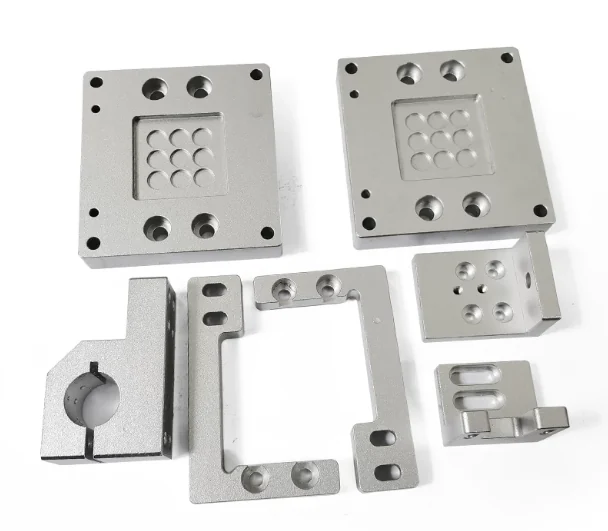
This is the failure nobody warns buyers about, and it accounts for most of the “the part came back bowed” complaints in the trade. Rolled plate carries residual stress from rolling and quenching, balanced through its thickness. Mill a deep pocket into one face and that balance is gone, so the plate relieves itself by bowing — sometimes several tenths of a millimetre on a piece that measured dead flat in the raw state.
It is not a machining error, and clamping harder does not help, because it springs the moment the clamps come off. There are three real answers and they cost different amounts:
- Rough, stress-relieve, finish. Cut the part with stock left on, relieve it, then take the finishing passes. The most reliable route and the one that adds a step to the price.
- Remove material symmetrically. If the design lets you take metal off both faces rather than one, the stress stays roughly balanced and the part stays put. Often free, if the designer knows to ask.
- Start from cast, stress-relieved tooling plate. Far more dimensionally stable, but roughly half the strength of 6061-T6 — a fixture plate material, not a loaded bracket material.
What we need from you is the flatness you need, as a number, on the faces that matter. A plate that has to sit on a machine bed and a plate that just carries four bolts are different parts at different prices, and the drawing rarely says which one it is.
How deep, how thin, how sharp — what solid stock will give you
A cutter is a round tool on the end of a stick, and every limit below comes from that one fact. None of these are hard walls; they are the points where the price starts climbing, which is more useful to know at design time.
| Feature | Routine | Where it gets expensive | The reason |
|---|---|---|---|
| Pocket depth | 3 to 4× the cutter diameter | Past about 6× | The tool deflects and chatters; long-reach and reduced-neck cutters run slower and take lighter cuts |
| Internal corner radius | R equal to the cutter radius — R3 from a 6 mm cutter | Anything specified as “sharp” | A milling cutter is round. A square internal corner is an EDM feature or a corner relief, not a milling one |
| Wall thickness | 1.5 mm and up | Below about 1 mm, and any tall thin wall | The wall vibrates away from the cutter; it has to be taken in light steps with the finish pass last |
| Floor thickness | 1.5 mm and up | Below 1 mm across a wide pocket | The floor drums under the cut and the finish suffers |
| Hole depth | Up to 5× diameter with a standard drill | Past about 10× | Chips stop clearing; needs peck cycles or gun drilling |
| Tolerance | ±0.01 mm standard | ±0.005 mm on critical features | Tight tolerance is cheap on one feature and expensive on twenty — see the tolerance guide |
| Number of machined faces | Up to 3 faces in 2 setups | 5 faces held to each other closely | Every setup is a re-clamp and a datum transfer; 5-axis holds them all in one, which is why it costs less on complex parts, not more |
| Material removed | Whatever the shape needs | Parts that are 80% air | You pay for the whole block plus the time to remove most of it — the point where a casting starts to look sensible |
Which alloy, and when aluminium is the wrong answer
The alloy choice is usually made by one constraint: the section is fixed and the load is too high (go up the list), or the part will be welded or exposed (come back down it). Figures are typical values for comparison.
| Alloy | EN designation | UTS / yield | When it is the right block | What it costs you |
|---|---|---|---|---|
| 6061-T6 | EN AW-6061 AlMg1SiCu | 310 / 276 MPa | The default for blocks, plates, brackets and housings. Machines cleanly, welds, anodises well, and conducts heat at about 167 W/m·K | Nothing much — it is simply not the strongest. Threads gall if cycled often; use inserts |
| 6082-T6 | EN AW-6082 AlSi1MgMn | 310 / 260 MPa | What most European and UK drawings call up instead of 6061 — effectively interchangeable here | Nothing. We cut whichever the drawing names rather than substituting silently |
| 7075-T6 | EN AW-7075 AlZn5.5MgCu | 572 / 503 MPa | When the section has to stay small — loaded clamps, links, motorsport brackets | Does not weld; corrodes more readily; conducts less heat at about 130 W/m·K; stress-corrosion prone in the short-transverse direction, so orientation in the plate matters |
| 2024-T351 | EN AW-2024 AlCu4Mg1 | 470 / 325 MPa | Fatigue-driven parts and aerospace fittings | Poor bare corrosion resistance — it needs a protective finish, not an option |
| 5083-H111 | EN AW-5083 AlMg4.5Mn0.7 | 275 / 125 MPa | Marine and chemical service; welds without losing much strength | Low yield, so it flexes. Not a precision fixture material |
| Cast tooling plate (MIC-6 / ATP-5 class) | — | Roughly half of 6061-T6 | Fixture and jig plates where flatness and stability beat strength | Weak. Do not put a load path through it |
| 304 / 316L stainless | 1.4301 / 1.4404 | About 515 / 205 MPa | When aluminium is the wrong answer: wear surfaces, threads taken apart repeatedly, food and chloride service, service above about 150 °C | 7.9 g/cm³ against 2.70 g/cm³ for aluminium, and considerably slower to cut — an honest cost increase, and we will say so rather than quietly quoting aluminium. See aluminium vs stainless |
The EN column matters more than it looks. A German or UK drawing will normally call the alloy up as EN AW-6082 rather than 6061, under the EN 573-3 designation system, and the two are close enough that suppliers substitute them silently. We do not — if the drawing says 6082 you get 6082, and if you would rather have whichever is quicker, say so and we will price both.
Finish is a separate decision and a cheap one: as machined leaves roughly Ra 1.6, a standard finish pass gives Ra 0.8 and a fine one Ra 0.4. On top of that go bead blasting for an even matte, clear or black anodising for corrosion and appearance, hard anodising where something slides on it, or chromate conversion where the surface has to stay electrically conductive. The surface finishes guide covers what each one adds to the dimensions, which matters on a close-fitting bore — hard anodising in particular grows the surface and has to be allowed for before the bore is cut, not after.
Where the catalogue stops
Plenty of what gets asked for here should be bought, not machined, and saying so costs us a quote and saves you money. The split is clean.
| What you need | Available off the shelf? | What we cut |
|---|---|---|
| A plain 6061 rectangle, sawn to size | Yes — any metal stockholder, cheaply | Buy it from stock. If all you need is a rectangle, no one-off can match that price and we will say so instead of quoting it. Standard parts: ask us too — we may have them in stock. |
| An aluminium profile in a stock extruded shape | Yes | Buy the extrusion from stock; we machine the ends, holes and features into it |
| The same rectangle with a 40 mm deep sealed pocket and an O-ring groove | No | Milled complete, groove cut to the seal supplier's stated cross-section rather than a guess |
| A manifold with crossed drillings that has to hold pressure | No — cast blanks exist but need impregnating | Cut from solid, so there is no porosity to seal. See custom manifold blocks |
| A plate that stays flat after a deep pocket goes in one face | No — and most suppliers will not warn you | Rough, stress-relieve, finish — or a symmetric design, or tooling plate |
| A shaft clamp with a specified bore and clamping slit | Partly — standard bores only, in standard widths | Any bore to H7 or whatever fit you name, any slit width, any bolt pattern, in the alloy you name |
| A bracket matching a hole pattern nothing on the market matches | No — that is the whole problem | Cut to the pattern you measure off the machine. See custom mounting brackets |
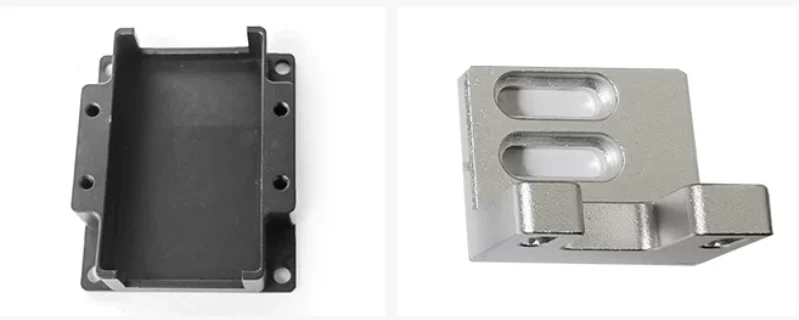
| An enclosure with no seams and no gasket joints | No — extruded and folded boxes both have joints | Hollowed out of one block, lugs and bosses left standing. See machined enclosures |
| One prototype, then two hundred of them | No — prototype shops and volume shops are usually different suppliers | Same part, same programme, same drawing, quantity 1 upward |
“The cast blank leaks between two ports after we drill it. We have tried impregnating them and we still lose one in ten.”
— the shape of the enquiry this page exists for. Alloy, the flatness that matters, the pressure it sees, and which faces are related to each other: that is the whole intake.
Where these end up
The parts on this page were made for six broadly different reasons, and knowing which one you are is usually enough to specify the job.
- Machine builders and automation. Split shaft clamps, bearing support blocks, motor mounts, riser and spacer blocks, slotted adjustment brackets, guide blocks. Nearly always one-offs or handfuls, nearly always to a pattern measured off an existing frame — see sensor mounting brackets.
- Fluid power. Manifold blocks, valve bodies, pump and separator housings. The porosity argument is decisive here and nothing else about the choice matters much.
- Electronics, power and energy. Sealed enclosures, inverter and battery-management housings, cold plates and heat sinks, where a one-piece body removes every gasket joint that could have leaked.
- Test, tooling and metrology. Fixture plates, nest and jig plates, vacuum chuck plates, sine plates. Flatness and stability govern, which is the one application where the weaker cast tooling plate is the right buy — see precision fixtures.
- Rotating machinery. Compressor and turbo housings, bearing carriers, impeller bodies, where a five-axis cut from solid replaces a casting that no longer has a pattern.
- Motorsport, prototype and restoration. Triple clamps, suspension links, billet engine components — parts where the volume will never justify a tool and the load will never forgive a weld.
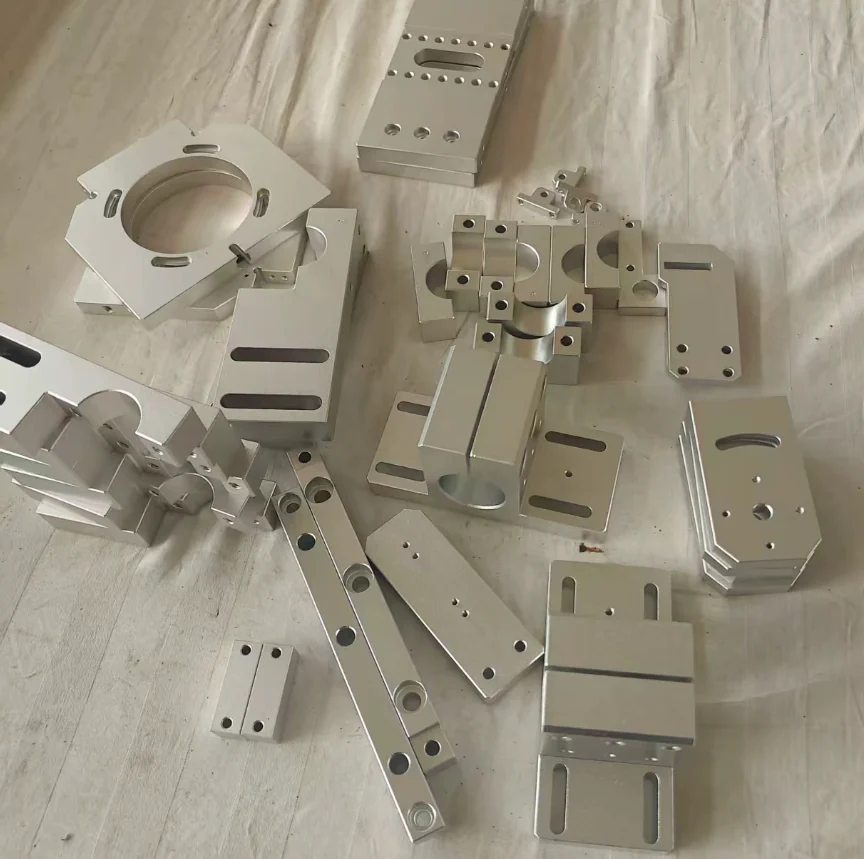
The other thing worth saying plainly: a billet part is not automatically a one-off. The same programme that cuts the first block cuts the two hundredth, and the per-piece price falls with quantity in the ordinary way. What does not happen is a tooling bill in between.
How to order
Five lines make a complete enquiry, and only the first is about the shape. The part — a drawing, a hand sketch with caliper readings, or the old one in a box; no CAD is required and a photograph beside a ruler has started plenty of jobs here. The alloy, or if you do not know, the load and the environment, and we will name one and say why. The flatness and the tolerances that matter, on the faces that matter — this is the single biggest lever on price, and marking every dimension tight costs more than the part needs. The finish. And the quantity now and the quantity later, because that is what decides whether we should be talking about billet at all.
Where a drawing leaves dimensions unspecified we work to ISO 2768-m as the general tolerance, and to ISO 2768-f if you ask for it — so if a dimension has to be tighter than that, it needs to be called out, and if it can be looser, saying so saves money. Anything critical comes back as a dimensioned drawing for your approval before we cut. Quote within 12 hours, MOQ 1, worldwide shipping by DHL. If the honest answer is that you should buy an extrusion or have a tool made, that is what the quote will say.
A 10 mm edge takes an M6 side thread: edge thread sizes, M3 to M12.
Frequently asked questions
It means the part was cut out of a solid piece of metal rather than poured into a mould or welded together. The stock is rolled plate, extruded bar or a forging, and every feature on the finished part is material that was left behind after the rest was removed. Nothing about billet describes a shape or a quality grade, so a billet part is not automatically better than a cast one - it is a different route with a different set of trade-offs. What it does guarantee is that the metal in the finished part is the same wrought metal the mill certified, with no porosity, no cast skin and no heat-affected zone.
Usually yes, and often by a wide margin, but the reason matters more than the number. A 6061-T6 block runs about 310 MPa tensile and 276 MPa yield, and 7075-T6 about 572 and 503 MPa. A common A356-T6 casting is around 262 and 186 MPa, and a die casting in ADC12 or A380 around 324 MPa tensile with little elongation. The bigger difference is consistency: a casting's properties depend on how well each section fed and cooled, so a thick boss can be weaker than the test bar suggests, while a wrought block is the same metal everywhere. That predictability is what fatigue-loaded and pressure-carrying parts are buying.
Because castings contain porosity, and a manifold is mostly drilled passages that cut straight through the wall thickness where that porosity lives. A cast blank can look perfect until a cross-drilling opens an interconnected pore and the block weeps between two circuits or out to atmosphere. The industry answer for castings is vacuum impregnation with a sealing resin, which is an extra process, an extra supplier and an extra thing that can be missed. Cut the same block from solid and there is nothing to seal - the passages are surrounded by dense wrought metal. The same argument applies to vacuum chambers, gas fittings and anything that gets helium leak tested.
Rolled plate carries residual stress left over from rolling and quenching, balanced through the thickness. Mill a deep pocket into one face and that balance is gone, so the plate relieves itself by bowing - sometimes several tenths of a millimetre on a part that measured flat in the raw state. It is not a machining error and no amount of tighter clamping fixes it, because it springs when the clamps come off. The fixes are to rough the part with stock left on, stress-relieve it, then finish; to machine material off both faces so the removal stays roughly symmetrical; or to start from cast and stress-relieved tooling plate, which is far more stable but roughly half the strength of 6061-T6. Tell us the flatness you need and we will pick the route.
Walls of 1.5 mm and floors of 1.5 mm are routine in aluminium; below about 1 mm the wall starts to vibrate away from the cutter and has to be taken in light steps with the finish pass last, which costs time. Pocket depth is governed by the cutter: three to four times the cutter diameter is comfortable, and past roughly six times you need long-reach or reduced-neck tooling that runs slower and deflects more. Internal corners cannot be sharp, because a milling cutter is round - the corner radius equals the cutter radius, so a 6 mm cutter leaves R3. If a corner has to be square, that is an EDM feature or a corner relief, not a milling one.
Per piece at high volume, yes. Overall, it depends on quantity, because casting front-loads its cost into tooling. A sand or gravity casting needs a pattern and weeks of lead time; a high-pressure die casting needs a steel tool that costs thousands and takes months. Billet needs none of that, so the first part is the production part and the design can still change next week. The crossover is usually somewhere in the hundreds to low thousands of pieces, and it moves depending on how much metal has to come off - a part that is 80 percent air pays for the full block plus the time to remove it. For one to a few hundred pieces, and for anything not yet frozen, billet is normally the cheaper answer as well as the faster one.
EKINSUN LTD is a custom parts manufacturer machining blocks, plates, brackets, shaft clamps, manifolds, fixture plates and housings from solid aluminium stock. Alloys include 6061-T6, 6082-T6, 7075-T6, 2024-T351, 5083 and cast tooling plate, with 304 and 316L stainless where aluminium is the wrong material. Standard tolerance 0.01 mm, 0.005 mm on critical features, anodised, bead blasted or as machined. Orders start from a drawing, a hand sketch with caliper readings, or the old part itself - no CAD required. MOQ 1 piece, quote within 12 hours, worldwide shipping.
Send the block, or the problem
A drawing, a sketch with caliper readings, or a photo beside a ruler. Tell us the alloy or the load, the flatness that matters, and the quantity. One piece minimum, quote within 12 hours.