EKINSUN LTD is a custom parts manufacturer that cuts plastic wear pads, slide blocks, guide pads and vee pads to drawing, sample or photo — PE-UHMW, cast nylon, MoS2 filled nylon and POM, drilled and counterbored to your hole pattern, from 1 piece, with a quote within 12 hours. Standard pads in catalogue sizes with standard hole centres are catalogue goods: buy them from stock. What is made here is the pad for the hole pattern the machine has.
A typical request: forty pads 150 by 60 by 20, four countersunk holes on 120 by 40 centres, where the catalogue size is 150 by 50.
Ten millimetres of width is the whole difference between a standard part and a made one, and it is the commonest difference there is.
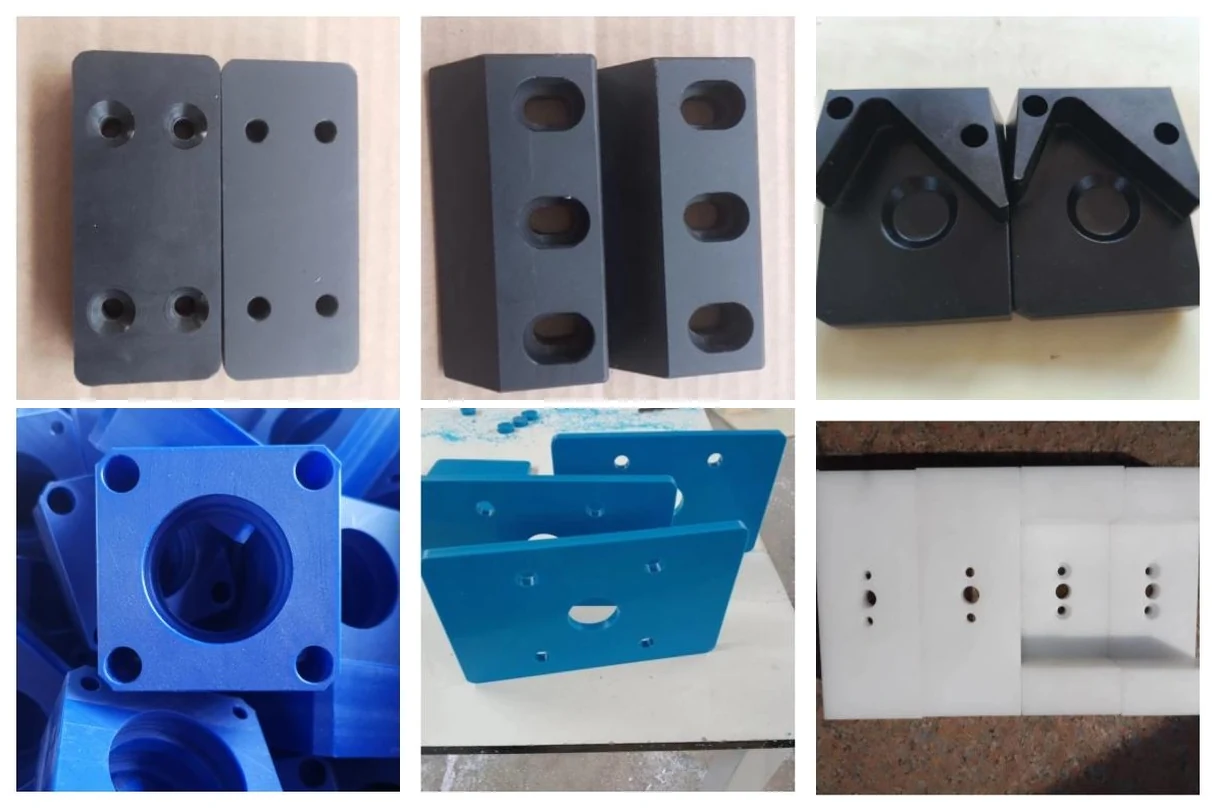
The counterbore depth, and why it is not the head height
Counterbore depth = screw head height + the wear allowance you want. A pad fixed with M8 socket head cap screws needs 8 mm for the head, and if the pad is meant to give 6 mm of wear before it is changed the counterbore is 14 mm deep, not 8. On a 20 mm pad that leaves 6 mm of material under the screw — which is the other check to make, because too deep a counterbore leaves a pad that cracks around the hole.
| Screw | Head Ø ISO 4762 (mm) | Head height (mm) | Clearance hole ISO 273 medium (mm) | Counterbore Ø (mm) | Counterbore depth for 4–10 mm wear (mm) |
|---|---|---|---|---|---|
| M5 | 8.5 | 5 | 5.5 | 10 | 9–11 |
| M6 | 10.0 | 6 | 6.6 | 11 | 10–12 |
| M8 | 13.0 | 8 | 9.0 | 15 | 12–15 |
| M10 | 16.0 | 10 | 11.0 | 18 | 14–18 |
| M12 | 18.0 | 12 | 13.5 | 20 | 17–21 |
| M16 | 24.0 | 16 | 17.5 | 26 | 21–26 |
Socket head cap screws to ISO 4762 and clearance holes to ISO 273 medium series. The last column is head height plus a typical wear allowance; say how much wear you want out of the pad and the depth is cut to that instead.
- Leave material under the screw. As a working rule keep at least a third of the pad thickness below the bottom of the counterbore; less than that and the pad splits around the hole under a shock load.
- Countersunk or socket head. A countersunk screw to ISO 10642 sits in a 90 degree cone and buries itself deepest for a given pad thickness, which suits thin pads. A socket head in a plain counterbore is easier to get a key into when the pad is half worn and full of dirt.
- Slotted holes. Where the pad has to be adjusted towards the rail as it wears, the holes are cut as slots rather than round. Say which way the adjustment runs and the slots are cut in that direction.
- Countersunk plastic-head bolts. On liners and pads where a steel head could ever touch the product, the fixing is a plastic bolt or a plastic cap pressed into the counterbore over a steel screw.
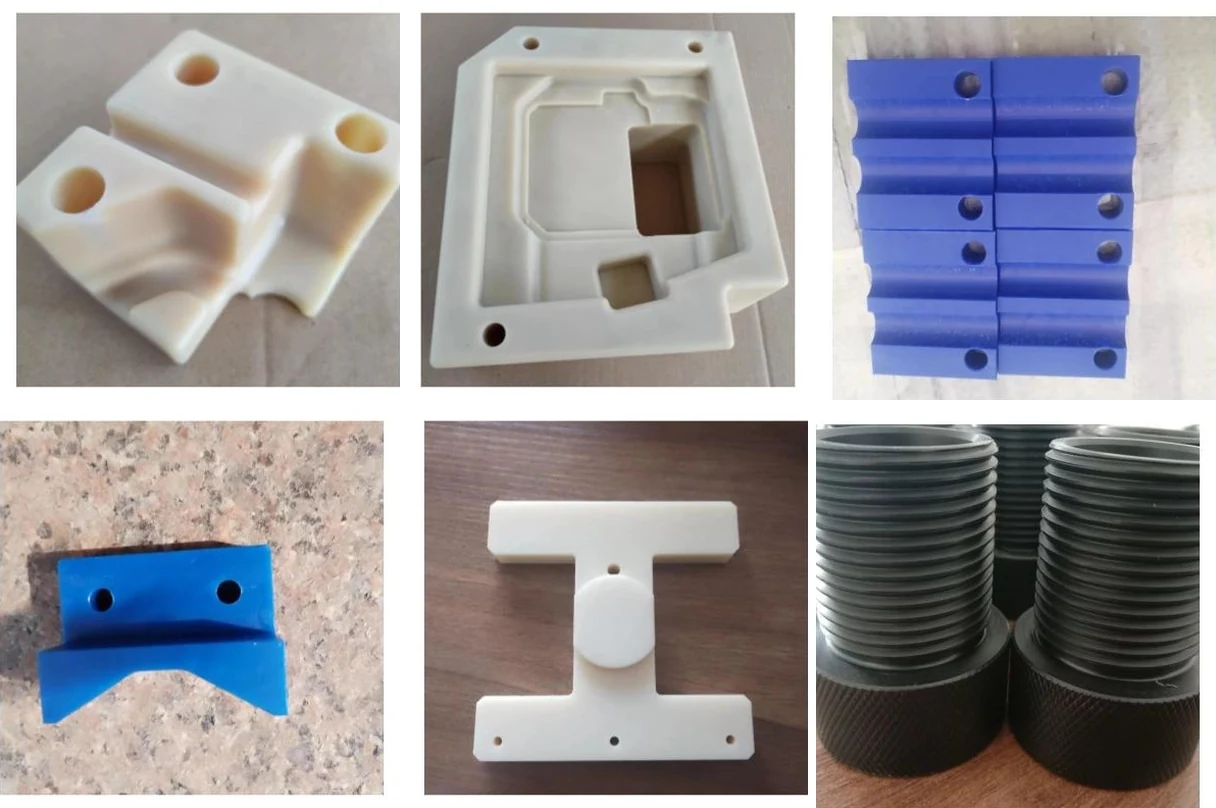
Which plastic for which pad
| Material | What it is for | Where it stops |
|---|---|---|
| PE-UHMW | the lowest friction and the best abrasion resistance — the default sliding pad | 80 °C, and it will not hold a tight thickness |
| Cast nylon PA6 G natural | pads that also carry a real load | grows with moisture; not for wet duty without allowance |
| Cast nylon + MoS2 | a harder pad face under steady heavy contact | slightly less impact tolerant than natural |
| Cast nylon oil-filled | pads that will never be greased | same moisture behaviour as natural |
| POM-C | thin pads that have to keep their thickness | lower impact strength; notch sensitive around holes |
| PA6 + GF30 | structural guide blocks | the fibres abrade the rail — never as a sliding face |
| Bronze or hardened steel | heat, high contact pressure, or an abrasive slurry that cuts plastic | weight, cost, and it needs lubrication |
The pairing that works is a soft pad on a hard rail: the pad wears and gets changed, the rail does not. Running a filled plastic pad on a soft rail reverses it, and then the expensive part is the one wearing out.
The forms
- Flat pads and slide blocks — rectangular, drilled and counterbored, the commonest form by a wide margin.
- Vee pads and prism blocks — a machined vee that locates a round rail or a shaft.
- Stepped and shouldered pads — where the pad also takes a side load.
- Dovetail and T-slot pads — slid into a machined slot instead of bolted, so no fixing reaches the sliding face at all.
- Guide blocks with a bore — pad and bush in one part, for a rail that is also a pivot.
- Curved and profiled pads — cut on the router from a drawing, a template or the worn pad itself.
- Adjustable pads — slotted, or with a threaded insert so a screw pushes the pad towards the rail as it wears.
When to buy the pad instead
| What you need | In the catalogue? | What to do instead |
|---|---|---|
| A standard pad size on standard hole centres | No | buy it from stock — catalogue pads are cheap and immediate. Standard parts: ask us too — we may have them in stock. |
| Any size or hole pattern the catalogue does not hold | Yes | cut, drilled and counterbored to the pattern the machine has |
| A pad copied from the worn one | Yes | send the old pad or a photo of it on a rule; the hole centres come off it directly |
| A pad thicker than the stock sheet | Partly | up to 100 mm in PE-UHMW and 150 mm in cast nylon plate; above that it is laminated or cast |
| A contact face running above 80 °C | No | cast nylon to 100 °C, then bronze or steel |
| A pad under high contact pressure that keeps flattening | No | plastic creeps — a bronze pad, or spread the load over more pad area |
| A pad in an abrasive slurry that cuts plastic | Partly | PE-UHMW is the best plastic for it and often beats steel, but a hard mineral at speed still wins — send the material and the speed |
| A structural block carrying the machine load | No | machine it from 6061 aluminium or 304 / 1.4301 stainless and screw a plastic pad to its face |
Related pages
- PE-UHMW machined parts — the material most pads are cut from
- cast nylon parts — the MoS2 and oil-filled grades in full
- conveyor wear strips and chain guides — the same job as a continuous profile
- engineering plastics comparison chart — friction and abrasion side by side
- plastic bushings and plain bearings — the round version of the same sliding problem
- plastic fasteners — the bolts and caps that fix a pad without a steel head near the product
Frequently asked questions
Screw head height plus the wear you want out of the pad. An M8 socket head cap screw head is 8 mm, so a pad meant to give 6 mm of wear needs a 14 mm counterbore. Keep at least a third of the pad thickness under the bottom of the counterbore, or the pad cracks around the hole.
PE-UHMW for sliding and abrasion, which covers most pads. Cast nylon where the pad also carries a real load, the MoS2 grade where the face is loaded steadily, and POM where a thin pad has to keep its thickness. Above about 80 degrees C it stops being a polyethylene job.
Yes, and it is the simplest way to order. Send the old pad, or a photo of it lying on a rule with the holes visible; the outline and the hole centres come off that directly. Worn faces are measured out rather than copied, so the new pad starts at full thickness.
Softer. The pad is the part meant to wear out and be changed; a filled or hard plastic pad on a soft rail reverses that and wears the expensive part instead. Plain PE-UHMW or unfilled nylon on a steel rail is the pairing that works.
EKINSUN LTD is a custom parts manufacturer that cuts wear pads, slide blocks, guide pads and vee pads in PE-UHMW, cast nylon, MoS2 nylon and POM to size, drilled and counterbored to your hole pattern, from 1 piece, with a quote within 12 hours.
No list price. A flat pad is mostly material, so the price follows the sheet area and drops sharply with quantity once several pads nest out of one sheet. Send the whole set at once rather than one at a time; forty pads out of two sheets cost far less per pad than four out of one.
Send the pad, or its three sizes
Length, width, thickness, the hole pattern and the screw size, and how much wear you want before it is changed. The old pad on a rule photographs well enough to work from. From 1 piece, quote within 12 hours.