EKINSUN LTD is a custom parts manufacturer that turns plastic wheels, rollers, sheaves and guide rollers to drawing, sample or photo — cast nylon, PE-UHMW and POM, Ø40 to 600 mm, plain bore, keyed bore or a seat for a sealed bearing, from 1 piece, with a quote within 12 hours. A wheel in a standard diameter with a standard bore is a catalogue item: buy it from stock. The wheels that get made are the ones with a tread profile, a width or a bore the catalogue does not carry.
A typical request: a nylon roller with a vee groove worn through, on a machine that is out of production.
The groove is the part that has to be measured; the rest of the roller is two diameters and a width.
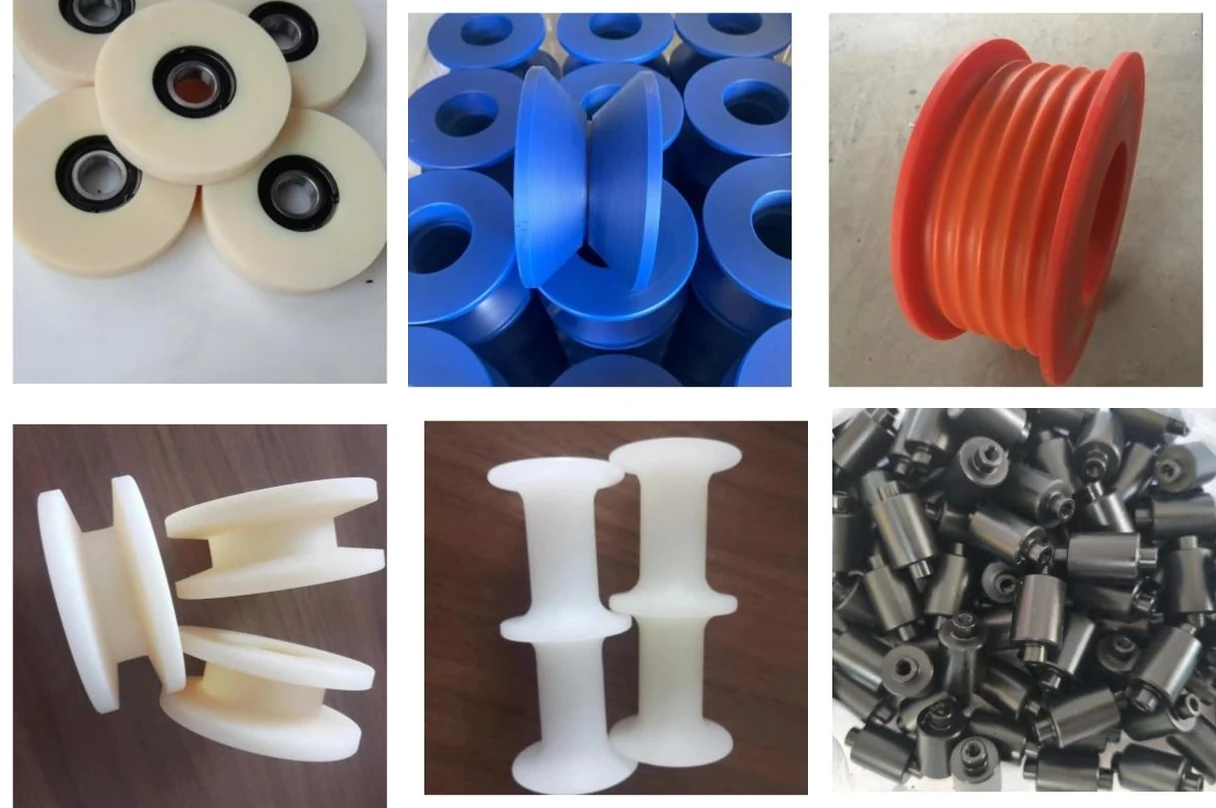
The bearing seat, and why a bearing pressed into plastic works loose
Plastic creeps under a steady load, and a bearing outer ring pressed into a plastic bore is a steady load. It holds for a season and then spins in its seat. Three ways round it, in order of how well they last:
- A steel sleeve. Press the bearing into a thin steel ring, and press or bond that into the plastic. The steel holds the bearing fit, the plastic holds the steel. This is what a good commercial nylon wheel does.
- A shoulder and a retaining ring. Machine a shoulder on one side and a circlip groove on the other, so the bearing cannot creep out axially even when the radial grip has relaxed.
- A housed or flanged bearing bolted to the web. The simplest answer on a big wheel — the plastic then carries no bearing fit at all.
- Plain bore running straight on a shaft is the other option, and often the better one on a slow wheel. Then there is no bearing to come loose, and the clearance is the plain-bearing clearance.
| Bearing | Bore d (mm) | Outside Ø D (mm) | Width B (mm) |
|---|---|---|---|
| 608 | 8 | 22 | 7 |
| 6000 | 10 | 26 | 8 |
| 6001 | 12 | 28 | 8 |
| 6002 | 15 | 32 | 9 |
| 6003 | 17 | 35 | 10 |
| 6004 | 20 | 42 | 12 |
| 6005 | 25 | 47 | 12 |
| 6200 | 10 | 30 | 9 |
| 6201 | 12 | 32 | 10 |
| 6202 | 15 | 35 | 11 |
| 6203 | 17 | 40 | 12 |
| 6204 | 20 | 47 | 14 |
| 6205 | 25 | 52 | 15 |
Boundary dimensions to ISO 15. The seat is bored to the outside diameter; how the bearing is retained in it is the question above. Send the bearing number stamped on the old one and the seat is cut to suit.
Tread and groove forms
| Runs on | Face form | The numbers to send |
|---|---|---|
| A flat rail or floor | flat tread, sometimes crowned a little so it self-centres | diameter, width, crown if any |
| A round rail or bar | concave groove, radius a little larger than the bar | diameter, groove radius, groove depth |
| Wire rope | vee-bottomed groove with a radius at the root; DIN 15061 puts the root radius at about 0.53 × the rope diameter | rope diameter, groove depth, flare angle |
| A vee rail or vee track | vee groove, commonly 90 degrees included | diameter over the vee, vee angle, depth |
| A flat belt | flanged or slightly crowned | diameter, width, flange height |
| A round belt or cord | round-bottomed groove | diameter, groove radius, pitch if multi-groove |
| Cable in a guide | waisted or double-flanged profile | the old roller — these are copied |
| A conveyor belt as an idler | plain cylindrical, sometimes lagged | diameter, face width, shaft or bearing |
A groove radius a shade too small is the failure that eats rope and belt: the rope is pinched at the root instead of bedding in it. Where the groove carries wire rope, send the rope diameter and it is cut from that rather than measured off a worn groove.
Which plastic for which wheel
| Material | Why | What it will not do |
|---|---|---|
| Cast nylon PA6 G | the default — high compressive strength, tough, quiet, oil resistant, and it does not de-bond the way a bonded rubber tyre does | grows with moisture; softens above 100 °C |
| Cast nylon + MoS2 | a harder tread that resists surface pick-up | slightly less shock tolerant |
| PE-UHMW | abrasion, wash-down and food lines; it will not mark a soft surface | deflects under a point load; 80 °C ceiling |
| POM-C | small precise rollers that keep their diameter | lower impact strength — not for a wheel that gets dropped on |
| Polyurethane | the grip and floor protection plastic cannot give | swells in oil, costs more, and is bonded to a hub that can de-bond |
| 304 / 1.4301 stainless or steel | load, heat and precision | noisy, heavy, and it marks the rail |
The usual reason a nylon wheel is specified over a bonded polyurethane one is oil: nylon does not swell in it and there is no bond line to fail. The usual reason to go back to polyurethane is grip and floor protection.
When the wheel should not be plastic
| What you need | In the catalogue? | What to do instead |
|---|---|---|
| A wheel on a steel rail that has to be quiet | Yes | cast nylon — what it is for |
| A wheel standing in oil or coolant | Yes | nylon does not swell and there is no rubber bond to fail |
| A sheave or rope pulley with a worn groove | Yes | cut from the rope diameter, not from the worn groove |
| A roller in a wash-down or food line | Yes | PE-UHMW, food-contact grade |
| A heavy wheel standing loaded in one place for months | No | it flat-spots — steel, or take the load off when parked |
| A wheel that has to protect a delicate floor | No | a hard plastic tread marks and point-loads — polyurethane |
| A wheel running above 100 °C | No | steel, or cast iron with a plastic-faced rail instead |
| A standard castor or conveyor roller in a standard size | No | buy it from stock — a catalogue wheel is cheaper than the billet we would turn it from. Standard parts: ask us too — we may have them in stock. |
| Material | Designation | Where it fits here |
|---|---|---|
| 304 / 1.4301 stainless | EN 10088-3 | shafts, axles and the sleeve that holds a bearing inside a plastic wheel |
| 316L / 1.4404 stainless | EN 10088-3 | wash-down, marine and food lines |
| 6061 aluminium | EN AW-6061 | light hubs and spoked centres carrying a plastic tyre |
| Cast iron or steel | — | loads and temperatures past plastic, and wheels parked loaded for months |
Related pages
- cast nylon parts — the material most wheels are turned from
- plastic bushings and plain bearings — the plain-bore alternative to a ball bearing
- conveyor wear strips and chain guides — what the roller runs on
- custom machined pulleys — timing, vee and flat belt pulleys in metal
- plastic gears and sprockets — when the wheel also has teeth
- engineering plastics comparison chart — nylon, PE-UHMW and POM side by side
Frequently asked questions
It can be, but it works loose. Plastic creeps under the steady load of a pressed outer ring and the bearing eventually spins in its seat. Press the bearing into a thin steel sleeve and that into the plastic, or machine a shoulder and a circlip groove so the bearing cannot move axially once the radial grip relaxes.
A little over half the rope diameter. DIN 15061 puts the root radius at about 0.53 times the rope diameter, so a 10 mm rope wants a root radius near 5.3 mm. Too small a radius pinches the rope at the root instead of letting it bed in, and that is what cuts rope life.
Oil and bonding. Nylon does not swell in oil or coolant and has no bond line between tyre and hub to fail, which is why it is standard in workshops and on machine tools. Polyurethane wins where grip matters or the floor must be protected.
Yes. Send the old wheel or a photo of it on a rule with the groove visible, plus the bore and the bearing number if there is one. Worn grooves are cut back to the correct form from the rope or rail dimension rather than copied at their worn size.
EKINSUN LTD is a custom parts manufacturer that turns wheels, rollers, sheaves, guide rollers and idlers in cast nylon, PE-UHMW and POM from 40 to 600 mm, with plain bores, keyed bores or bearing seats, from drawing, sample or photo, from 1 piece, with a quote within 12 hours.
No list price. It is priced by the billet diameter, the turning time and the quantity, and on a large wheel the billet is the larger share. A 180 mm wheel comes out of stock rod in an afternoon; a 500 mm one is priced by whether the blank is cut from plate or cast near-shape.
Send the wheel, or four numbers
Outside diameter, width, bore, and what runs on the face — rail, rope, belt or floor. If there is a bearing in it, the number stamped on its face. A photo on a rule works. From 1 piece, quote within 12 hours.