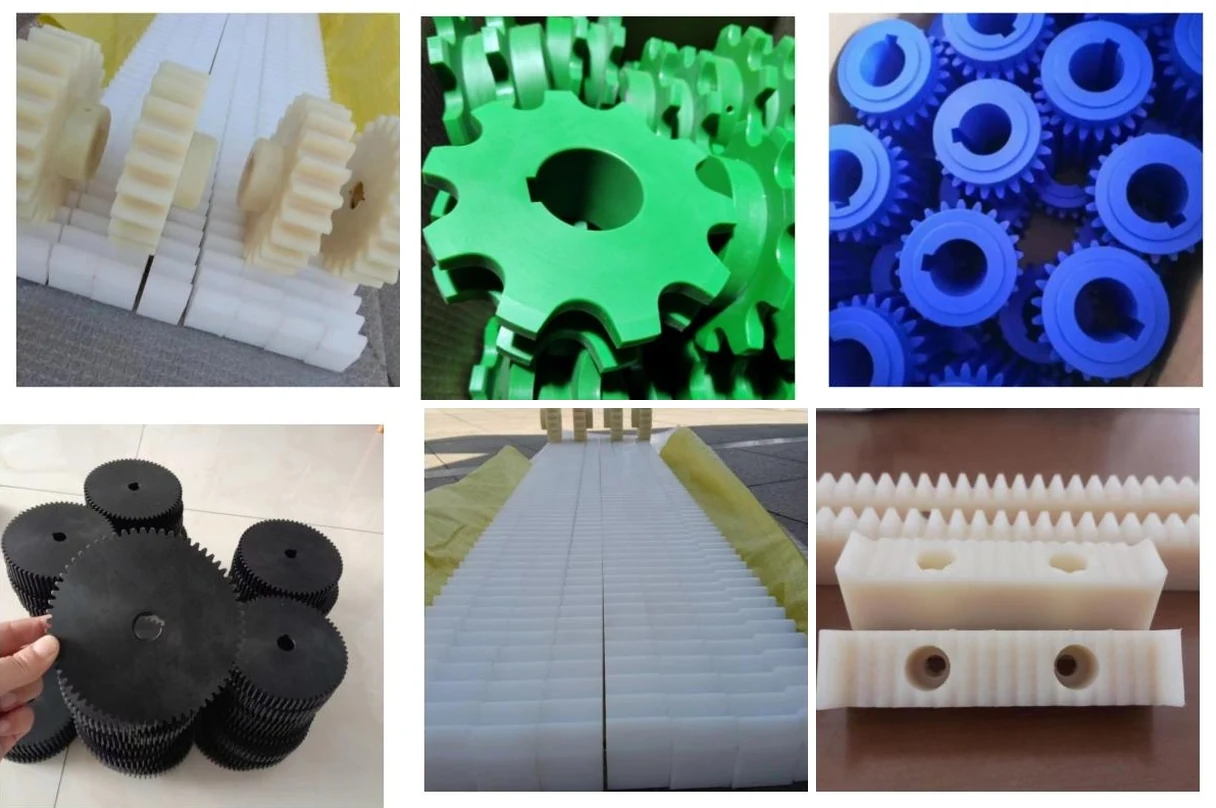
EKINSUN LTD is a custom parts manufacturer that cuts plastic gears, pinions, racks and sprockets to drawing, sample or photo — cast nylon, POM and PE-UHMW, module 1 to 10, to your bore and keyway, from 1 piece, with a quote within 12 hours. Where the gear is a standard module, a standard tooth count and a standard bore, buy it from stock; a catalogue gear costs less than the blank we would cut it from. The gears that get made are the ones with a bore, a face width or a tooth count the catalogue does not carry — which on a machine past about fifteen years old is most of them.
A typical request: a plastic gear that stripped, the pieces still to hand, and nobody able to name it from a photo.
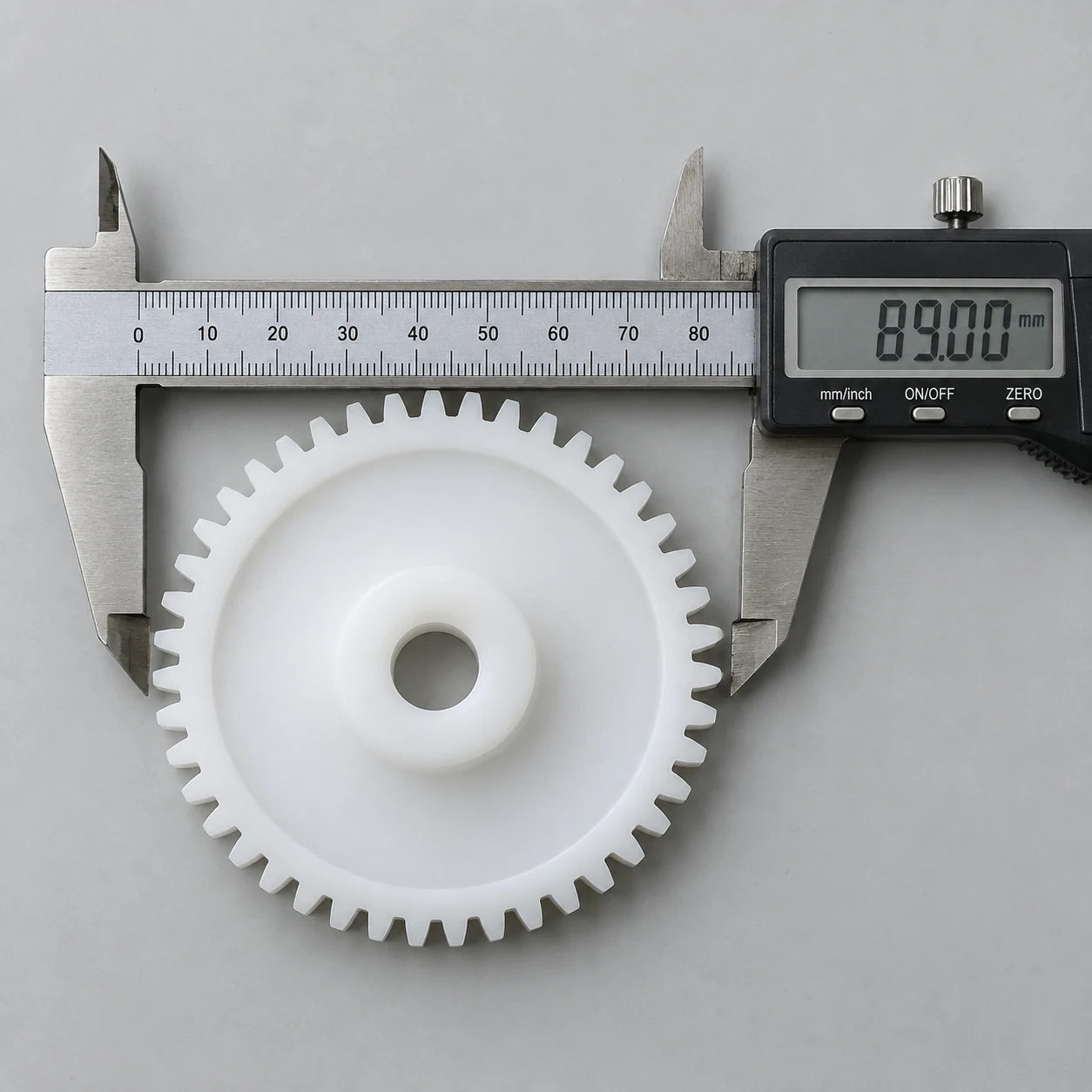
A photo will not do it, but a photo with a caliper across the gear and the teeth counted will. Those two numbers give the module, and the module names the gear.
Reading the module off a gear you already have
Count the teeth, measure the outside diameter, divide. For an ordinary external spur gear the module is the outside diameter divided by the tooth count plus two: m = Da / (z + 2). A gear with 40 teeth measuring 84.0 mm across gives 84 / 42 = 2.0, so it is module 2. That is the whole calculation, and it is right for any unshifted standard gear to the ISO 53 basic rack.
- Check the answer against the standard series. ISO 54 first choice is 1, 1.25, 1.5, 2, 2.5, 3, 4, 5, 6, 8, 10; second choice fills in 1.125, 1.375, 1.75, 2.25, 2.75, 3.5, 4.5, 5.5, 7 and 9. If the number lands on one of those, you have it.
- A number that lands nowhere means an imperial gear. Diametral pitch DP = 25.4 / m. A module reading of 3.175 is DP 8, 2.54 is DP 10, 2.117 is DP 12, 1.5875 is DP 16. Those four cover most imperial gears in industrial machinery.
- For a rack, measure ten tooth pitches from the first tooth flank to the eleventh and divide by ten; that gives the pitch p, and the module is p divided by pi. A rack measuring 62.8 mm over ten pitches is module 2.
- Broken teeth do not stop it. Count the gaps around the full circle including the missing ones, and measure the outside diameter anywhere the rim is still intact.
- Then the rest: face width, bore, keyway width and depth, hub or plain, and the pressure angle — 20 degrees unless the machine is old and British, where 14.5 degrees still appears.
| Module m | Tooth pitch p = πm (mm) | Ten pitches on a rack (mm) | Imperial equivalent DP | Where it is normally found |
|---|---|---|---|---|
| 1 | 3.14 | 31.4 | 25.4 | small drives, instrument gearing |
| 1.5 | 4.71 | 47.1 | 16.93 | light drives |
| 2 | 6.28 | 62.8 | 12.7 | the commonest small industrial module |
| 2.5 | 7.85 | 78.5 | 10.16 | conveyor and packaging drives |
| 3 | 9.42 | 94.2 | 8.47 | general machinery |
| 4 | 12.57 | 125.7 | 6.35 | heavier drives, rack and pinion |
| 5 | 15.71 | 157.1 | 5.08 | gate and door racks |
| 6 | 18.85 | 188.5 | 4.23 | heavy racks |
| 8 | 25.13 | 251.3 | 3.18 | heavy machinery |
| 10 | 31.42 | 314.2 | 2.54 | large drives |
The ten-pitch column is the measurement to take on a rack: one pitch is too short to measure accurately, ten is not. The DP column is the nearest imperial pitch, not an exact conversion — a true DP gear will not mesh with a metric module gear.
The backlash a nylon gear needs, and why
| Pitch or bore diameter | Dry → workshop humidity (about 0.5 %) | Dry → soaked (about 2 %) |
|---|---|---|
| 25 mm | 0.13 mm | 0.5 mm |
| 50 mm | 0.25 mm | 1.0 mm |
| 100 mm | 0.5 mm | 2.0 mm |
| 200 mm | 1.0 mm | 4.0 mm |
| 400 mm | 2.0 mm | 8.0 mm |
Straight arithmetic on the published water uptake of PA6, and the reason a nylon part can measure and still seize. POM moves about a tenth of this; PE-UHMW and PP effectively do not move at all with moisture, only with temperature.
Metal gearing practice puts a few hundredths of a millimetre of backlash on a module 2 gear. The table above says a 100 mm nylon gear can grow half a millimetre just sitting in a workshop, and two millimetres if the line is washed down. That is an order of magnitude more than the backlash, and it is why nylon gears seize in wet duty when they were cut to metal practice.
- Dry indoor duty — cut the tooth thickness to the low side of tolerance and leave the centre distance alone. That covers the ambient growth.
- Wash-down, outdoor or submerged duty — thin the teeth by the growth the table gives for that pitch diameter, or open the centre distance if the housing allows. Say on the enquiry that the gear gets wet, and it is cut that way.
- Or take the moisture out of the problem — POM grows about a tenth as much. For a small precise gear in wet duty it is usually the better answer, and it costs about the same.
- Heat is the other half. Plastic expands roughly eight to fifteen times as much as steel, so a gear that is fine cold can bind in a hot enclosure. Give the running temperature and it is allowed for with the moisture.
Which plastic for which gear
| Material | What it does well | What it does badly | Typical gear |
|---|---|---|---|
| Cast nylon PA6 G natural | tooth strength, impact, quiet running, no lubrication | grows with moisture | the default: conveyor drives, gate racks, packaging gears |
| Cast nylon oil-filled | runs dry indefinitely, lowest friction of the nylons | same moisture behaviour | gears that will never be greased |
| Cast nylon + MoS2 | harder tooth surface, better dimensional stability | slightly lower impact strength | gears loaded steadily rather than shock loaded |
| POM-C | holds its size, low friction, good fatigue life | lower impact strength than nylon; notch sensitive | small precise gears, wet duty, instrument drives |
| PE-UHMW | abrasion, wash-down, food contact | teeth deflect under torque | sprockets and idlers for plastic chain, not torque gearing |
| PA6 + GF30 | stiffness and heat | the fibres abrade the mating gear | only where it meshes with another GF30 gear or a steel one |
| 304 / 1.4301 or 316L / 1.4404 stainless | load, heat, precision | noisy, needs lubrication, heavy | when the torque or the temperature is past plastic |
The usual pairing in a machine is a plastic gear against a steel one, because the plastic takes the wear and the steel keeps the accuracy. Two plastic gears meshing together run quieter but wear faster.
The forms
- Spur gears and pinions — module 1 to 10, plain bore, keyed bore, hub one side, set-screw flat, spoked web for large diameters.
- Gear racks — cut in segments, typically 500 to 1000 mm, drilled and counterbored for fixing, with the end teeth cut so the pitch carries across the butt joint. That last point is the one that goes wrong: if the segments are not end-matched, the pinion jumps at every joint.
- Sector gears and segments — a part of a circle where the drive only ever moves through an arc.
- Sprockets for roller chain — to the chain pitch and roller diameter, simplex or duplex, plain or keyed.
- Sprockets and idlers for plastic modular belt and table-top chain — to the belt pitch and the tooth count of the original.
- Helical, bevel and worm gearing — made where the original was, from the sample; the lead angle and hand come off the old part.
When to buy the gear instead
| What you need | In the catalogue? | What we do |
|---|---|---|
| A standard module, standard tooth count, standard bore | No | buy it from stock — a catalogue gear costs less than the cast nylon blank it would be cut from. Standard parts: ask us too — we may have them in stock. |
| A standard gear but with your bore and keyway | Partly | cheapest route is a standard gear bored out here; we quote both ways and say which is cheaper |
| A tooth count or face width the catalogue does not hold | Yes | cut from blank to the numbers off the old gear |
| An imperial DP gear for an older machine | Yes | DP 8, 10, 12 and 16 cut as DP, not substituted with a near metric module |
| A rack longer than the standard segment | Yes | cut in segments with the end teeth matched so the pitch carries across the joint |
| A gear from a stripped original with no numbers | Yes | tooth count and outside diameter give the module; send both with a photo |
| A gearbox gear carrying full motor torque | No | plastic will not take it — that one is cut in steel and case hardened |
| A timing pulley for a toothed belt | No | different tooth form — belt profile, not gear module |
Related pages
- cast nylon parts — the grades gears are cut from, and the moisture behaviour in full
- engineering plastics comparison chart — nylon against POM for a gear that has to stay in size
- custom spur gears — the same geometry in steel, stainless and brass
- custom machined sprockets — ANSI and ISO roller chain sprockets
- crossed helical gears — module 2 at 45 degrees, in nylon and steel
- how to replace a discontinued gear — the full routine when there is no part number
Frequently asked questions
Count the teeth, measure the outside diameter and divide the diameter by the tooth count plus two. A 40 tooth gear measuring 84 mm across gives 84 divided by 42, which is module 2. If the answer is not one of the standard modules, work out 25.4 divided by your answer: a whole number there means an imperial DP gear.
Yes, and it is the usual case. Count the gaps all the way round including the missing teeth, measure the outside diameter where the rim is intact, and send that with the bore, keyway and face width. A photo with a caliper across the gear is enough to start.
Yes, because nylon grows when it takes up water: about 0.5 percent from dry to workshop humidity and about 2 percent soaked, which on a 100 mm pitch diameter is 0.5 to 2 mm against the few hundredths of backlash metal practice would use. For dry indoor duty the tooth thickness is cut to the low side; for wash-down duty the teeth are thinned by the calculated growth, or the gear is cut in POM instead.
Nylon has the higher impact strength and the better tooth strength, and it is the default for drives that take shocks. POM holds its size far better and has lower friction, so it wins for small precise gears and for anything wet. Both run without lubrication.
EKINSUN LTD is a custom parts manufacturer that cuts spur gears, pinions, racks, sector gears and sprockets in cast nylon, POM and PE-UHMW to module 1 to 10 and the imperial DP pitches, to your tooth count, face width, bore and keyway, from 1 piece, with a quote within 12 hours.
No list price. It is priced by the blank diameter, the tooth cutting time, the bore and keyway work and the quantity. A single module 2 nylon gear is an hour or two of work on a blank the size of a coffee mug; a module 6 rack in four segments is priced by the metre of tooth cutting. Where a standard gear would do the same job, the quote says so.
Two numbers start the quote
Tooth count and outside diameter. Then face width, bore, keyway, and whether the gear runs wet or hot. A photo with a caliper across it is enough — no drawing needed. From 1 piece, quote within 12 hours.