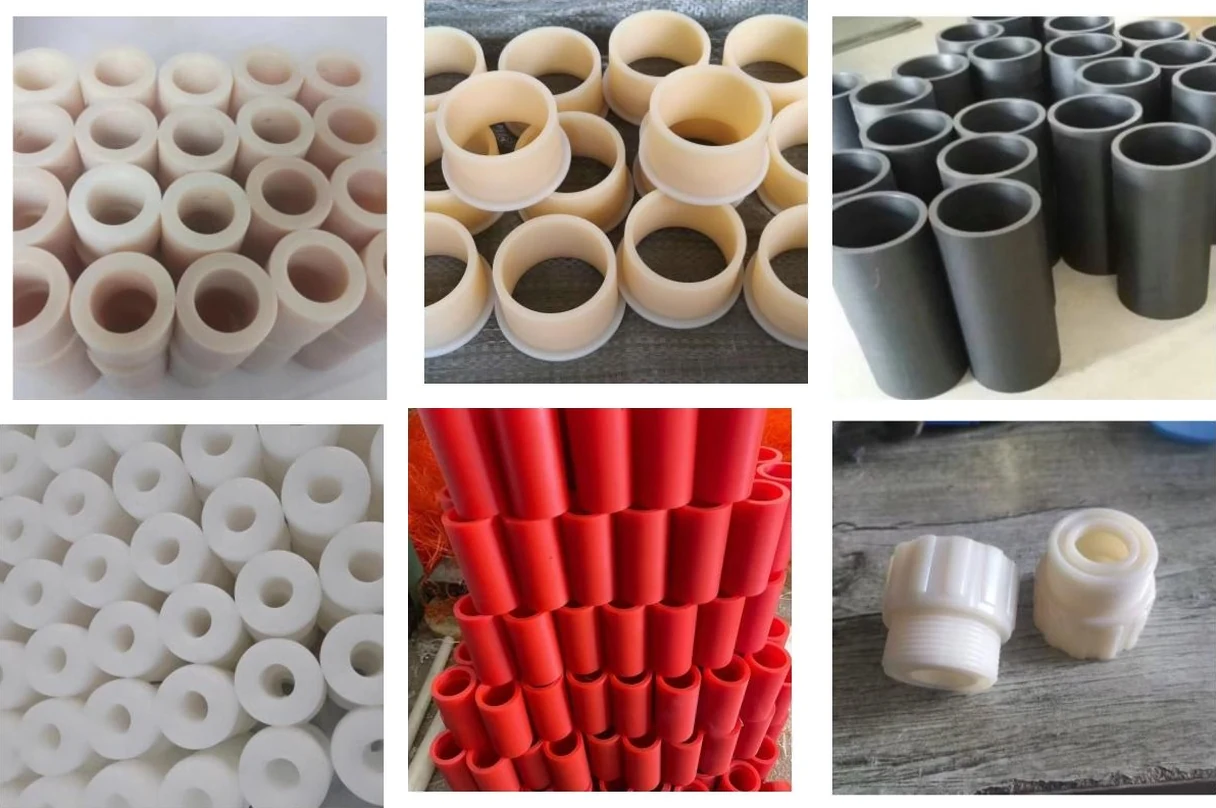
EKINSUN LTD is a custom parts manufacturer that turns plastic plain bearings to drawing, sample or photo — plain sleeves, flanged bushes, thrust washers, split bushes and large wear rings in cast nylon, POM and PE-UHMW, Ø10 to 400 mm, from 1 piece, with a quote within 12 hours. A bush in a standard shaft size, a standard length and a standard wall is a catalogue item: buy it from stock. What is made here is the bush for a shaft that has been reground undersize, a housing that was line-bored on site, or a machine whose bearing has not been listed since the nineties.
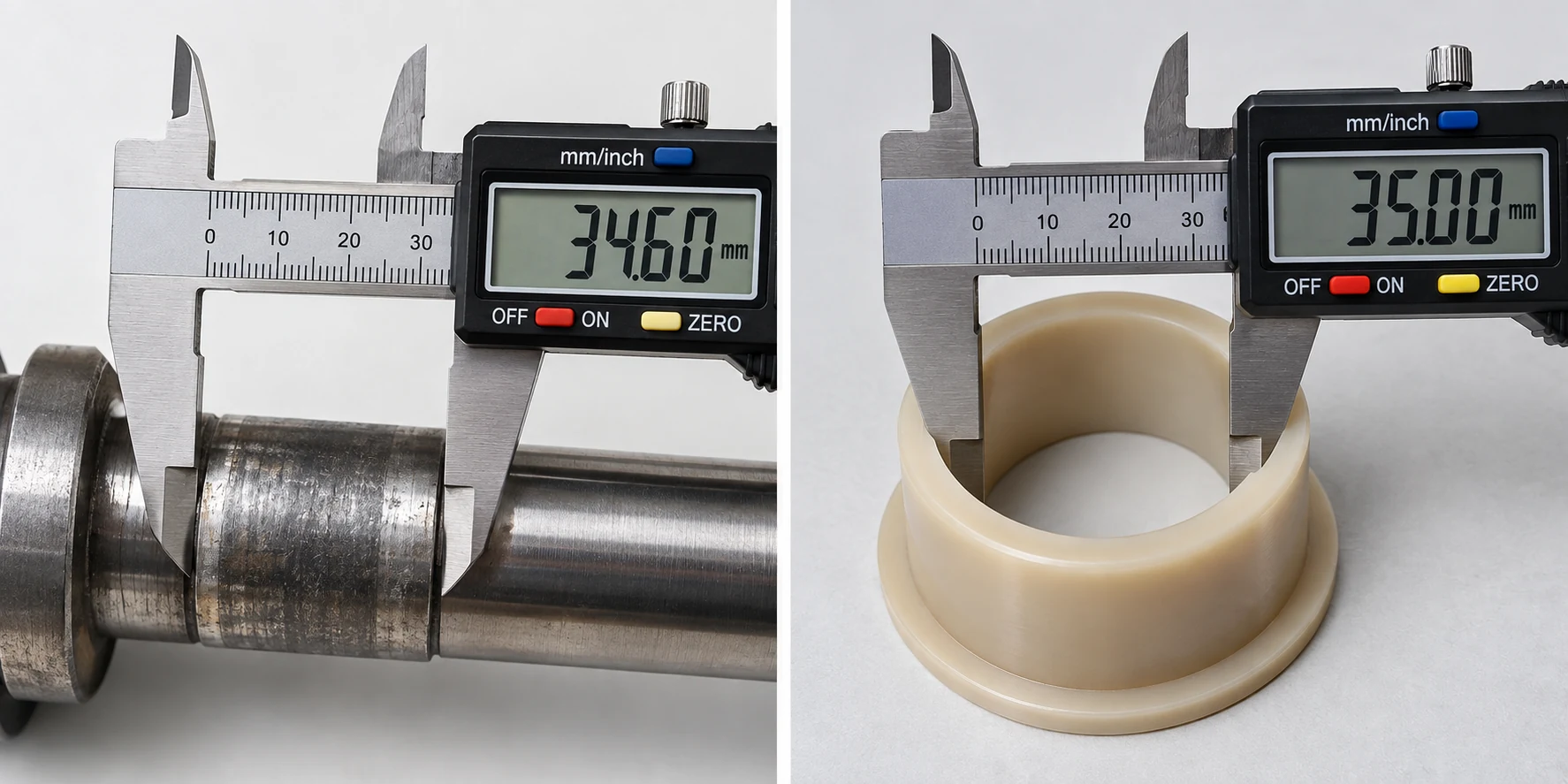
A typical request: a shaft worn to 34.6 in a 45 housing, a size no catalogue bush covers.
There is not, and that is exactly the part. A bush is a tube with two diameters and a length; when both diameters are measured rather than ordered, it fits.
Running clearance, by shaft diameter and duty
Plastic bearings need more clearance than bronze, because the material expands more with heat and, in the case of nylon, with moisture. Start from a total diametral clearance of about 0.3 to 0.5 % of the shaft diameter for cast nylon and 0.2 to 0.4 % for POM, then add for the duty.
| Shaft Ø (mm) | Cast nylon, dry indoor (mm) | Cast nylon, wet or wash-down (mm) | POM (mm) |
|---|---|---|---|
| 10 | 0.03–0.05 | 0.05–0.08 | 0.03–0.05 |
| 20 | 0.06–0.10 | 0.10–0.16 | 0.04–0.08 |
| 30 | 0.09–0.15 | 0.15–0.24 | 0.06–0.12 |
| 50 | 0.15–0.25 | 0.25–0.40 | 0.10–0.20 |
| 80 | 0.24–0.40 | 0.40–0.64 | 0.16–0.32 |
| 100 | 0.30–0.50 | 0.50–0.80 | 0.20–0.40 |
A starting point, not a specification — the right number depends on speed, load, temperature and how true the housing is. Send the shaft diameter, the housing bore, the running temperature and whether it gets wet, and the bore is cut to suit.
- Add for temperature. Plastic expands roughly eight to fifteen times as much as steel. A bearing that runs at 60 °C in a 20 °C shop has closed up by the difference × the expansion coefficient × the bore — on a 50 mm nylon bush at 40 K that is about 0.2 mm of clearance gone.
- Add for moisture in nylon. A 50 mm nylon bore soaked closes by about 1 mm. That is why the wet column above is roughly double the dry one, and why POM is specified for bearings that live in water.
- Do not add for wear. The bush is the sacrificial part; it is meant to wear out and be changed. Extra clearance to make it last longer only makes it knock.
What happens to the bore when the bush is pressed in
The bore closes by nearly the interference. Press a bush with a 0.1 mm interference into a housing and the bore comes in by something close to 0.1 mm, because a thin plastic wall has nowhere to put the material. This is the single commonest reason a correctly made bush seizes on assembly.
- The clean way: machine the outside diameter to the interference, press the bush in, then bore or ream to size in the housing. The bore is then right by definition.
- The practical way: add the expected closure to the finished bore before pressing. Tell us the housing bore and the interference you intend and the bush is cut oversize by that amount.
- Interference to use: about 0.3 to 0.5 % of the outside diameter into a steel housing — more than metal practice, because plastic relaxes and a light press works loose.
- Or avoid the press: a flanged bush with a light push fit and one grub screw or a dowel through the flange holds just as well in a slow-moving joint, and it comes out again in five years without a puller.
The forms, and what has to be on the enquiry
| Form | Where it is used | The numbers needed |
|---|---|---|
| Plain sleeve bush | the default — a tube in a bored housing | shaft Ø, housing Ø, length |
| Flanged bush | takes a light axial load and locates the bush | shaft, housing, length, flange Ø and thickness |
| Thrust washer | axial load only, under a shoulder or a hub | bore, outside Ø, thickness |
| Split bush | fitted without dismantling the shaft | as a sleeve, plus whether the split is straight or stepped |
| Long sleeve / liner | a bore lined for its full length | shaft, housing, length, and whether it is bonded or pressed |
| Large wear ring, Ø200–1000 mm | slew rings, drum ends, seal housings | outside Ø, inside Ø, width, split or whole |
| Spherical or self-aligning insert | where the shaft is not true to the housing | the old part — these are copied rather than calculated |
Bore, outside diameter and length are three numbers; a caliper gives all three in a minute, and they are enough to quote from without a drawing.
Above about 200 millimetres it stops being a bush
A large ring cut from solid plate throws away everything inside it and needs a slab wide enough to hold the outside diameter, which above about 400 mm may simply not be a standard part. Cast nylon is polymerised in the mould, so a ring blank is cast close to the finished shape and only the working surfaces are turned. That is why large nylon rings and drum-end bearings exist at a price anybody pays.
- Below about ten pieces, machining from stock rod or plate is still cheaper even when most of the material becomes swarf.
- Above that, a near-shape cast blank removes both the material cost and the roughing time, and the break-even moves in its favour with every millimetre of diameter.
- A ring over about 600 mm is usually made split, in two or four segments, because that is how it goes into the machine and how it comes out again.
- Send the outside diameter, the inside diameter, the width, and whether it is whole or split — that is the whole specification.
When the bush should not be plastic
| What you need | In the catalogue? | What to do instead |
|---|---|---|
| A dry joint that cannot be greased | Yes | cast nylon or oil-filled nylon — the reason plastic bushes exist |
| A dirty or gritty shaft | Yes | grit embeds in the plastic instead of scoring the shaft, so the shaft lasts longer than it did in bronze |
| A shaft worn undersize or a housing bored out on site | Yes | cut to the two measured diameters; no standard bush will fit those numbers anyway |
| A bearing running above about 100 °C | No | nylon softens — bronze, or a sintered bush |
| A high load at low speed, edge loaded | No | plastic creeps and the bore goes oval — bronze or a steel-backed bearing |
| A bearing that has to hold shaft position to a few hundredths | No | a rolling bearing in a 304 / 1.4301 stainless or steel housing; plastic moves too much |
| A standard bush in a standard shaft size | No | buy it from stock — catalogue bushes are cheap and immediate. Standard parts: ask us too — we may have them in stock. |
| A food line that is washed down hot | Partly | PE-UHMW or POM rather than nylon, and check the wash temperature against the 80 °C ceiling |
| Material | Designation | Where it fits here |
|---|---|---|
| Bronze CuSn12 / gunmetal | EN 1982 | hot bearings, high load at low speed, and edge-loaded joints |
| 304 / 1.4301 stainless | EN 10088-3 | the housing that holds the fit while the plastic liner does the sliding |
| 316L / 1.4404 stainless | EN 10088-3 | marine and food plant, where the bush is also washed in chlorides |
| 6061 aluminium | EN AW-6061 | light housings and carriers around a plastic bush |
Related pages
- cast nylon parts — the grades bushes are turned from
- engineering plastics comparison chart — nylon, POM and PE-UHMW compared for bearing duty
- custom machined bushings and sleeves — the same part in bronze, steel and stainless
- split bushings and taper sleeves — fitted without dismantling the shaft
- plastic rollers and wheels — when the bush and the wheel are one part
- plastic wear pads — the flat version of the same sliding problem
Frequently asked questions
Start from about 0.3 to 0.5 percent of the shaft diameter as total diametral clearance for dry indoor duty, and roughly double that if it runs wet, because nylon swells. On a 50 mm shaft that is 0.15 to 0.25 mm dry and 0.25 to 0.40 mm wet. POM needs less, about 0.2 to 0.4 percent, because it barely moves with moisture.
The bore closed. A plastic bush pressed into a housing loses nearly the whole interference off its bore, because a thin wall has nowhere to put the material. Either machine the bore after pressing, or have the bush cut oversize by the interference you intend to use.
In most slow and moderate speed joints, yes, and it is one of the commonest upgrades: no grease, a third of the weight, and grit embeds instead of scoring the shaft. Bronze stays where the bearing runs hot, where the load is high at low speed, or where the bore has to hold position closely.
Yes, and it is the usual reason to make one. Measure the shaft where it runs and the housing where the bush sits, send both numbers with the length, and the bush is cut to those rather than to a nominal size. No drawing is needed.
EKINSUN LTD is a custom parts manufacturer that turns plain sleeves, flanged bushes, thrust washers, split bushes and large wear rings in cast nylon, POM and PE-UHMW from 10 to 400 mm, to a measured shaft and housing, from 1 piece, with a quote within 12 hours.
No list price. A small bush is a few minutes of lathe time on a short length of bar, so quantity moves the price far more than size does; a large cast nylon ring is priced mostly by the blank. Where a catalogue bush in a standard size would do the job, we say so rather than quote against it.
Three numbers, no drawing
Shaft diameter where it runs, housing bore, length. Then whether it is pressed or a push fit, whether it runs wet, and the temperature. A caliper photo is enough. From 1 piece, quote within 12 hours.