EKINSUN LTD is a custom parts manufacturer that cuts PE-UHMW and cast nylon scraper blades, flight bars, wipers, ploughs and dewatering panels from sheet to drawing, sample or photo, from 1 piece, with a quote within 12 hours. Standard belt-scraper blades for a current cleaner are catalogue items and cheaper bought from stock. What gets made is the flight for a chain conveyor nobody supports any more, the wiper cut to a drum profile, the blade for a machine whose maker has gone.
A typical request: 8 mm plastic flights with square notches over the chain, and one good flight left out of sixty.
One good one is all it takes: it is the drawing, the slot pattern and the wear history in a single part.
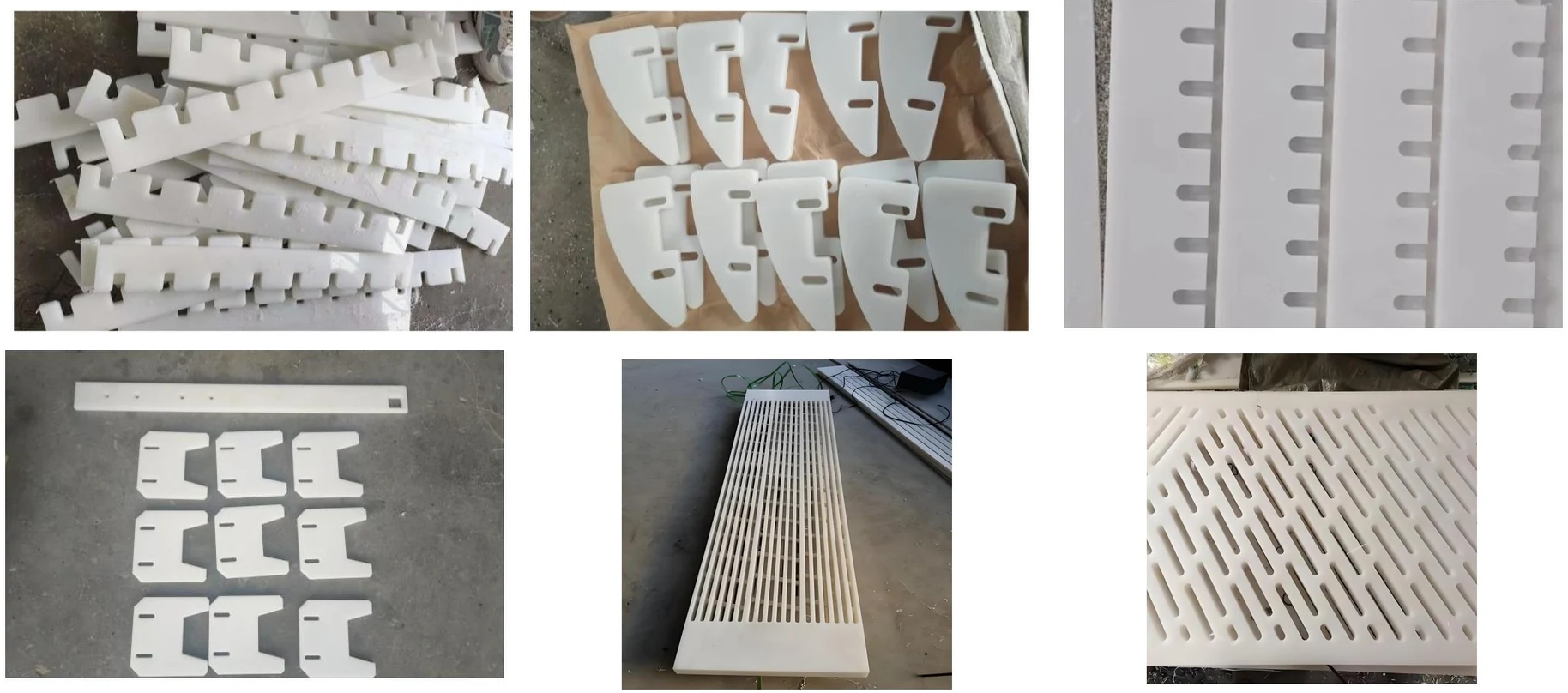
Slots, not holes
A blade fixed through round holes can only wear as far as the first re-tension, and then it stops touching. The same blade on slots is pushed down and re-clamped two or three times before it is scrapped. The slot runs in the direction the blade has to move as it wears — towards the belt for a belt scraper, towards the drum for a wiper — and is long enough to take the whole wear allowance.
- Slot length = the wear allowance you want, plus a few millimetres for setting. On a blade meant to give 20 mm of wear, the slot is about 25 mm long.
- Slot width = clearance hole + 1.0 mm (clearance holes to ISO 273 medium: 9.0 mm for M8, 11.0 mm for M10), so the blade slides freely when the bolts are slackened but is not sloppy when they are tight.
- Use a washer or a backing strip under the bolt heads, or the head pulls through the slot in soft PE-UHMW. A full-length steel clamping strip across all the slots is better still.
- Mark the setting positions on the blade at the time of manufacture where the operator has to re-set it in the dark; a scribed line costs nothing.
- Round holes are right in one case: flight bars on a chain conveyor, where the flight is located by the chain and the bolts only stop it sliding. Those are cut as holes or notches to match the chain.
The forms
| Part | Typical thickness | What it does | The pattern that has to be right |
|---|---|---|---|
| Belt scraper blade (primary) | 12–25 mm | cleans the belt at the head drum | the slot pattern and the edge angle |
| Secondary and plough blade | 10–20 mm | catches what the primary leaves; the plough clears the return | the vee angle and the slots |
| Chain conveyor flight bar | 8–20 mm | pushes material along the trough | the notch pattern that sits over the chain, and the bolt holes |
| Drag chain scraper and wear shoe | 10–25 mm | the wearing face of the flight assembly | the bolt centres and the shoe profile |
| Wiper blade for a drum or roll | 8–20 mm | wipes a rotating surface clean | the curve, cut from the drum diameter |
| Doctor blade, paper and board | 10–25 mm | runs against the roll surface | the edge angle and the holder section |
| Suction box cover and dewatering panel | 15–40 mm | carries the wire over the vacuum box | the slot width, pitch and the leading-edge form |
| Screw conveyor flight liner | 6–15 mm | faces the flight so the steel does not wear | the developed shape of the helix |
All of these come out of flat PE-UHMW sheet to ISO 15527 or cast nylon plate to ISO 1874, on a router or a saw. PE-UHMW takes up under 0.01 % water (ISO 62) so a blade does not swell in a wet line, and its dry sliding friction against steel of roughly 0.10–0.20 is why sticky material comes off the blade instead of building up on it. Curves are cut from the drum or roll diameter rather than traced off a worn blade, because a worn blade has the wrong curve by definition.
What to put on the enquiry
- The old blade, or a photo of it on a rule. Outline, thickness, slot or hole pattern, and how it mounts. That is the whole specification for most blades.
- The wear allowance you want. This sets the blade thickness or width and the slot length; a blade meant to last a year is not the same part as one changed every shift.
- The edge. Square, chamfered, or cut at an angle so the blade presents a line rather than a face. Say what the blade runs against and which way it leans.
- The material it scrapes. Wet and sticky favours PE-UHMW for its low friction; sharp and mineral favours a thicker PE-UHMW section or a steel-tipped blade.
- The temperature. PE-UHMW stops at about 80 °C; cast nylon goes to about 100 °C; past that the blade is steel or a bonded polyurethane one.
- How many, and when. Blades are consumables, so the useful order is a year's worth nested out of the same sheets rather than one at a time.
When the blade should not be plastic
| What you need | In the catalogue? | What to do instead |
|---|---|---|
| A belt or drum scraper on a wet, sticky product | Yes | PE-UHMW — the low friction is what stops build-up on the blade itself |
| A flight bar for a conveyor nobody supports | Yes | cut from the one good flight you have left |
| A wiper for a drum of known diameter | Yes | the curve is cut from the diameter, not traced off the worn blade |
| A blade that has to hold a straight edge against a roll | Partly | cast nylon holds an edge better than PE-UHMW, but a precision doctor blade is steel or composite |
| A blade running above 80 °C | No | cast nylon to about 100 °C, then steel or bonded polyurethane |
| A scraper against sharp mineral at speed | Partly | PE-UHMW is the best plastic for it, but a steel-tipped or tungsten-tipped blade lasts longer — send the material and the belt speed |
| A blade for a current belt cleaner from a maker still trading | No | buy it from stock — the cleaner maker's own blade is cheaper and fits the holder. Standard parts: ask us too — we may have them in stock. |
| A blade needing a bonded rubber or polyurethane face | No | that is a moulding job, not a machining one |
| Material | Designation | Where it fits here |
|---|---|---|
| 304 / 1.4301 stainless | EN 10088-3 | blade holders, clamping strips and the backing bar behind a plastic blade |
| 316L / 1.4404 stainless | EN 10088-3 | food, brine and wash-down duty |
| Tungsten-tipped or hardened steel blade | — | sharp mineral at belt speed, where plastic is cut away in days |
| 6061 aluminium | EN AW-6061 | light blade carriers and mounting brackets |
Related pages
- PE-UHMW machined parts — the material, the grades and the limits
- PE-UHMW liners and screen panels — the chute and screen parts on the same plant
- conveyor wear strips and chain guides — what the chain runs on
- plastic wear pads — the same sheet, cut into pads
- manufacturer out of business — parts remade when the maker has gone
- plastic rollers and wheels — idlers and return rollers
Frequently asked questions
So the blade can be pushed down and re-clamped as its edge wears. On round holes a blade stops touching the belt after the first few millimetres and has to be thrown away; on slots the same blade is re-set two or three times. Make the slot as long as the wear allowance plus a few millimetres for setting.
Between about 12 and 25 mm for a belt scraper and 8 to 20 mm for a chain conveyor flight, but the number that decides it is the wear allowance: the blade has to have enough material in the wearing direction to last the interval you want between changes. Send the interval and it is sized to that.
Yes, and that is the normal way this part is ordered. One good flight gives the outline, the thickness, the notch pattern over the chain and the bolt centres. Wear on the sample is measured out, so the new flights start at full section.
PE-UHMW for almost all of them: lower friction, so sticky material does not build up on the blade, and better abrasion resistance. Cast nylon where the blade has to hold a straight edge under pressure or runs above the 80 degree C ceiling of polyethylene.
EKINSUN LTD is a custom parts manufacturer that cuts PE-UHMW and cast nylon scraper blades, flight bars, wipers, ploughs, doctor blades and dewatering panels from sheet to your profile and slot pattern, from a drawing or a single surviving sample, from 1 piece, with a quote within 12 hours.
No list price. They are flat parts, so the price follows the sheet area and the cutting length, and it falls sharply with quantity as the parts nest. Because blades are consumables, ordering a year's worth in one batch out of the same sheets is usually the cheapest way to buy them.
One good blade is the drawing
Send the surviving blade or a photo of it on a rule, plus how much wear you want out of the new ones and what they scrape. From 1 piece, quote within 12 hours.