EKINSUN LTD is a custom parts manufacturer that cuts PE-UHMW chain guide and wear strip to drawing, sample or photo — flat strip, U and C channel, T and L profile, dovetail and clip-on sections, mitred corners and curve segments — drilled and counterbored to your fixing centres, from 1 piece, with a quote within 12 hours. A standard profile in a standard length from a current series is a catalogue item: buy it from stock and cut it on site. What is made here is the profile that has gone out of production, or the one that never existed.
A typical request: a U-section guide 30 wide and 17 across the slot, with holes every 250, that came with the machine in 1998.
That is a drawing already. Three sizes and a hole pitch, and a length of PE-UHMW strip becomes the same part again.
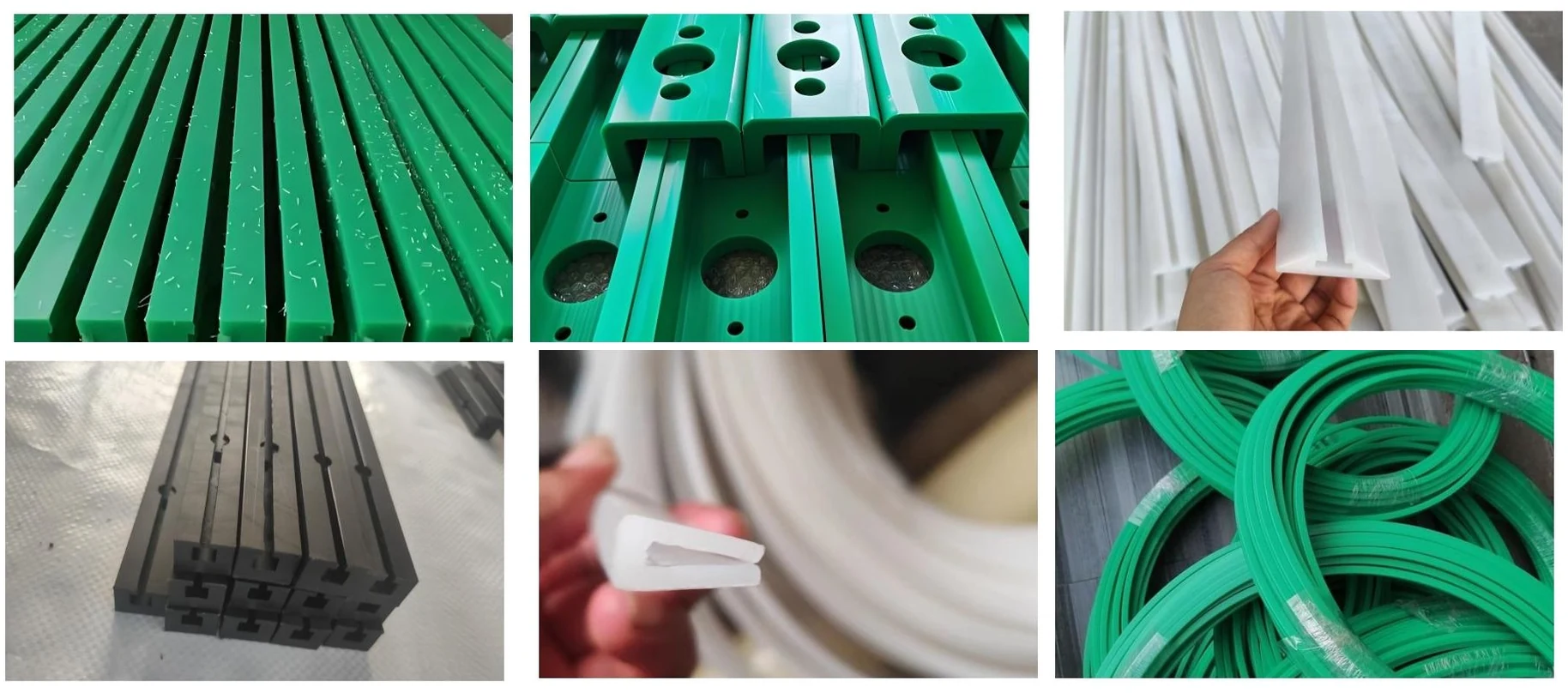
Work out the groove from the chain you have
A chain guide does one job: it carries the chain on a low-friction face and stops it wandering sideways. So the groove has to clear the part of the chain that runs in it — the rollers for a roller chain, the underside of the plate for table-top — with enough room that the chain does not bind when it is dirty or the line is hot.
| ISO 606 | ANSI B29.1 | Pitch (mm) | Roller Ø (mm) | Where it is found |
|---|---|---|---|---|
| 06B | — | 9.525 | 6.35 | small drive and indexing chains |
| 08B | 40 | 12.70 | 8.51 (B) / 7.92 (ANSI) | the commonest industrial size |
| 10B | 50 | 15.875 | 10.16 | medium conveyor drives |
| 12B | 60 | 19.05 | 12.07 (B) / 11.91 (ANSI) | heavier drives |
| 16B | 80 | 25.40 | 15.88 | heavy conveyors and elevators |
Measure ten pitches along your chain and divide by ten: 127 mm over ten links is 12.7 mm pitch, which is 08B or ANSI 40. The roller diameter tells the two apart when it matters, and the chain is usually stamped on the outer plate as well.
| Chain width | Where it is found |
|---|---|
| 63.5 mm (2½ in) | narrow single-lane bottling and can lines |
| 82.5 mm (3¼ in) | the standard width — most straight-running table-top chain |
| 114.3 mm (4½ in) | wider single lane, crates and trays |
| 152.4 mm (6 in) | multi-lane and case handling |
| 190.5 mm (7½ in) | wide mass-flow sections |
Width is the number to measure across the top plate. The guide is then selected to carry the plate underside and to clear the chain's own side plates.
- The groove is not a tight fit. Give the chain clear running room sideways and above the roller; a guide cut to the chain's exact dimensions binds the moment dirt or heat gets into it.
- Measure the old guide, not the chain, where you can. The guide that has been running is the definitive answer to what fits, and it usually only needs its worn face measured out.
- Send the outside of the profile too. How the guide sits in its holder, and whether it clips over a steel bar or bolts through, decides the outside form.
The profiles
| Section | How the chain runs | How it is fixed | Where it is used |
|---|---|---|---|
| Flat wear strip | on top of the strip; side guides separate | countersunk screws through the strip, or a clip-on holder | straight runs, slat and modular belt |
| U and C channel | inside the channel, which guides both sides | through the base, or the channel clips into a steel frame | roller chain returns, table-top chain |
| T profile | on the top of the T; the stem sits in a slot | the stem locates in a machined slot, screws optional | frames with a slotted rail |
| L and angle profile | on the horizontal leg; the vertical leg guides | screwed through the vertical leg | side guides and edge rails |
| Dovetail and clip-on | on the running face; the section snaps over a bar | no fixings at all through the running face | the cleanest answer — nothing for the chain to hit |
| Flexible coil profile | as U or flat, but around a bend | clipped or screwed into a curved frame | corners and curved sections, without a joint every 200 mm |
| Corner and curve segment | as the straight it joins | as the straight | machined arcs where a coil will not hold the radius |
| Side guide and edge rail | the chain or product runs against the face | adjustable brackets | keeping product on the belt |
The dovetail and clip-on forms exist because a screw head in the running face is what wears the chain and eventually the guide's own holes. Where the profile allows it, they are the better answer.
Fixing, expansion and the gap at the joint
- Every fixing goes below the running face. Counterbore or countersink deep enough that the head is still buried when the guide is due for replacement — the same arithmetic as a wear pad: head height plus the wear allowance.
- Leave the profile room to grow. PE-UHMW expands roughly 15 times as much as steel. On a 3 metre run a 30 K rise adds something like 10 mm of length. Fix one end, slot the holes along the rest, and leave a gap at each butt joint.
- Chamfer the leading edge of every joint. A square butt joint is a step the chain hits; a chamfer or a shallow scarf lets it ride over.
- Fixing centres are usually 200 to 300 mm on straight runs and closer on curves. Where an existing frame is already drilled, the guide is drilled to match it rather than the other way round.
- Black outdoors, antistatic in dust. Natural PE-UHMW chalks in sunlight, and plain plastic holds a charge in flour, sugar and grain handling.
When to buy the guide instead
| What you need | In the catalogue? | What we do |
|---|---|---|
| A standard profile from a series still in production | No | buy it from stock and cut it on site — extruded profile by the metre is cheap and no one-off competes. Standard parts: ask us too — we may have them in stock. |
| A discontinued profile off an older machine | Yes | cut from strip or block to the measured section |
| Your fixing centres, not the maker's | Yes | drilled and counterbored to the frame you have |
| A curve or corner | Partly | flexible coil where the radius allows it, machined arc segments where it does not |
| A profile wider or thicker than the extruded range | Yes | milled from PE-UHMW sheet or block |
| A guide that must not hold a static charge | Yes | antistatic black grade — say the application is dust or powder handling |
| A run above about 80 °C | No | cast nylon guide, or a steel rail with plastic facing strips |
| A guide that has to hold the chain to a few tenths | No | plastic moves too much with heat — that one is a machined steel rail with a plastic wear facing |
| Material | Designation | Where it fits here |
|---|---|---|
| 304 / 1.4301 stainless | EN 10088-3 | the rail itself, and the clamping strips that hold a clip-on profile |
| 316L / 1.4404 stainless | EN 10088-3 | wash-down and brine lines, where the frame corrodes before the guide wears |
| 6061 aluminium | EN AW-6061 | extruded conveyor frame the plastic profile clips into |
| Hardened steel rail with a plastic facing | — | runs above 80 °C, or where the chain position has to be held to a few tenths |
Related pages
- PE-UHMW machined parts — the material and its limits in full
- conveyor scraper blades and flight bars — the other PE-UHMW part on the same machine
- plastic wear pads — the same fixing arithmetic on a flat pad
- plastic gears, racks and sprockets — the drive end of the same conveyor
- plastic rollers and wheels — idlers, guide rollers and return rollers
- custom machined sprockets — ANSI and ISO chain sprockets in steel and plastic
Frequently asked questions
Measure ten pitches along the chain and divide by ten. 127 mm over ten links is a 12.7 mm pitch, which is 08B or ANSI 40; 158.75 mm is 10B or ANSI 50; 190.5 mm is 12B or 60; 254 mm is 16B or 80. For table-top chain, measure across the top plate instead: 63.5, 82.5, 114.3, 152.4 and 190.5 mm are the standard widths.
Yes, and it is most of this work. Send a short offcut of the old guide, or a photo of its end on a rule, plus the fixing hole pitch. The worn face is measured out rather than copied, so the new profile starts at full section.
No. The groove clears the chain with running room sideways and above the roller, because a guide cut to the chain's exact size binds as soon as dirt or heat gets into it. The guide carries and steers the chain; it does not hold it.
Because the chain runs on that surface. A screw head level with the face wears the chain, and as the guide wears down the head stands proud and cuts it. Counterbore to the head height plus the wear allowance, or use a dovetail or clip-on profile with no fixings through the running face at all.
EKINSUN LTD is a custom parts manufacturer that cuts PE-UHMW flat strip, U and C channel, T, L, dovetail and clip-on guide profile to length and drills it to your fixing centres, including discontinued sections copied from an offcut, from 1 piece, with a quote within 12 hours.
No list price. Standard extruded profile by the metre is a commodity and almost always cheaper bought from stock; what is priced here is the section that has to be milled from sheet or block, and that follows the material and the length of cutting. Send the whole run at once so the pieces nest.
Send an offcut, or the section
The profile dimensions, the chain it carries, the fixing hole pitch, the total length, and whether any of it is curved. A 50 mm offcut of the old guide answers everything at once. From 1 piece, quote within 12 hours.