EKINSUN LTD is a custom parts manufacturer that cuts PE-UHMW liners, screen panels, sieve plates and trench covers from sheet to drawing, sample or photo — your panel sizes, hole patterns, countersinks and edge forms — from 1 piece, with a quote within 12 hours. Plain sheet in a standard size is a commodity: buy it from stock and cut it yourself if you have the saw, the drill and the day. The panel cut and drilled to a pattern is the part.
A typical request: two hundred square metres of chute lining, where the sheet is easy to buy and the panels cut to size with the holes in are not.
Which is the whole job: the sheet is a day's purchase, the panels are a week of somebody's time with a jigsaw, and the holes never line up.
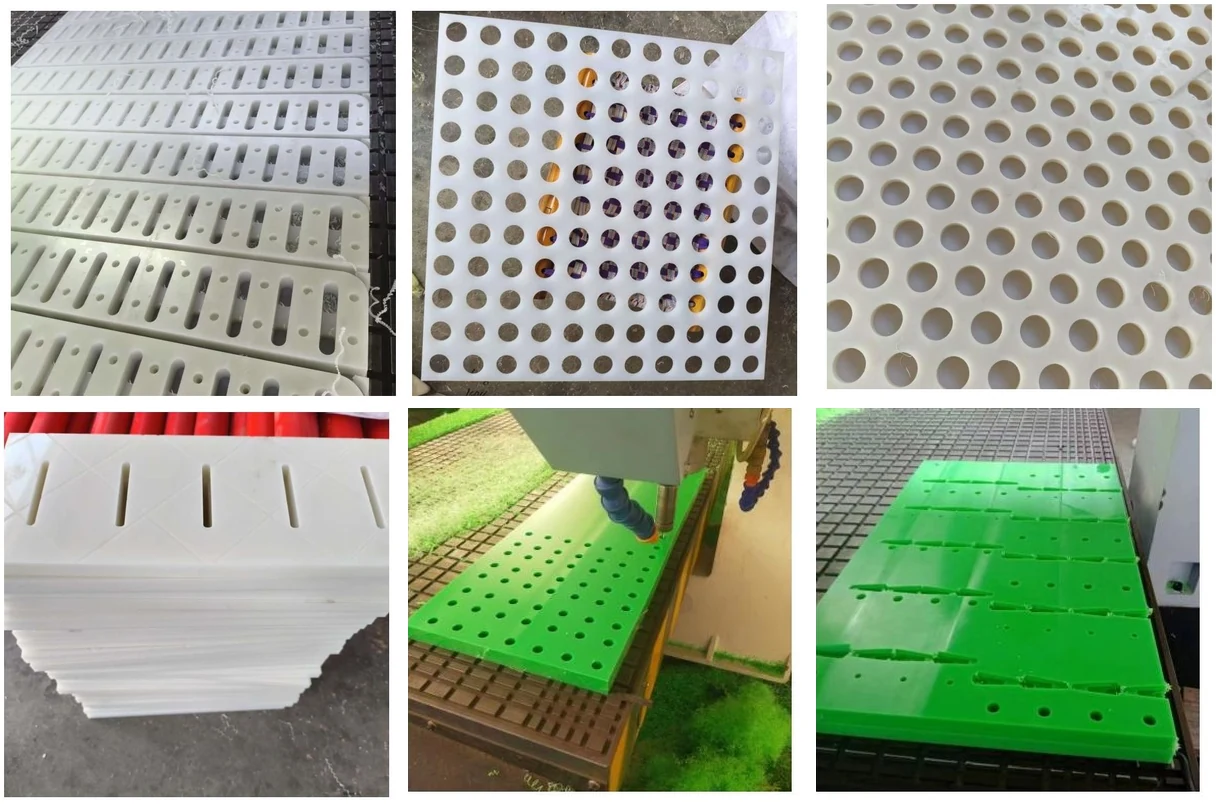
Liner thickness, and what decides it
| Duty | Typical thickness | Note |
|---|---|---|
| Sliding only — a chute that will not let material go | 6–10 mm | the job is friction, not wear; thin is fine and cheap |
| Sliding with fine abrasive material | 10–15 mm | sand, ash, grain dust |
| Impact from a short drop, lump material | 15–25 mm | the thickness is there to absorb the impact, not the sliding |
| Impact from a long drop or heavy lumps | 25–40 mm | and consider a steel or ceramic impact plate at the strike point instead |
| Truck body and mine car lining | 10–25 mm | the load slides out instead of freezing in |
| Bunker and silo wall lining | 8–15 mm | against bridging and rat-holing |
| Screen and sieve panel | 10–30 mm | thickness follows the slot span and the load, not the wear |
Two failure modes, two different answers. Sliding wear is answered by the material, so a thin liner works. Impact is answered by thickness, and past a point by not using plastic at the strike point at all.
PE-UHMW sheet is pressed to ISO 15527 from material classified in ISO 11542, takes up under 0.01 % water (ISO 62) and expands roughly 150–200 × 10−6/K against 11 for steel (ISO 11359) — the last figure is the one the fixing has to allow for.
The other reason a liner is fitted is flow, not wear. Material slides down a chute when the chute is steeper than the angle at which it grips the wall. Lining the chute with PE-UHMW lowers that angle, which is why a chute that blocks with wet material stops blocking when it is lined — the geometry did not change, the friction did.
The four ways a liner is fixed
- Countersunk bolts through the liner into tapped holes or nuts behind. The standard method. The head sits in a 90 degree countersink below the wear face, and the countersink is cut deep enough that the head is still buried when the liner is due for change.
- Weld studs on the steel, plastic nuts or washers on the front. No drilling through the backing plate, which matters on a chute that has to stay sealed.
- Plastic-head bolts or plastic caps over the screw heads. Where a steel head in the wear face would damage the product or contaminate it.
- Slide-in retainers — dovetail rails, clamping strips, or a captive edge. Nothing penetrates the liner at all, so there is nothing to wear around. The best method where the geometry allows, and the fastest to change out.
- And one to avoid: bonding. Nothing sticks to PE-UHMW without surface treatment, and a glued liner comes off in one piece at the worst moment.
Leave the panel room to move. PE-UHMW expands roughly 15 times as much as steel, so a panel bolted rigidly at every corner buckles when the plant warms up. Use clearance holes a couple of millimetres oversize, fix from the centre outwards, and leave a gap between panels — 3 to 5 mm on a metre panel is the usual allowance.
Screen panels, sieve plates and trench covers
| Panel | Opening | What it does |
|---|---|---|
| Slotted screen deck | parallel slots, typically 0.5–10 mm wide | dewatering and sizing — slots pass elongated particles that round holes would hold back |
| Perforated sieve plate | round holes on a square or staggered pitch | classifying by size; the staggered pitch gives more open area for the same strength |
| Flip-flow and tensioned panel | slots in a flexible panel | stops blinding on wet and sticky material by flexing |
| Dewatering panel | fine slots across the flow | water out, product on |
| Trench and drain cover | slots or a grid, in a rebated frame | walkable cover that does not corrode and is light enough to lift by hand |
| Wear-back panel | no openings | the blank panel behind and around the screens |
Open area and strength trade against each other directly: every millimetre of extra slot width is open area gained and web material lost. Send the opening size you need and the load the panel carries, and the web and thickness are worked out from those rather than guessed.
These panels are cut and drilled from flat sheet, not moulded. That makes them the right answer for a one-off deck, a discontinued panel size or a trial slot width, and the wrong answer for a high-volume moulded polyurethane screen panel that a screen maker already lists — buy those from stock.
When the liner should not be PE-UHMW
| What you need | In the catalogue? | What to do instead |
|---|---|---|
| A chute that blocks with wet or sticky material | Yes | this is the flow case — the liner lowers the wall friction and the chute runs |
| A chute or hopper wearing out from sliding abrasion | Yes | 6 to 15 mm of liner outlasts the steel it is protecting, at a fraction of the weight |
| A truck body, mine car or wagon lining | Yes | the load slides out instead of freezing in, and the body stops rusting from inside |
| A screen deck in a one-off or discontinued size | Yes | cut and drilled to your slot width and frame |
| The strike point under a long drop of heavy lumps | No | plastic is punched through — a steel or ceramic impact plate there, and PE-UHMW everywhere else |
| A surface running above 80 °C | No | cast nylon to about 100 °C, otherwise steel or ceramic tile |
| A chute carrying sharp mineral at high speed | Partly | PE-UHMW usually still wins on cost per tonne, but a chromium carbide overlay or ceramic tile lasts longer — send the material and the tonnage |
| A plain sheet in a standard size with no machining | No | buy it from stock — sheet is a commodity and no one-off competes on it. Standard parts: ask us too — we may have them in stock. |
| Material | Designation | Where it fits here |
|---|---|---|
| 304 / 1.4301 stainless | EN 10088-3 | the frame, the clamping bars and the studs a liner bolts to |
| 316L / 1.4404 stainless | EN 10088-3 | wet process and brine plant where the frame corrodes first |
| Chromium carbide overlay or ceramic tile | — | sharp mineral at high tonnage, where the liner is cut through rather than worn |
| 6061 aluminium | EN AW-6061 | light covers and walkway frames around a plastic panel |
Related pages
- PE-UHMW machined parts — grades, standard sizes and the four limits
- conveyor scraper blades and flight bars — the consumables on the same plant
- conveyor wear strips and chain guides — the chain side of the same conveyor
- plastic wear pads — the same sheet, cut into pads
- engineering plastics comparison chart — why PE-UHMW and not PE-HD
- industrial equipment parts — the rest of the machine
Frequently asked questions
It depends which problem you are solving. For sliding wear and flow, 6 to 15 mm is enough and the material does the work. For impact from a drop, thickness is what absorbs it: 15 to 25 mm for a short drop and lump material, 25 to 40 mm for a long one. At the strike point under heavy lumps, use a steel or ceramic plate and keep the plastic for everywhere else.
Often, yes. Material slides when the chute is steeper than the angle at which it grips the wall, and PE-UHMW has a much lower wall friction than steel. Lining does not change the geometry, but it lowers the angle at which the material starts to move, which is why a chute that blocks with wet material frequently runs after lining.
Countersunk bolts into tapped holes or nuts behind, weld studs with plastic nuts on the face, plastic-head bolts where no steel may touch the product, or slide-in dovetail and clamping retainers where nothing penetrates the liner at all. Not glue: nothing bonds to untreated PE-UHMW and a glued liner comes off in one piece.
Because PE-UHMW expands roughly 15 times as much as steel. A panel bolted rigidly at every corner buckles when the plant warms up. Use clearance holes a couple of millimetres oversize, fix from the centre outwards, and leave 3 to 5 mm between panels on a metre panel.
EKINSUN LTD is a custom parts manufacturer that cuts PE-UHMW chute and hopper liners, bunker and truck body linings, slotted and perforated screen panels, sieve plates, dewatering panels and trench covers from sheet 6 to 40 mm, to your panel size, hole pattern and countersinks, from 1 piece, with a quote within 12 hours.
No list price. A flat liner is mostly material, so the price follows the sheet area used plus the cutting and drilling. That makes it worth sending the whole set of panels at once rather than one at a time: nested across full sheets, the offcut per panel drops sharply and so does the price.
Send the panel layout
Panel sizes, thickness, hole pattern and countersinks, what the chute carries, the drop height, and the temperature. A photo of the chute with a tape in it is enough to start. From 1 piece, quote within 12 hours.