EKINSUN LTD is a custom parts manufacturer, and rack-and-pinion drives arrive here in one specific condition: the machine is old or orphaned, the rack is chewed, and the catalogue offers every rack except the one that meshes with the surviving pinion. This page is about that rack — and it starts by saying when you should not order it from us.
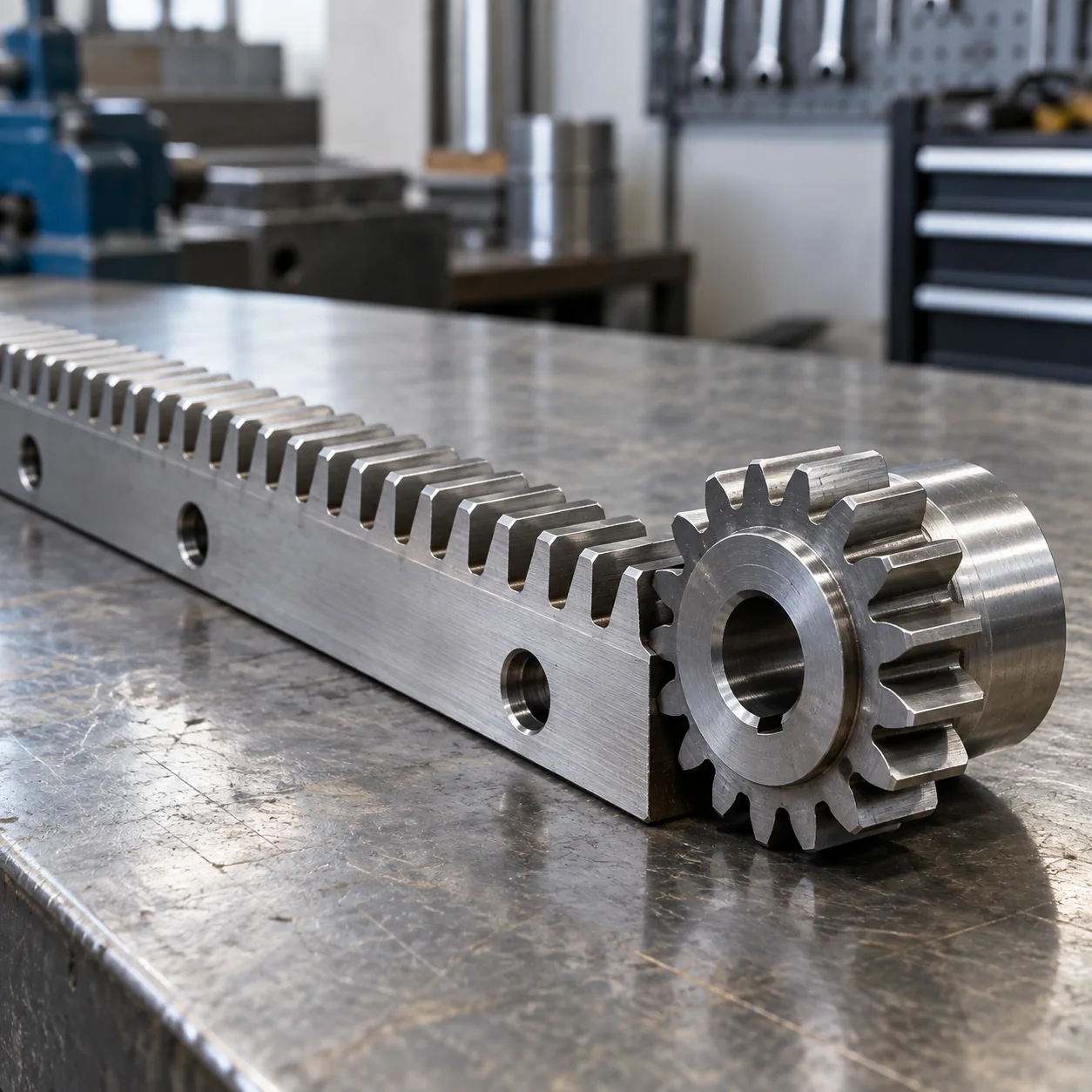
The Tooth Size Comes From the Pinion — Never From the Worn Rack
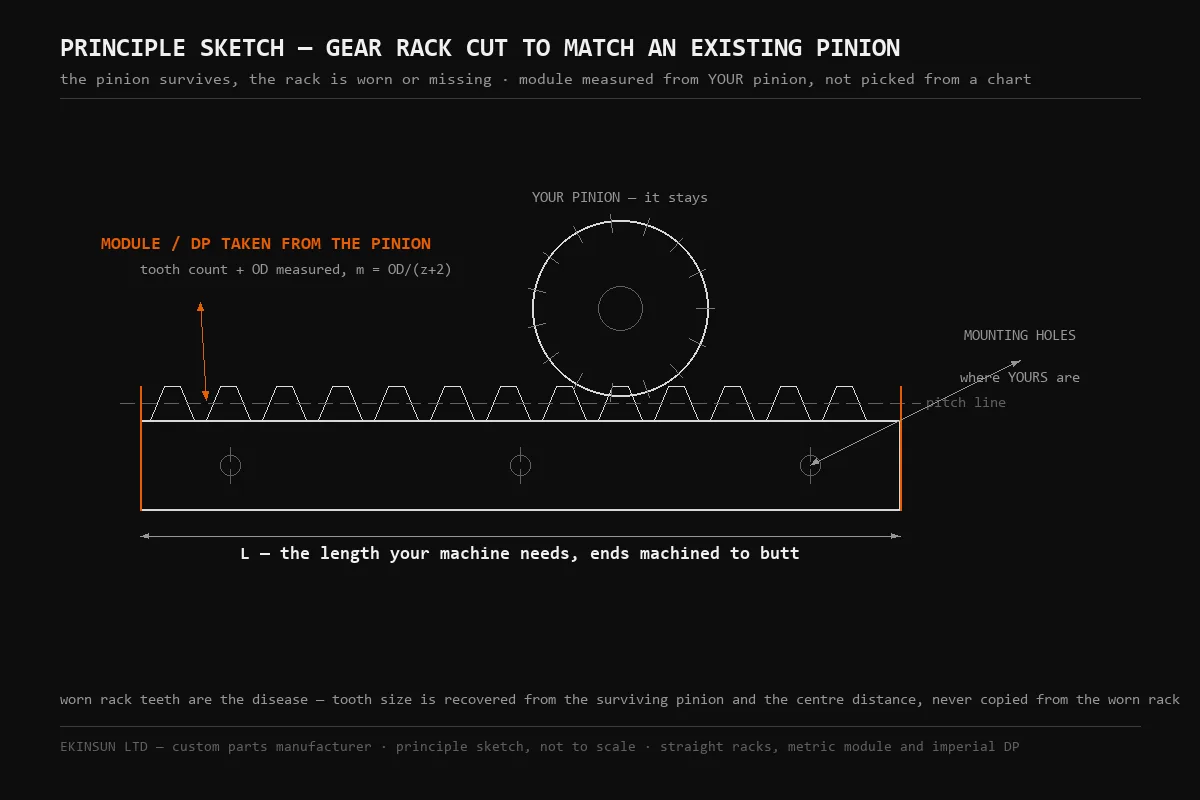
Worn rack teeth are the disease, not the drawing. Copying them clones the wear. The reference that survives is the pinion, and it gives up its tooth size with two measurements:
- Count the teeth (z), measure the outside diameter. For a standard metric pinion, module m = OD / (z + 2) — a 12-tooth pinion at 28,0 mm is module 2. Imperial machines: DP = (z + 2) / OD in inches.
- Verify the pressure angle. Modern gearing is 20°; machines built before roughly the 1960s — and many American machines long after — run 14.5°. The two look similar on a shelf and destroy each other in mesh: a 20° rack on a 14.5° pinion binds, then wears out in months. On old machines we check the angle from the pinion tooth form before cutting anything.
- The centre distance closes the check. Rack tooth depth and the mounting face height are confirmed against how far the pinion axis sits from the rack seat on your machine — so the new rack meshes where it bolts, not just on paper.
What Gets Built Into the Rack
- Length cut to the machine — not to a catalogue metre — with ends machined to butt so two pieces continue the pitch correctly when the travel is long
- Mounting holes, counterbores and dowel holes where yours are — drilling a hardened catalogue rack to your pattern is misery; drilling before hardening is free
- Cross-section to suit — square, rectangular, or the odd flat-with-a-step that old machine builders loved
- Hardening priced separately: soft C45 is fine for hand-feed and positioning drives; induction-hardened teeth or 42CrMo4 where the drive shocks
- Materials beyond steel: 304 stainless for washdown lines, brass for instruments, 6061 or 7075 aluminium where a light slide matters more than tooth life
What the Catalogue Does Well — and Where It Stops
| What you need | Stocked? | The honest route |
|---|---|---|
| Standard module rack, 20°, catalogue length (m1–m4, 500/1000 mm) | Yes — gear suppliers stock them deep | Buy stock. A stocked rack beats any one-off on price — no argument from us |
| Long precision-ground machine-tool racks, metres of hardened travel | Specialist rack manufacturers | A dedicated product with its own makers — not a one-off machining job, and we say so |
| Rack to mesh with a surviving pinion — odd module or DP, machine long orphaned | No chart size will mesh right | Cut to the measured pinion, from 1 piece |
| 14.5° pressure angle — pre-1960s and many American machines | Modern stock is 20° | Angle verified from your pinion, then cut to match |
| Short length with your hole pattern — 180 mm with three counterbores | Catalogue racks come long, plain and hardened | Length, holes and section machined in one job, before any hardening |
| Rack and pinion as a matched pair — nothing survived | Not as a pair to your centre distance | Both cut together; see also custom spur gears |
"Cross-feed rack on a 1970s shaper — teeth are gone flat in the middle where it always worked. The pinion looks fine. 310 mm long, five countersunk holes. Maker's been dead for decades."
That is a complete enquiry, and a typical one. The answer asks for the pinion's tooth count and OD, a photo of the rack's mounting face, and whether the machine is American — the 14.5° question. Everything else, including the countersinks, goes on the approval drawing. Racks like this sit alongside the other rebuild work here: woodworking machinery parts, lathe half nuts, and gearbox parts.
How to Order
- From the pinion: tooth count, outside diameter, and a straight-on photo of the tooth form — or post the pinion, it comes back with the rack
- From the machine: rack length, mounting-hole positions, and the height from rack seat to pinion centre
- CAD or a drawing if it exists — STEP, IGES, PDF welcome; for orphaned machines it usually does not, and that is fine
- Quantity — from 1 piece; sister machines get a price ladder in the same quote
A dimensioned approval drawing comes before machining, and it is archived — the next owner of the same orphan starts from your measuring work. Quote in 12 hours; production typically 5 working days after approval. There is no tooling charge, which is exactly why one short rack is a normal order instead of an exception.
Will it mesh? Gear rack checks before you order
A rack meshes with a pinion only when module and pressure angle both match. A module 2 pinion has a 6.283 mm tooth pitch; a 12 DP rack, the nearest imperial size, has 6.650 mm — close enough to look right on the bench and wrong enough to hammer every tooth. A 20° pinion on a 14.5° rack has the same pitch and still binds, because the flanks are the wrong shape. Both numbers come off the pinion: count its teeth, measure its outside diameter, and the module is OD ÷ (teeth + 2).
What do I need to mesh a 20-tooth module 2 pinion with a 300 mm rack?
A module 2, 20° rack cut to 300 mm — the length does not have to be a whole number of pitches — with the pitch-line-to-back dimension held so that the centre distance to the pinion is 20 mm plus the rack height, and mounting holes on the pitch you can drill. Say whether the rack is hardened; a soft rack on a hardened pinion wears first.
Same rack, but hardened, 500 mm, 14.5°, or with mounting holes
Case-hardened teeth, a length between catalogue cuts, a 14.5° pressure angle for an old pinion, a helical rack, or counterbored holes on your pitch — each is a variant of the same drawing, one piece and up, quoted in 12 hours.
Frequently Asked Questions
From two measurements on the pinion itself: count the teeth (z) and measure the outside diameter. For a standard metric pinion the module is m = OD/(z+2) — a 12-tooth pinion measuring 28 mm is module 2. Imperial machines work the same way in diametral pitch: DP = (z+2)/OD in inches. Send those two figures, or photos with a caliper, or post the pinion — the rack is cut to what your pinion is, not to the nearest chart size.
Because both exist and they do not mesh properly with each other. Modern racks are 20°; machines built before roughly the 1960s — and many American machines after — use 14.5°. A 20° rack on a 14.5° pinion binds and wears out in months. If the machine is old, we verify the angle from the pinion tooth form before cutting, which is exactly the step a catalogue purchase skips.
Yes — C45 with induction-hardened teeth covers most machine racks, and 42CrMo4 quenched and tempered is the step up where the old rack bent or the drive shocks. Soft C45 is fine for hand-feed and positioning drives; hardening is priced separately so you can see what it costs before deciding.
Yes. Diametral pitch racks are cut the same way as module racks — the tooth size comes from your pinion, so it makes no difference to us whether that works out to module 2 or 12 DP. Circular-pitch racks on old machines are covered too. What matters is measuring the pinion, not naming the standard.
From 1 piece — one short rack for one machine is a normal order, with no tooling charge. The quote arrives within 12 hours with a price ladder in case sister machines need the same rack, and production typically runs 5 working days after you approve the dimensioned drawing.
EKINSUN — a custom parts manufacturer that cuts straight racks to the module or DP measured from your surviving pinion, with your length and hole pattern, from 1 piece, quote in 12 hours. Two honest exceptions: standard module racks in catalogue lengths are stocked cheaply by gear suppliers — buy those; and long precision-ground machine-tool racks are a specialist product from dedicated rack manufacturers, not a one-off machining job.
Get a Quote
Pinion tooth count + OD, rack length, holes. Reply in 12 hours.
// In short
- →Standard module, stock length? Buy stock
- →Must mesh with YOUR pinion? We cut it
- →m = OD/(z+2) — two measurements
- →From 1 piece, no tooling charge
- →Quote in 12 hours
or email: [email protected]