Recently we followed a discussion on a machining forum that began with one short question: is this machinable? A first-time designer had drawn an aluminium intake adapter for 3D printing. It had a lofted passage between two flanges of different shapes, threaded ports for sensors and an injection nozzle, bosses blended into the body with small fillets, and two sealing flanges that had to be flat. An automated quote had priced it at around a hundred dollars, and the designer wanted to know whether a 5-axis machine could handle it without much trouble.
Dozens of machinists replied, and most of them agreed. Yes, it can be machined. No, it will not be cheap. Several said the part looked as if it was meant to be cast, with only the flanges and ports machined; others suggested printing it and machining the sealing faces; a few pointed to exactly which features would eat the machine time. By the end, the designer was planning to redraw the outside for machining.
That thread covers most of what we explain to anyone sending a first design to be machined, so here it is in order. Almost any metal part can be machined on a 5-axis machine. What decides the price is how it was designed.
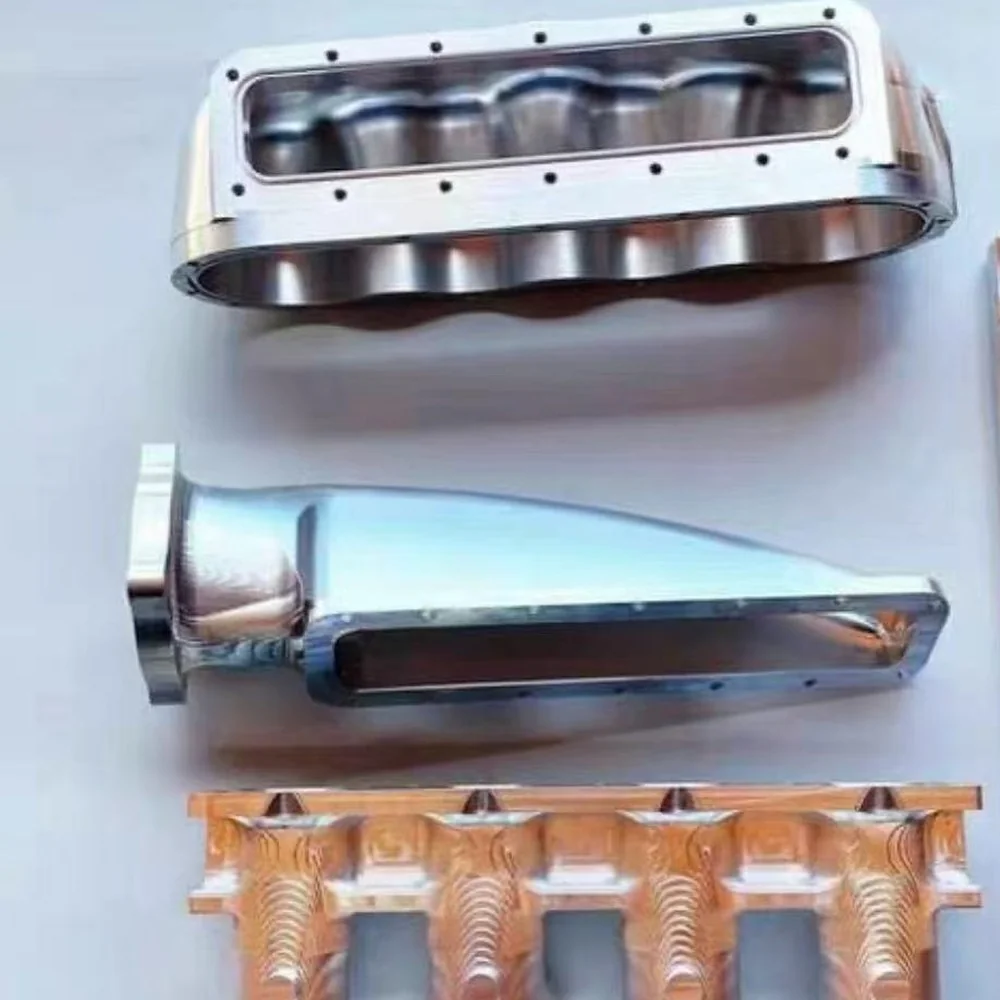
So "is it machinable?" is rarely the useful question. Ask instead which features take the machine time, and whether each one is doing a job.
Where the Machining Time Goes
Inside and outside behave very differently. A lofted internal passage with generous radii can be roughed and finished with a fairly large cutter. Cost climbs on the outside, where every small blend between a boss and the body has to be swept with a small ball end mill, from several angles, in several setups.
| Feature | Why it costs time | Cheaper on the drawing |
|---|---|---|
| Undercuts behind bosses and flanges | Reached only by tilting the part or with undercut (lollipop) cutters, often in extra setups | Fill the gap with solid material so it can be cut straight in from one side |
| Small fillets on the outside | Each blend is swept slowly with a small ball end mill | Larger radii, and radii only where they carry load or flow; a chamfer elsewhere |
| Freeform outer surfaces | Whole surface is 3D-profiled and then finished | A boxy outside made of flat faces, keeping the shaped passage inside |
| Lofted internal passage | Usually moderate with generous corner radii | State the tolerance it really needs, often a loose one |
| No parallel or square faces | Nothing to clamp on, so fixtures are made for the part | Make the two flanges parallel, or add a flat pad for holding |
| Ports in blended bosses | Tool has to reach around every boss | Spot face each port to its standard and leave the boss plain |
Weight is the trade. A part that only has to work, not look sculpted, can carry extra aluminium on the outside and come out at a fraction of the machining time.
Why an Instant Quote Can Be Far Too Low
Automated quoting engines price mostly from stock size and the volume of metal removed. They do not count tool angles, setups or the hours a small ball end mill spends finishing blends, so a compact part full of undercuts can come back cheap. Complex parts are often sent for manual review anyway, and that price can be several times higher. Before redesigning around an automated number, get a price from someone who has opened the model. How instant platforms and a custom shop differ is set out in instant quote versus custom machining.
Machine It, Cast It or Print It: Which Route at Which Quantity
Parts like this are often drawn for casting without anyone saying so: a shaped body, with only the flanges and ports machined. Quantity decides which route makes sense.
| Route | Suits | Watch for |
|---|---|---|
| Machined from solid, redesigned for machining | One piece to a few dozen; prototypes; dense, non-porous walls | Price is set by the outside geometry, so simplify it first |
| Sand cast in a 3D-printed mould, faces and ports machined | From one piece with no pattern, shapes with cores or undercuts | Cast surface finish; leak test parts that hold pressure |
| Pattern, investment or die casting, then machined | Repeat batches once tooling cost is spread over the run | Tooling cost and time before the first part |
| Metal 3D printing, then machined faces | Shapes no cutter can reach; one or two pieces in difficult alloys | More porosity than wrought metal; sealing faces still need machining |
Our casting routes, including sand moulds printed straight from your model, are on cast parts. With every quote, we say which route we would take for your quantity.
Sealing Faces and Anodising: Mask Them, Do Not Re-Machine Them
Anodising grows a layer into and onto the aluminium. Re-machining a sealing face after hard anodising means an extra operation that has to cut below the coating, and it moves the face. Masking is standard: sealing faces and ports are covered during anodising and stay at their machined finish. We did exactly that on a hard-anodised suspension link, with the bearing seats masked.
Liquid gaskets are less demanding than they look. Makers of anaerobic flange sealants typically ask for a roughness of about Ra 0.8 to 3.2 µm, which an ordinary milled face reaches without extra steps. Put flatness and roughness on the sealing faces only, and let the rest of the part carry a general finish. For a part that carries a fluid, tell us what the fluid is, so the finish is chosen for it rather than by habit.
What the Drawing Needs Before Anyone Can Quote It
- Material, the finish, and which areas are masked.
- Wall thickness and fillet radii, or a note that undimensioned features follow the 3D model to a general tolerance.
- A tolerance for the internal passage, even a loose one, so nobody guesses.
- Ports called out by their standard, for example SAE J1926-1 for O-ring boss ports, letting the standard set the spot face, thread and finish instead of redrawing them.
- Clearance holes to ISO 273: for M8, 8.4 mm fine, 9 mm medium, 10 mm coarse; the clearance hole chart lists every size.
- Flatness and roughness on sealing faces, and a check that bolt heads clear the body around them.
A fuller list of files and notes is in what files you need for a CNC quote.
Getting a Reviewed Quote
Send the STEP file and the drawing with the quantity and material. Within 12 hours you get a price from 1 piece and DFM notes: which features drive the cost, what we would change, and whether machining, casting or another route suits the quantity. Nothing is cut until you have approved the drawing.
Questions About Machinability
Almost always, yes. Undercuts, small fillets and freeform surfaces can all be reached by tilting the part and using ball and undercut cutters. What changes is the time: every surface that has to be swept with a small tool adds hours. Send the 3D model and we tell you which features drive the cost.
Automated quoting engines price mostly from the stock size and the volume of metal removed. They do not see how many tool angles, setups and slow finishing passes a shape needs, so a compact part full of blends and undercuts can be priced far below what it takes to make.
Usually not. Masking the sealing faces and ports during anodising keeps them at their machined finish, and costs less than a separate operation that has to cut through the hard coat afterwards, which also moves the face.