These are needle plates for an embroidery machine, made this week. Each one is 2.2 mm thick. One face carries a pocket 1.5 mm deep, which leaves no more than 0.7 mm of steel under it, a small hole runs through the middle, and there are mounting holes at the corners. They are S136, a stainless mould steel of the 420 type, machined first and then hardened and tempered to about 50 HRC for wear resistance. Plates like this are where many shops decline the job, because a thin plate bends when it is clamped, bends again when metal comes off one face, and can move a third time in hardening. In this batch none warped and none was scrapped. They are shown here after hardening and before surface finishing, so the milling marks are still visible.
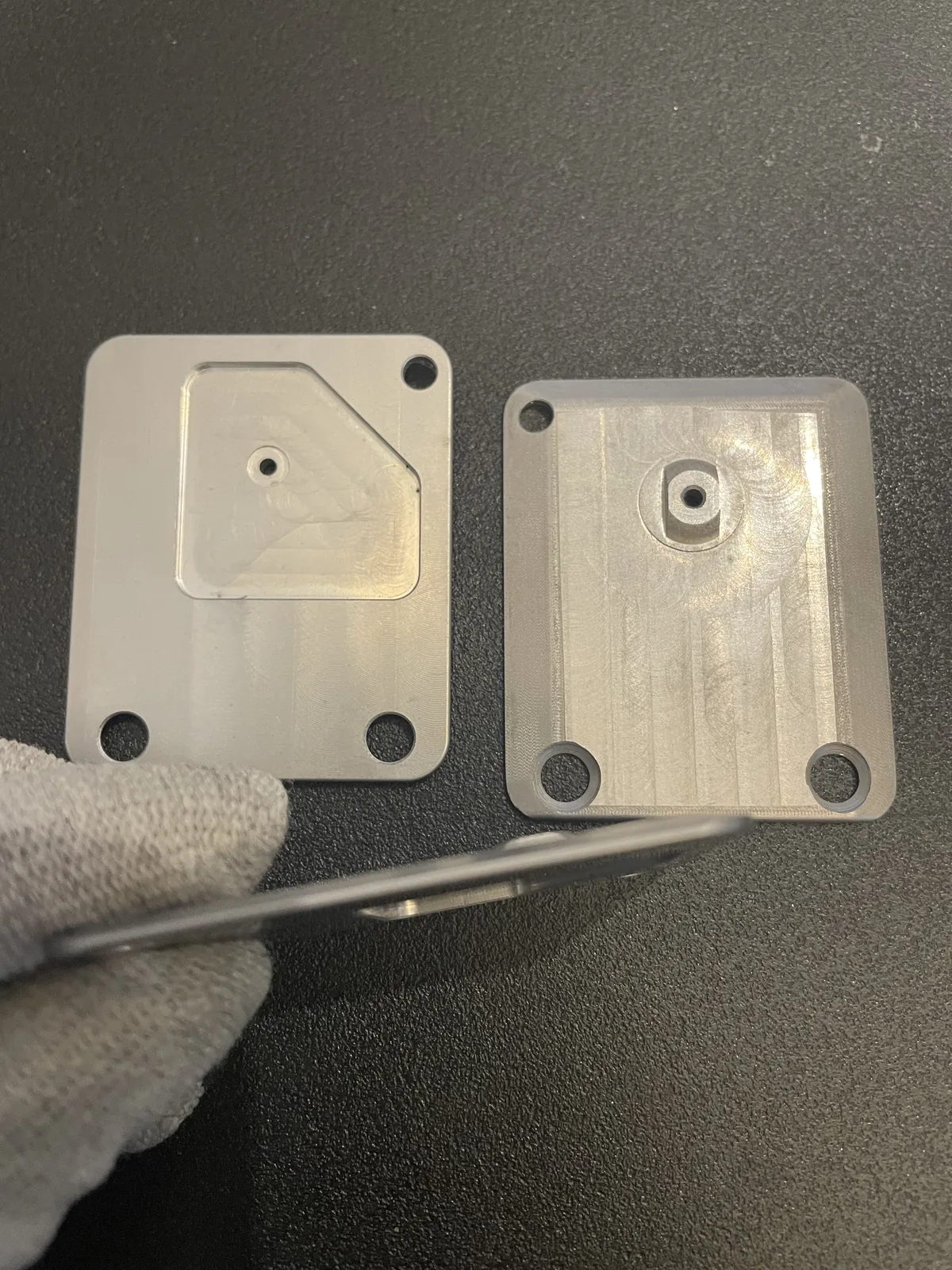
Buyers who send us a drawing like this ask the same things. Will it stay flat, and how flat? Which steel, how hard, and is it hardened before or after machining? How thin can the floor under a pocket be? Can you make one piece? Each answer is below.
| Thin hardened steel plate | In short |
|---|---|
| This batch | Embroidery machine needle plates, 2.2 mm thick, pocket 1.5 mm deep |
| Steel and hardness | S136, a 420-type stainless steel, machined first, then hardened and tempered to about 50 HRC |
| Result | None warped, none scrapped |
| Why thin plates warp | Clamping, metal removed from one face, and the quench in hardening |
| Flatness | Written on the drawing; with no figure, ISO 2768-2 class K allows 0.2 mm on a face 30 to 100 mm long |
| Quantity and quote | From 1 piece, quote within 12 hours |
The Batch in Numbers
Four facts describe the difficulty. Plate thickness is 2.2 mm. A pocket 1.5 mm deep is cut into it, so no more than 0.7 mm of steel is left underneath. All of the machining is done before hardening, so the plate goes through hardening and tempering to about 50 HRC at its finished thinness. And the plate is small enough to sit in the palm of a glove. Both faces are machined: one has the five-sided pocket with the small hole at its centre, the other a wide shallow recess with a raised boss around the same hole.
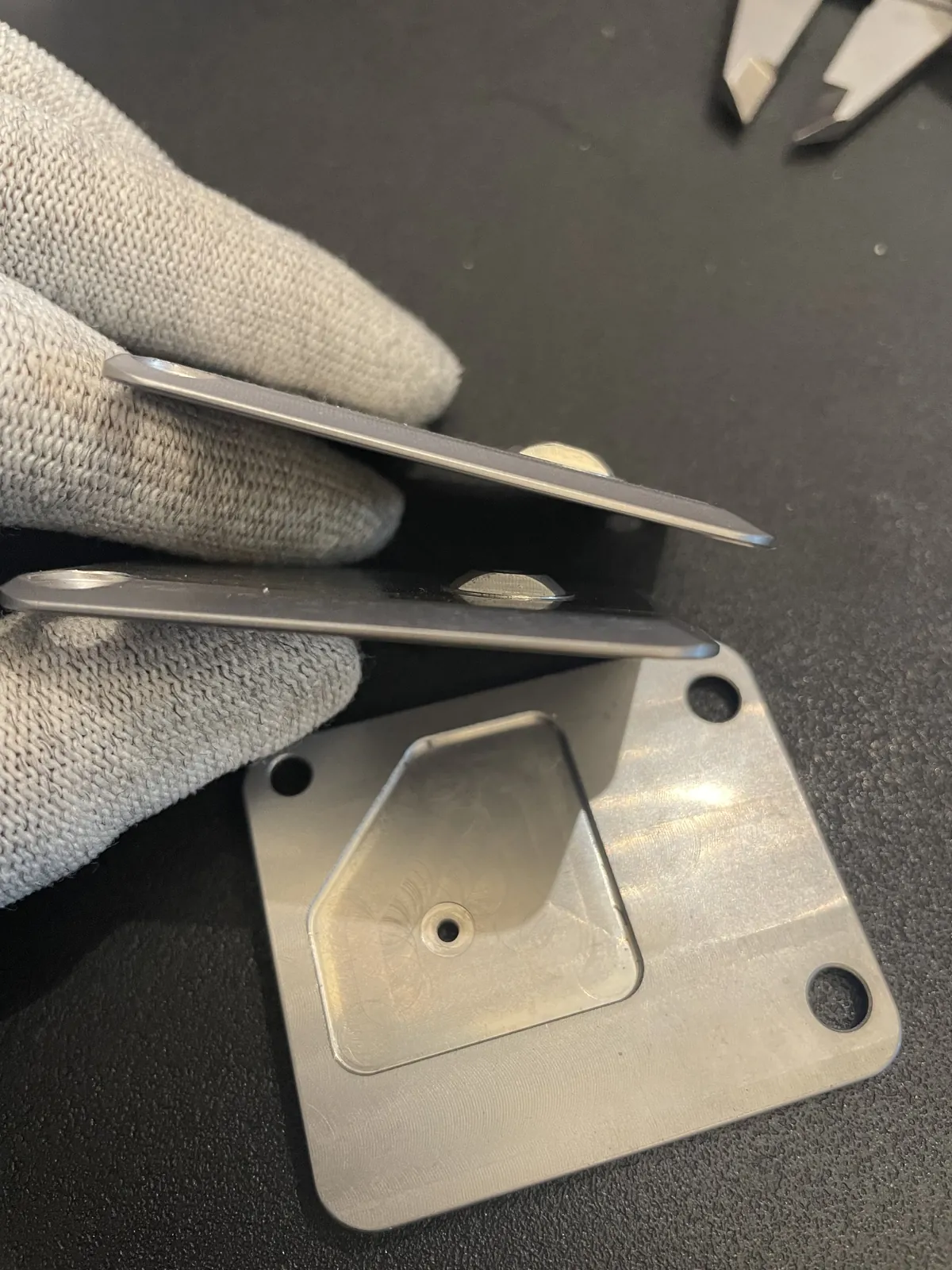
Held on edge against each other, the plates sit straight, with no bow along the length. That is the check a buyer can repeat on arrival: lay the plate on a flat surface, or hold two together, and look for light under the edge.
Why Thin Steel Plates Warp in Machining
A thick block ignores forces that a thin plate cannot. Three things bend a plate of 2 or 3 mm, and each one happens at a different stage.
| Cause | What happens |
|---|---|
| Clamping | Holding a thin plate can bow it slightly. It is cut flat while bowed, then springs back when released, and the flat face is no longer flat |
| Stress in the stock | Rolled plate and bar carry locked-in stress. Taking metal from one face removes part of it, and the plate curls |
| Hardening | A quench moves steel by about 0.1 to 0.3%, and a thin wide part shows that movement as a bow or a twist |
A pocket makes all three worse, because it thins one area of the plate and leaves the rest at full thickness. Under the pocket is where movement shows first, which is why the depth of the pocket matters more than the thickness of the plate.
How Flat Can a Thin Steel Plate Be?
As flat as the drawing asks for, so the figure belongs on the drawing. A drawing with no flatness figure falls under the general tolerance in its title block, usually ISO 2768-2, and those limits are looser than most people expect for a plate that has to seal, slide or seat.
| Longer side of the face | Class H | Class K | Class L |
|---|---|---|---|
| Up to 10 mm | 0.02 mm | 0.05 mm | 0.1 mm |
| Over 10 to 30 mm | 0.05 mm | 0.1 mm | 0.2 mm |
| Over 30 to 100 mm | 0.1 mm | 0.2 mm | 0.4 mm |
| Over 100 to 300 mm | 0.2 mm | 0.4 mm | 0.8 mm |
If the plate sits on a machine bed, carries a seal or guides something across its face, name that face and give it a flatness figure. On a hardened plate a tight figure is reached by grinding the face after hardening, so it changes the route and the price, and it is better known before the quote than after. All classes and ranges are on the ISO 2768 tolerance chart.
Hardened Before or After Machining?
For a thin plate the answer follows from the hardness on the drawing. There are three usual routes.
| Route | Hardness | What it means for a thin plate |
|---|---|---|
| Pre-hardened steel, machined directly | About 28 to 35 HRC | Nothing is quenched after machining, so there is no quench movement. Enough for many guide and cover plates |
| Machined finished, gas nitrided last | Hard surface, core unchanged | Done at 500 to 530 °C with no quench. Each surface grows by about 10 to 30 µm. Suits thin plates that would warp in a quench |
| Machined first, then hardened and tempered | About 45 HRC and above, through the plate | How this batch was made: S136 to about 50 HRC. Hardening can move a thin plate, so a face with a tight flatness figure is ground afterwards, with about 0.15 to 0.25 mm per face left for it |
A drawing that says only “hardened” leaves this open. Tell us the hardness, or what runs against the plate, and the route comes back with the quote. Every route and its effect on size is set out on heat treatment before or after machining.
Which Steels Can Be Hardened, and Which Cannot
| Steel | Hardens by heat treatment? | Where it fits on a thin plate |
|---|---|---|
| 42CrMo4 / 4140 | Yes, or bought pre-hardened at 28 to 35 HRC | Strong plates machined directly from pre-hardened stock |
| Tool steel | Yes, to high hardness | Longest wear life; needs oil or a coating against rust |
| Hardenable stainless, 420 family, S136 included | Yes; about 50 HRC on this batch | Wear faces that must also resist corrosion and take a polish |
| 17-4PH stainless | Aged to about 40 to 44 HRC | Shrinks by about 0.05% in ageing with very low distortion |
| 304 / 316 stainless | No | Stays soft whatever the drawing says; a hardened plate needs a different grade |
304 is the common trap. It is the stainless most drawings name by habit, and it cannot be hardened by heat treatment, so a wear plate in 304 grooves early. When a drawing asks for hardened 304 we say so on the quote and propose the grade that reaches the hardness.
How Thin Can the Floor Under a Pocket Be?
On this batch the pocket is 1.5 mm deep in a 2.2 mm plate, so no more than 0.7 mm of steel is left under it. Three things decide how thin a floor can go: the area of the pocket, the steel, and whether the plate is hardened after the pocket is cut, because a wide thin floor is the first place to move. A small pocket over a thin floor is easy; one that covers most of the plate is not.
Send the drawing before you fix the thickness. If a floor needs another few tenths, or the route needs to change to hold it flat, we say so before quoting, not after the parts are made.
Where Thin Hardened Plates Sit in a Machine
A needle plate sits under the needle of an embroidery or sewing machine. Needle and thread pass through the small hole at its centre, and thread wears a soft plate into a groove, which is why this batch is hardened. When a needle plate is worn and out of production it is copied from the old plate; that job is on embroidery machine needle plates.
Other thin hardened plates do similar work. Wear plates take the rubbing so a housing does not. Guide plates steer strip, wire or thread through a small hole or slot. Cover plates close a mechanism and locate a part by a boss or a pocket on the inner face.
Two neighbouring jobs go elsewhere on this site. Rings and shims under 1 mm are etched, laser cut or stamped, not milled: see thin washers and shims. Aluminum mounting, adapter and fixture plates are on custom machined plates.
What to Send for a Quote
| Send | Why |
|---|---|
| Drawing, STEP file or dimensioned sketch | Thickness, pocket depths and hole positions |
| No drawing: the old plate, or photos of both faces with a caliper in frame | We measure it and draw it for your approval |
| Hardness, or what runs against the plate | Decides the steel and whether it is hardened before or after machining |
| Which face must be flat, and how flat | Decides whether the face is ground |
| Quantity now and later | One piece is a normal order; the drawing is kept for reorders |
| Delivery country | Shipping is quoted door to door |
Quotes come back within 12 hours, from 1 piece. An approval drawing with every dimension comes before machining starts. Milling of plates in general is on CNC milling, and ordering with no CAD file on order CNC parts without CAD.
Thin Steel Plate Questions
Yes. A thin plate tends to warp when it is clamped, when metal is taken from one face, and when it is quenched, so the work is planned around all three. A batch of 2.2 mm plates in S136 steel with a pocket 1.5 mm deep, machined and then hardened to about 50 HRC, came out with none warped and none scrapped.
As flat as the drawing asks for, so write the figure on the drawing. With no figure, ISO 2768-2 applies: class K allows 0.2 mm on a face 30 to 100 mm long and class H allows 0.1 mm. A tighter figure on a hardened plate is reached by grinding the faces after hardening.
It depends on the hardness. Up to about 35 HRC, pre-hardened steel is machined directly and nothing is quenched afterwards. Above about 45 HRC, the plate is machined first, then hardened and tempered, and a face with a tight flatness figure is ground afterwards. A wear surface on a finished thin plate can be gas nitrided last at 500 to 530 °C, which adds about 10 to 30 µm per surface with no quench.
Yes. Send the old plate, or photos of both faces with a caliper in frame. We measure it, send an approval drawing and quote within 12 hours, from 1 piece.
Sources
- ISO, ISO 2768-2:1989 General tolerances. Part 2: Geometrical tolerances for features without individual tolerance indications. Flatness limits of classes H, K and L by length of the face.
Plate dimensions are from our own job. Heat treatment temperatures, movement and grinding allowances are the planning values we work to. Where this page and your drawing differ, the drawing governs.