// Reference · Metric vs Imperial Threads

Metric vs Imperial Thread Chart — Will a 1/4-20 Fit an M6? 44 Lookalike Pairs That Do Not Mate

A 1/4-20 bolt will not start in an M6 nut: its major diameter is 6.350 mm against 6.000 mm. The other way round, an M6 bolt starts in a 1/4-20 nut and binds after a few turns, because its 1.000 mm pitch runs against the nut’s 1.270 mm and the threads are 1.350 mm out of step after 5 turns. M8 and 5/16-18 are only 0.062 mm apart in diameter and 0.161 mm apart in pitch, so the 5/16-18 bolt runs into the M8 nut and jams; #10-32 and M5 share a pitch to within 0.006 mm and differ by 0.174 mm in diameter, so the #10-32 screw runs in and sits loose. The chart covers 44 metric / UNC / UNF pairs from M1.6 to M30 and names the machined adapter, standoff or stud that bridges each.

Download the chart as PDF ↓

The Chart — 44 Lookalike Metric and Inch Threads, M1.6 to M30

Every pair on the chart is within 1.750 mm in major diameter and looks like the same thread to the eye, and every pair fails in one of two ways: the pitches differ and the flanks bind after a few turns, or the pitches agree and the diameter is wrong. Metric sizes are ISO 261 / ISO 262 coarse pitch unless the label carries a fine pitch (M8×1, M10×1.25, M12×1.5); inch sizes are Unified coarse (UNC) and fine (UNF) with the major diameter converted at 25.4 mm per inch and the pitch as 25.4 / TPI, both rounded to three decimals. Diameter and pitch differences are taken between the nominal majors and the nominal pitches; drift over 5 turns is five times the pitch difference.

EKINSUN LTD is a custom parts manufacturer that machines the thread adapters, standoffs and double-end studs that bridge these pairs — a metric thread one end, a Unified inch thread the other — from one piece, to a drawing, a sketch or the worn part.

Metric (ISO 261 / 262) against Unified inch (UNC / UNF) threads that look alike — nominal major diameters and pitches, differences in mm
Metric (size · pitch mm)Inch (size · major mm · TPI · pitch mm)Ø difference mmPitch difference mmDrift over 5 turns mmWhich one starts in whichResultCustom part that bridges it
M1.6 · 0.350 mm#0-80 · 1.524 mm · 80 TPI · 0.318 mm0.0760.0320.160#0-80 bolt starts in M1.6 nut; M1.6 bolt does not start in #0-80 nutEngages, feels right, then bindsstandoff or spacer with different thread each end
M1.6 · 0.350 mm#1-64 · 1.854 mm · 64 TPI · 0.397 mm0.2540.0470.235M1.6 bolt starts in #1-64 nut; #1-64 bolt does not start in M1.6 nutStarts, binds within a few turnsstandoff or spacer with different thread each end
M2 · 0.400 mm#2-56 · 2.184 mm · 56 TPI · 0.454 mm0.1840.0540.270M2 bolt starts in #2-56 nut; #2-56 bolt does not start in M2 nutStarts, binds within a few turnsstandoff or spacer with different thread each end
M2 · 0.400 mm#2-64 · 2.184 mm · 64 TPI · 0.397 mm0.1840.0030.015M2 bolt starts in #2-64 nut; #2-64 bolt does not start in M2 nutRuns in, wrong diameter, no loadstandoff or spacer with different thread each end
M2.5 · 0.450 mm#3-48 · 2.515 mm · 48 TPI · 0.529 mm0.0150.0790.395M2.5 bolt starts in #3-48 nut; #3-48 bolt does not start in M2.5 nutEngages, feels right, then bindsstandoff or spacer with different thread each end
M3 · 0.500 mm#4-40 · 2.845 mm · 40 TPI · 0.635 mm0.1550.1350.675#4-40 bolt starts in M3 nut; M3 bolt does not start in #4-40 nutStarts, binds within a few turnsstandoff or spacer with different thread each end
M3 · 0.500 mm#5-40 · 3.175 mm · 40 TPI · 0.635 mm0.1750.1350.675M3 bolt starts in #5-40 nut; #5-40 bolt does not start in M3 nutStarts, binds within a few turnsstandoff or spacer with different thread each end
M3.5 · 0.600 mm#6-32 · 3.505 mm · 32 TPI · 0.794 mm0.0050.1940.970M3.5 bolt starts in #6-32 nut; #6-32 bolt does not start in M3.5 nutStarts, binds within a few turnsstandoff or spacer with different thread each end
M3.5 · 0.600 mm#6-40 · 3.505 mm · 40 TPI · 0.635 mm0.0050.0350.175M3.5 bolt starts in #6-40 nut; #6-40 bolt does not start in M3.5 nutEngages, feels right, then bindsstandoff or spacer with different thread each end
M4 · 0.700 mm#8-32 · 4.166 mm · 32 TPI · 0.794 mm0.1660.0940.470M4 bolt starts in #8-32 nut; #8-32 bolt does not start in M4 nutStarts, binds within a few turnsstandoff or spacer with different thread each end
M4 · 0.700 mm#8-36 · 4.166 mm · 36 TPI · 0.706 mm0.1660.0060.030M4 bolt starts in #8-36 nut; #8-36 bolt does not start in M4 nutRuns in, wrong diameter, no loadstandoff or spacer with different thread each end
M5 · 0.800 mm#10-24 · 4.826 mm · 24 TPI · 1.058 mm0.1740.2581.290#10-24 bolt starts in M5 nut; M5 bolt does not start in #10-24 nutStarts, binds within a few turnsstandoff or spacer with different thread each end
M5 · 0.800 mm#10-32 · 4.826 mm · 32 TPI · 0.794 mm0.1740.0060.030#10-32 bolt starts in M5 nut; M5 bolt does not start in #10-32 nutRuns in, wrong diameter, no loadstandoff or spacer with different thread each end
M5 · 0.800 mm#12-24 · 5.486 mm · 24 TPI · 1.058 mm0.4860.2581.290M5 bolt starts in #12-24 nut; #12-24 bolt does not start in M5 nutStarts, binds within a few turnsstandoff or spacer with different thread each end
M6 · 1.000 mm1/4-20 · 6.350 mm · 20 TPI · 1.270 mm0.3500.2701.350M6 bolt starts in 1/4-20 nut; 1/4-20 bolt does not start in M6 nutStarts, binds within a few turnsthread adapter (female M6 / male 1/4-20)
M6 · 1.000 mm1/4-28 · 6.350 mm · 28 TPI · 0.907 mm0.3500.0930.465M6 bolt starts in 1/4-28 nut; 1/4-28 bolt does not start in M6 nutStarts, binds within a few turnsthread adapter (female M6 / male 1/4-28)
M8 · 1.250 mm5/16-18 · 7.938 mm · 18 TPI · 1.411 mm0.0620.1610.8055/16-18 bolt starts in M8 nut; M8 bolt does not start in 5/16-18 nutStarts, binds within a few turnsthread adapter (female M8 / male 5/16-18)
M8 · 1.250 mm5/16-24 · 7.938 mm · 24 TPI · 1.058 mm0.0620.1920.9605/16-24 bolt starts in M8 nut; M8 bolt does not start in 5/16-24 nutStarts, binds within a few turnsthread adapter (female M8 / male 5/16-24)
M8x1 · 1.000 mm5/16-24 · 7.938 mm · 24 TPI · 1.058 mm0.0620.0580.2905/16-24 bolt starts in M8x1 nut; M8x1 bolt does not start in 5/16-24 nutEngages, feels right, then bindsthread adapter (female M8x1 / male 5/16-24)
M10 · 1.500 mm3/8-16 · 9.525 mm · 16 TPI · 1.588 mm0.4750.0880.4403/8-16 bolt starts in M10 nut; M10 bolt does not start in 3/8-16 nutStarts, binds within a few turnsthread adapter (female M10 / male 3/8-16)
M10 · 1.500 mm3/8-24 · 9.525 mm · 24 TPI · 1.058 mm0.4750.4422.2103/8-24 bolt starts in M10 nut; M10 bolt does not start in 3/8-24 nutStarts, binds within a few turnsthread adapter (female M10 / male 3/8-24)
M10x1.25 · 1.250 mm3/8-24 · 9.525 mm · 24 TPI · 1.058 mm0.4750.1920.9603/8-24 bolt starts in M10x1.25 nut; M10x1.25 bolt does not start in 3/8-24 nutStarts, binds within a few turnsthread adapter (female M10x1.25 / male 3/8-24)
M10x1 · 1.000 mm3/8-24 · 9.525 mm · 24 TPI · 1.058 mm0.4750.0580.2903/8-24 bolt starts in M10x1 nut; M10x1 bolt does not start in 3/8-24 nutStarts, binds within a few turnsthread adapter (female M10x1 / male 3/8-24)
M12 · 1.750 mm1/2-13 · 12.700 mm · 13 TPI · 1.954 mm0.7000.2041.020M12 bolt starts in 1/2-13 nut; 1/2-13 bolt does not start in M12 nutStarts, binds within a few turnsthread adapter (female M12 / male 1/2-13)
M12 · 1.750 mm7/16-14 · 11.113 mm · 14 TPI · 1.814 mm0.8870.0640.3207/16-14 bolt starts in M12 nut; M12 bolt does not start in 7/16-14 nutStarts, binds within a few turnsthread adapter (female M12 / male 7/16-14)
M12 · 1.750 mm1/2-20 · 12.700 mm · 20 TPI · 1.270 mm0.7000.4802.400M12 bolt starts in 1/2-20 nut; 1/2-20 bolt does not start in M12 nutStarts, binds within a few turnsthread adapter (female M12 / male 1/2-20)
M12x1.25 · 1.250 mm1/2-20 · 12.700 mm · 20 TPI · 1.270 mm0.7000.0200.100M12x1.25 bolt starts in 1/2-20 nut; 1/2-20 bolt does not start in M12x1.25 nutRuns in, wrong diameter, no loadthread adapter (female M12x1.25 / male 1/2-20)
M12x1.5 · 1.500 mm1/2-20 · 12.700 mm · 20 TPI · 1.270 mm0.7000.2301.150M12x1.5 bolt starts in 1/2-20 nut; 1/2-20 bolt does not start in M12x1.5 nutStarts, binds within a few turnsthread adapter (female M12x1.5 / male 1/2-20)
M14 · 2.000 mm9/16-12 · 14.288 mm · 12 TPI · 2.117 mm0.2880.1170.585M14 bolt starts in 9/16-12 nut; 9/16-12 bolt does not start in M14 nutStarts, binds within a few turnsthread adapter (female M14 / male 9/16-12)
M14 · 2.000 mm9/16-18 · 14.288 mm · 18 TPI · 1.411 mm0.2880.5892.945M14 bolt starts in 9/16-18 nut; 9/16-18 bolt does not start in M14 nutStarts, binds within a few turnsthread adapter (female M14 / male 9/16-18)
M14x1.5 · 1.500 mm9/16-18 · 14.288 mm · 18 TPI · 1.411 mm0.2880.0890.445M14x1.5 bolt starts in 9/16-18 nut; 9/16-18 bolt does not start in M14x1.5 nutStarts, binds within a few turnsthread adapter (female M14x1.5 / male 9/16-18)
M16 · 2.000 mm5/8-11 · 15.875 mm · 11 TPI · 2.309 mm0.1250.3091.5455/8-11 bolt starts in M16 nut; M16 bolt does not start in 5/8-11 nutStarts, binds within a few turnsthread adapter (female M16 / male 5/8-11)
M16 · 2.000 mm5/8-18 · 15.875 mm · 18 TPI · 1.411 mm0.1250.5892.9455/8-18 bolt starts in M16 nut; M16 bolt does not start in 5/8-18 nutStarts, binds within a few turnsthread adapter (female M16 / male 5/8-18)
M16x1.5 · 1.500 mm5/8-18 · 15.875 mm · 18 TPI · 1.411 mm0.1250.0890.4455/8-18 bolt starts in M16x1.5 nut; M16x1.5 bolt does not start in 5/8-18 nutStarts, binds within a few turnsthread adapter (female M16x1.5 / male 5/8-18)
M20 · 2.500 mm3/4-10 · 19.050 mm · 10 TPI · 2.540 mm0.9500.0400.2003/4-10 bolt starts in M20 nut; M20 bolt does not start in 3/4-10 nutStarts, binds within a few turnsstud with different thread each end
M20 · 2.500 mm3/4-16 · 19.050 mm · 16 TPI · 1.588 mm0.9500.9124.5603/4-16 bolt starts in M20 nut; M20 bolt does not start in 3/4-16 nutStarts, binds within a few turnsstud with different thread each end
M20x1.5 · 1.500 mm3/4-16 · 19.050 mm · 16 TPI · 1.588 mm0.9500.0880.4403/4-16 bolt starts in M20x1.5 nut; M20x1.5 bolt does not start in 3/4-16 nutStarts, binds within a few turnsstud with different thread each end
M22 · 2.500 mm7/8-9 · 22.225 mm · 9 TPI · 2.822 mm0.2250.3221.610M22 bolt starts in 7/8-9 nut; 7/8-9 bolt does not start in M22 nutStarts, binds within a few turnsstud with different thread each end
M22 · 2.500 mm7/8-14 · 22.225 mm · 14 TPI · 1.814 mm0.2250.6863.430M22 bolt starts in 7/8-14 nut; 7/8-14 bolt does not start in M22 nutStarts, binds within a few turnsstud with different thread each end
M24 · 3.000 mm1-8 · 25.400 mm · 8 TPI · 3.175 mm1.4000.1750.875M24 bolt starts in 1-8 nut; 1-8 bolt does not start in M24 nutStarts, binds within a few turnsstud with different thread each end
M24 · 3.000 mm1-12 · 25.400 mm · 12 TPI · 2.117 mm1.4000.8834.415M24 bolt starts in 1-12 nut; 1-12 bolt does not start in M24 nutStarts, binds within a few turnsstud with different thread each end
M30 · 3.500 mm1-1/8-7 · 28.575 mm · 7 TPI · 3.629 mm1.4250.1290.6451-1/8-7 bolt starts in M30 nut; M30 bolt does not start in 1-1/8-7 nutStarts, binds within a few turnsstud with different thread each end
M30 · 3.500 mm1-1/8-12 · 28.575 mm · 12 TPI · 2.117 mm1.4251.3836.9151-1/8-12 bolt starts in M30 nut; M30 bolt does not start in 1-1/8-12 nutStarts, binds within a few turnsstud with different thread each end
M30 · 3.500 mm1-1/4-7 · 31.750 mm · 7 TPI · 3.629 mm1.7500.1290.645M30 bolt starts in 1-1/4-7 nut; 1-1/4-7 bolt does not start in M30 nutStarts, binds within a few turnsstud with different thread each end

Reading the columns: a smaller major always starts in the larger nut, and a larger one never does, so the direction that “works” is fixed by the diameter alone. The pitch difference is what the joint does after that — 0.161 mm per turn on M8 / 5/16-18 is 0.805 mm after five turns, more than half a thread, and the flanks lock. The bridge column names the part that is machined for the pair: a female-to-male thread adapter from M6 to M16, a standoff below that, a double-end stud from M20 up.

The Closest Calls — 22 Pairs Within 0.10 mm in Pitch or Diameter

M2 and #2-64 are the closest pair on the chart in pitch, 0.400 against 0.397 mm; M5 and #10-32 are the close call met most often: 0.800 mm against 0.794 mm, a difference of 0.006 mm, so a #10-32 screw runs several turns into an M5 nut and only its 0.174 mm smaller diameter gives it away, as looseness rather than resistance. The 22 pairs below are within 0.10 mm in pitch or within 0.10 mm in diameter, which is the band where a part feels right by hand and a caliper alone cannot settle it; each row gives the full account of what happens in both directions.

Pairs with pitch difference ≤ 0.10 mm or diameter difference ≤ 0.10 mm — what happens in each direction
PairØ difference mmPitch difference mmDrift over 5 turns mmWhat happens
M5 / #10-320.1740.0060.030A #10-32 bolt (major 4.826 mm) runs several turns into an M5 nut (5.000 mm) because the pitches differ by only 0.006 mm (0.030 mm over 5 turns), but the 0.174 mm diameter shortfall leaves it loose with reduced flank contact; it must not carry load. An M5 bolt will not start in a #10-32 nut: it is 0.174 mm oversize.
M1.6 / #0-800.0760.0320.160A #0-80 bolt (1.524 mm, pitch 0.318 mm) screws into an M1.6 nut (1.600 mm, pitch 0.350 mm) with only 0.076 mm diameter and 0.032 mm pitch difference (0.160 mm over 5 turns), so it engages and feels right for the first turns, then the pitch difference accumulates and locks the flanks; it must not be used for load; an M1.6 bolt in a #0-80 nut is 0.076 mm oversize and will not start.
M1.6 / #1-640.2540.0470.235An M1.6 bolt (major 1.600 mm, pitch 0.350 mm) starts in a #1-64 nut (1.854 mm, pitch 0.397 mm) but the pitch differs by 0.047 mm, so after 5 turns the threads are 0.235 mm out of step and the flanks bind. A #1-64 bolt will not start in an M1.6 nut: it is 0.254 mm larger than the nut's nominal diameter.
M2 / #2-560.1840.0540.270An M2 bolt (major 2.000 mm, pitch 0.400 mm) starts in a #2-56 nut (2.184 mm, pitch 0.454 mm) but the pitch differs by 0.054 mm, so after 5 turns the threads are 0.270 mm out of step and the flanks bind. A #2-56 bolt will not start in an M2 nut: it is 0.184 mm larger than the nut's nominal diameter.
M2 / #2-640.1840.0030.015An M2 bolt (major 2.000 mm) runs several turns into a #2-64 nut (2.184 mm) because the pitches differ by only 0.003 mm (0.015 mm over 5 turns), but the 0.184 mm diameter shortfall leaves it loose with reduced flank contact; it must not carry load. A #2-64 bolt will not start in an M2 nut: it is 0.184 mm oversize.
M2.5 / #3-480.0150.0790.395An M2.5 bolt (2.500 mm, pitch 0.450 mm) screws into a #3-48 nut (2.515 mm, pitch 0.529 mm) with only 0.015 mm diameter and 0.079 mm pitch difference (0.395 mm over 5 turns), so it engages and feels right for the first turns, then the pitch difference accumulates and locks the flanks; it must not be used for load; a #3-48 bolt in an M2.5 nut is 0.015 mm oversize and will not start.
M3.5 / #6-320.0050.1940.970An M3.5 bolt (major 3.500 mm, pitch 0.600 mm) starts in a #6-32 nut (3.505 mm, pitch 0.794 mm) but the pitch differs by 0.194 mm, so after 5 turns the threads are 0.970 mm out of step and the flanks bind. A #6-32 bolt will not start in an M3.5 nut: it is 0.005 mm larger than the nut's nominal diameter.
M3.5 / #6-400.0050.0350.175An M3.5 bolt (3.500 mm, pitch 0.600 mm) screws into a #6-40 nut (3.505 mm, pitch 0.635 mm) with only 0.005 mm diameter and 0.035 mm pitch difference (0.175 mm over 5 turns), so it engages and feels right for the first turns, then the pitch difference accumulates and locks the flanks; it must not be used for load; a #6-40 bolt in an M3.5 nut is 0.005 mm oversize and will not start.
M4 / #8-320.1660.0940.470An M4 bolt (major 4.000 mm, pitch 0.700 mm) starts in a #8-32 nut (4.166 mm, pitch 0.794 mm) but the pitch differs by 0.094 mm, so after 5 turns the threads are 0.470 mm out of step and the flanks bind. A #8-32 bolt will not start in an M4 nut: it is 0.166 mm larger than the nut's nominal diameter.
M4 / #8-360.1660.0060.030An M4 bolt (major 4.000 mm) runs several turns into a #8-36 nut (4.166 mm) because the pitches differ by only 0.006 mm (0.030 mm over 5 turns), but the 0.166 mm diameter shortfall leaves it loose with reduced flank contact; it must not carry load. A #8-36 bolt will not start in an M4 nut: it is 0.166 mm oversize.
M6 / 1/4-280.3500.0930.465An M6 bolt (major 6.000 mm, pitch 1.000 mm) starts in a 1/4-28 nut (6.350 mm, pitch 0.907 mm) but the pitch differs by 0.093 mm, so after 5 turns the threads are 0.465 mm out of step and the flanks bind. A 1/4-28 bolt will not start in an M6 nut: it is 0.350 mm larger than the nut's nominal diameter.
M8 / 5/16-180.0620.1610.805A 5/16-18 bolt (major 7.938 mm, pitch 1.411 mm) starts in an M8 nut (8.000 mm, pitch 1.250 mm) but the pitch differs by 0.161 mm, so after 5 turns the threads are 0.805 mm out of step and the flanks bind. An M8 bolt will not start in a 5/16-18 nut: it is 0.062 mm larger than the nut's nominal diameter.
M8 / 5/16-240.0620.1920.960A 5/16-24 bolt (major 7.938 mm, pitch 1.058 mm) starts in an M8 nut (8.000 mm, pitch 1.250 mm) but the pitch differs by 0.192 mm, so after 5 turns the threads are 0.960 mm out of step and the flanks bind. An M8 bolt will not start in a 5/16-24 nut: it is 0.062 mm larger than the nut's nominal diameter.
M8x1 / 5/16-240.0620.0580.290A 5/16-24 bolt (7.938 mm, pitch 1.058 mm) screws into an M8x1 nut (8.000 mm, pitch 1.000 mm) with only 0.062 mm diameter and 0.058 mm pitch difference (0.290 mm over 5 turns), so it engages and feels right for the first turns, then the pitch difference accumulates and locks the flanks; it must not be used for load; an M8x1 bolt in a 5/16-24 nut is 0.062 mm oversize and will not start.
M10 / 3/8-160.4750.0880.440A 3/8-16 bolt (major 9.525 mm, pitch 1.588 mm) starts in an M10 nut (10.000 mm, pitch 1.500 mm) but the pitch differs by 0.088 mm, so after 5 turns the threads are 0.440 mm out of step and the flanks bind. An M10 bolt will not start in a 3/8-16 nut: it is 0.475 mm larger than the nut's nominal diameter.
M10x1 / 3/8-240.4750.0580.290A 3/8-24 bolt (major 9.525 mm, pitch 1.058 mm) starts in an M10x1 nut (10.000 mm, pitch 1.000 mm) but the pitch differs by 0.058 mm, so after 5 turns the threads are 0.290 mm out of step and the flanks bind. An M10x1 bolt will not start in a 3/8-24 nut: it is 0.475 mm larger than the nut's nominal diameter.
M12 / 7/16-140.8870.0640.320A 7/16-14 bolt (major 11.113 mm, pitch 1.814 mm) starts in an M12 nut (12.000 mm, pitch 1.750 mm) but the pitch differs by 0.064 mm, so after 5 turns the threads are 0.320 mm out of step and the flanks bind. An M12 bolt will not start in a 7/16-14 nut: it is 0.887 mm larger than the nut's nominal diameter.
M12x1.25 / 1/2-200.7000.0200.100An M12x1.25 bolt (major 12.000 mm) runs several turns into a 1/2-20 nut (12.700 mm) because the pitches differ by only 0.020 mm (0.100 mm over 5 turns), but the 0.700 mm diameter shortfall leaves it loose with reduced flank contact; it must not carry load. A 1/2-20 bolt will not start in an M12x1.25 nut: it is 0.700 mm oversize.
M14x1.5 / 9/16-180.2880.0890.445An M14x1.5 bolt (major 14.000 mm, pitch 1.500 mm) starts in a 9/16-18 nut (14.288 mm, pitch 1.411 mm) but the pitch differs by 0.089 mm, so after 5 turns the threads are 0.445 mm out of step and the flanks bind. A 9/16-18 bolt will not start in an M14x1.5 nut: it is 0.288 mm larger than the nut's nominal diameter.
M16x1.5 / 5/8-180.1250.0890.445A 5/8-18 bolt (major 15.875 mm, pitch 1.411 mm) starts in an M16x1.5 nut (16.000 mm, pitch 1.500 mm) but the pitch differs by 0.089 mm, so after 5 turns the threads are 0.445 mm out of step and the flanks bind. An M16x1.5 bolt will not start in a 5/8-18 nut: it is 0.125 mm larger than the nut's nominal diameter.
M20 / 3/4-100.9500.0400.200A 3/4-10 bolt (major 19.050 mm, pitch 2.540 mm) starts in an M20 nut (20.000 mm, pitch 2.500 mm) but the pitch differs by 0.040 mm, so after 5 turns the threads are 0.200 mm out of step and the flanks bind. An M20 bolt will not start in a 3/4-10 nut: it is 0.950 mm larger than the nut's nominal diameter.
M20x1.5 / 3/4-160.9500.0880.440A 3/4-16 bolt (major 19.050 mm, pitch 1.588 mm) starts in an M20x1.5 nut (20.000 mm, pitch 1.500 mm) but the pitch differs by 0.088 mm, so after 5 turns the threads are 0.440 mm out of step and the flanks bind. An M20x1.5 bolt will not start in a 3/4-16 nut: it is 0.950 mm larger than the nut's nominal diameter.

Three of these deserve a second look because they are met in mixed hardware every week. M3.5 and #6-40 are 0.005 mm apart in diameter and 0.035 mm in pitch, close enough that an M3.5 screw feels correct for the two or three turns a thin #6-40 tapped plate holds, and binds in a deeper hole. M8×1 and 5/16-24 sit 0.062 mm apart in diameter and 0.058 mm in pitch, the fine-thread trap on instruments and sensors. M12×1.25 and 1/2-20 share a pitch to within 0.020 mm but are 0.700 mm apart in diameter, so an M12×1.25 stud runs into a 1/2-20 port and carries nothing.

How to Tell Them Apart With a Caliper and a Rule

Counting threads over a 10 mm length separates M8 from 5/16-18 at 8.0 threads against 7.1, and a caliper on the major diameter separates M5 from #10-32 at 5.000 against 4.826 mm; between those two measurements every pair on the chart is identified. Lay a steel rule along the thread, count the crests that fall inside 10 mm, and read the count against the two columns below; when the counts are within 0.5 of each other, measure the diameter instead. The table gives the eight pairs that are most often confused, the count each side gives, and which of the two measurements decides.

Threads counted over 10 mm (10 / pitch, one decimal) and the measurement that separates each pair
PairMetric threads in 10 mmInch threads in 10 mmMajor diameters mm (metric / inch)Measure this
M6 / 1/4-2010.07.96.000 / 6.350Either — 0.350 mm on the diameter and 10.0 against 7.9 threads in 10 mm
M8 / 5/16-188.07.18.000 / 7.938Pitch — 8.0 against 7.1 threads in 10 mm; the diameters are only 0.062 mm apart
M5 / #10-3212.512.65.000 / 4.826Diameter only — 5.000 against 4.826 mm; the pitches differ by 0.006 mm and a rule cannot see it
M10 / 3/8-166.76.310.000 / 9.525Diameter — 10.000 against 9.525 mm, 0.475 mm apart; the counts are too close to call
M12 / 1/2-135.75.112.000 / 12.700Either — 0.700 mm on the diameter and 5.7 against 5.1 threads in 10 mm
M4 / #8-3214.312.64.000 / 4.166Pitch — 14.3 against 12.6 threads in 10 mm; the diameters are only 0.166 mm apart
M3 / #4-4020.015.73.000 / 2.845Pitch — 20.0 against 15.7 threads in 10 mm; the diameters are only 0.155 mm apart
M20 / 3/4-104.03.920.000 / 19.050Diameter — 20.000 against 19.050 mm, 0.950 mm apart; the counts are too close to call

A thread pitch gauge does the same job faster: the metric leaves are marked in millimetres, the inch leaves in TPI, and the leaf that sits on the flanks without rocking is the pitch. On a worn or painted thread the caliper reading drops below nominal by the wear, so read the diameter as a band, not a point — an M8 worn to 7.9 mm is still 8.0 threads in 10 mm. For Whitworth sizes, which share the 55° flank with BSP pipe threads and add a third set of lookalikes (1/4 BSW at 20 TPI against 1/4-20 UNC), use the Whitworth thread chart. Where a nut has to be identified by its hex rather than its thread, the wrench size chart lists the across-flats of both systems.

What the Results Mean — Four Outcomes, None of Them a Joint

Every one of the 44 pairs fails in one of the two ways above, pitch fight or wrong diameter, and none of them reaches the flank contact a matched thread gives, so none may carry load; seen from both directions and with the close calls split out, the chart uses four labels:

Does not start — on nominal diameters the bolt’s major is larger than the nut’s, by 0.005 mm (#6-32 in M3.5) to 1.750 mm (1-1/4-7 in M30), and the first crest will not enter the first groove without cutting it; below about 0.1 mm the 6g / 6H tolerance bands let the bolt enter a turn before the pitch difference locks it. Starts, binds within a few turns — the bolt is smaller than the nut and enters, but a pitch difference above 0.020 mm, on a pair more than 0.100 mm apart in pitch or in diameter, accumulates each turn until the crests ride onto the wrong flanks and lock, at 0.805 mm drift after 5 turns for 5/16-18 in M8. Runs in, wrong diameter, no load — the pitches agree to within 0.020 mm, so the bolt screws home freely, but the diameter is short by 0.166 to 0.700 mm and only the crest tips touch the flanks, as with #10-32 in M5 or M4 in #8-36. Engages, feels right, then binds — both differences are within 0.100 mm, the part feels right by hand, but the pitch difference of 0.032 to 0.079 mm still accumulates, 0.160 to 0.395 mm over 5 turns, and the flanks lock, as with #0-80 in M1.6 or 5/16-24 in M8×1.

A screw thread carries load on the flanks of the engaged turns, spread over the length of engagement. A mismatched pair loads a fraction of that: where the pitch differs, the first turn takes the load and the rest are out of step; where the diameter differs, the crests bear on the flanks instead of flank on flank. Under a tightening torque the crests deform, the thread strips from the softer part, and under vibration the joint that felt tight comes loose. Forcing the pair also destroys the nut or the tapped hole, which is the expensive half: an M8 tapped hole in a casting cannot be bought again. The right answer to a lookalike pair is a part with the correct thread on each end, machined for the two systems, not a forced joint.

Pipe Threads Are a Different Trap

G (BSPP, ISO 228) and NPT (ASME B1.20.1) share 14 TPI at 1/2 inch and 3/4 inch, a pitch of 1.814 mm, and still do not seal: G has a 55° flank angle, NPT a 60° flank angle plus a 1-in-16 taper (62.5 mm per metre), so where the counts match the flanks do not seat. The majors sit close enough to start — 20.955 mm for G1/2 against 21.336 mm for 1/2 NPT, 26.441 against 26.670 mm at 3/4 — and the joint screws together a few turns and then leaks or jams. At 1/4 and 3/8 inch the counts differ too, G at 19 TPI (1.337 mm) against NPT at 18 TPI (1.411 mm), and at 1/8 inch G is 28 TPI (0.907 mm) against NPT 27 TPI (0.941 mm). The G / NPT lookalike rows for 1/8, 1/4 and 1/2 inch, with flank angle and taper side by side, are on the thread adapters page; the bridge is a machined G-to-NPT adapter, never a forced fitting.

Where the Chart Stops — the Part With a Different Thread Each End

For all 44 pairs on the chart the catalogue stocks the bolt and the nut in each system and almost never the part that joins the two. A metric board in an inch enclosure, an imported press with a 1/2-13 frame and metric fittings, a probe with a 3/8-16 stem for an M10 boss: the fix is a standoff, a stud or an adapter with the correct thread on each end, machined to the two nominals in the chart. Two jobs bring buyers to this part: the replacement of an adapter that came with a discontinued machine and cannot be bought again, and a new design by an engineer who has to marry a metric assembly to inch-standard hardware and would rather specify one turned part than a bag of washers.

Metric-to-inch bridging parts: what the shelf holds, and what has to be machined
What you needIn the catalogue?What we machine
Standard metric or inch bolts, nuts and set screws in any size on this chartYes — every size here is stocked in both systemsBuy it from stock. A catalogue M6 or 1/4-20 bolt costs less than any one-off, and we say so in the quote instead of taking the order.
Camera and tripod adapters, 1/4-20 to 3/8-16, male or femaleYes — photographic stock itemBuy it from stock. A 1/4-20 to 3/8-16 bush is a shelf part in brass and steel; we only machine it when the length, the flange or the material is special.
A standoff with M3 one end and #6-32 the other, for a board designed in millimetres in an enclosure drilled in inchesNoMachined from brass CW614N, 303 stainless (1.4305) or 6061 aluminium, hex or round, any length, from one piece — a part that connects two systems.
A stud with M12 one end and 1/2-13 the other, for an imported press whose frame is tapped 1/2-13 and whose fittings are metricNoA double-end stud turned from 42CrMo4 or 304 / 316 stainless (1.4301 / 1.4404), threads single-pointed, shoulder or undercut between them.
A female-M10 / male-3/8-16 adapter for a sensor, a probe or a fixtureNoA female-to-male thread adapter in 303 / 316 stainless, brass CW614N or Delrin (POM), with a hex or knurl to tighten by.
Large sleeves and couplings, M24 to 1-8 or M30 to 1-1/8-7, for rigging, rams and structural anchorsNoTurned from 42CrMo4 or 304 stainless bar, tapped both ends, the wall sized for the larger thread — the same family as coupling nuts.
A hole that only needs re-tapping to the next size upYes — a thread repair kit or a tap from stockBuy it from stock. A stripped M8 hole re-tapped 3/8-16 (9.525 mm, 1.525 mm larger) needs a tap, not a machined part; we tell you so rather than sell a plug.
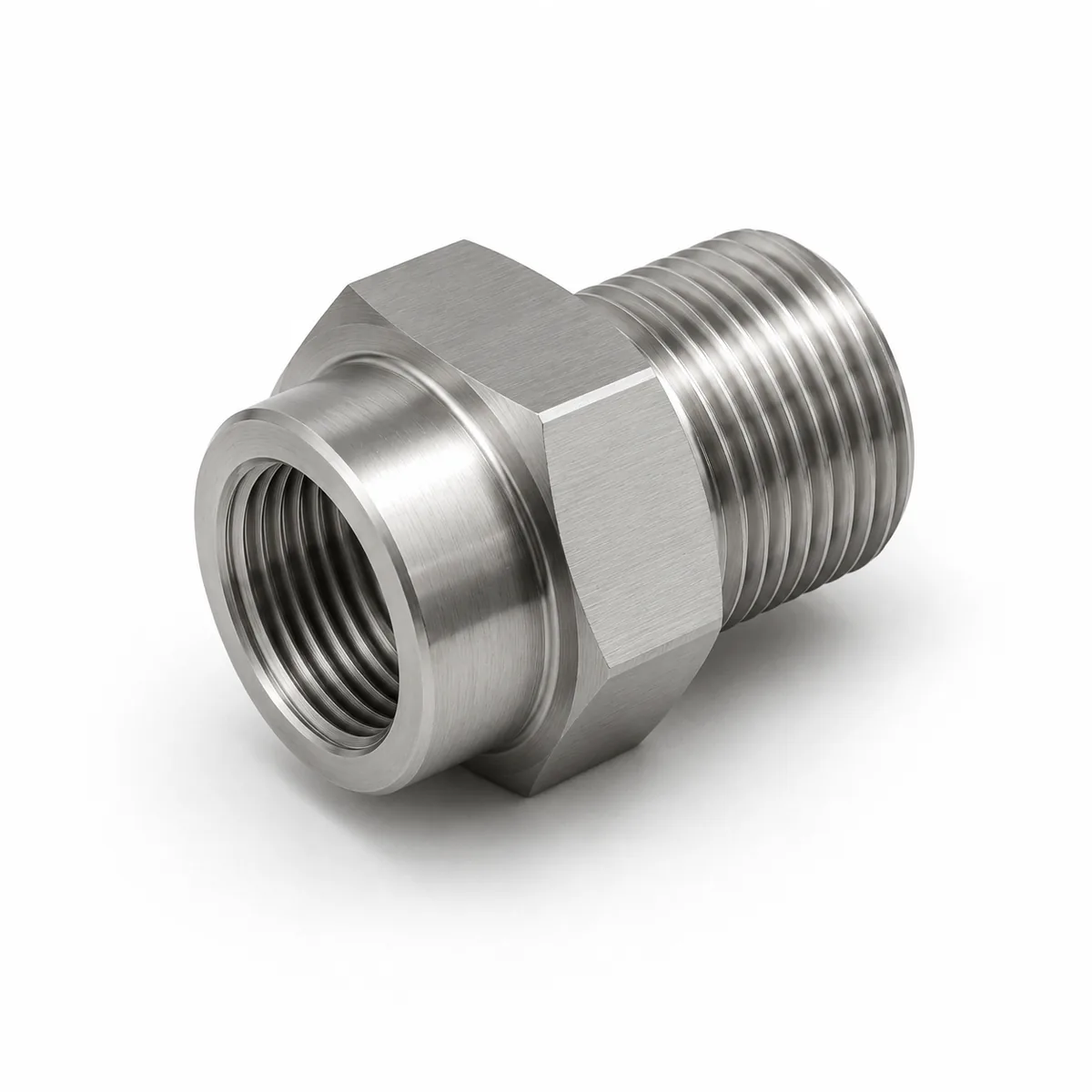
Stainless steel thread adapter with a UN male thread on one end and a metric female thread on the other, machined by EKINSUN
Stainless thread adapter, UN male thread one end and metric female the other — the part the chart points to

Requests read like this: “I need a standoff 1/2 in OD, 2-1/2 in long, 1/4-20 both ends, 1 in deep.” Or: “We need studs M12 one end, 1/2-13 the other, for an imported press.” Both are turned in one setting: bar to diameter, the metric thread and the inch thread single-pointed to their own pitch, a shoulder or a thread undercut between them so each thread runs out cleanly. Materials by duty: brass CW614N for electronics standoffs and instrument adapters, 303 stainless (1.4305) for free-machining adapters, 304 / 316 (1.4301 / 1.4404) for wet and marine service, 6061 aluminium for weight, 42CrMo4 for studs that carry preload, Delrin (POM) where the adapter must insulate. Small runs of 1 to a few dozen leave in 5 working days; shipping to Europe or the US takes 5–7 working days. A hand sketch with the two threads, the lengths and the hex is enough to quote; for the family of shapes see thread adapter types, hex adapters and threaded rods in the size the catalogue skips. The strength class of the finished stud is a separate question, answered on the bolt grade chart.

Quick Answers

Is 3/8-16 the same as M10?

No: 3/8-16 has a major of 9.525 mm against 10.000 mm for M10, 0.475 mm smaller, and a pitch of 1.588 mm against 1.500 mm, 0.088 mm coarser. A 3/8-16 bolt starts in an M10 nut and binds 0.440 mm out of step after 5 turns; an M10 bolt does not start in a 3/8-16 nut. The diameter, 0.475 mm apart, is the measurement that separates them at a glance.

Is 1/2-13 the same as M12?

No: 1/2-13 has a major of 12.700 mm against 12.000 mm for M12, 0.700 mm larger, and a pitch of 1.954 mm against 1.750 mm, 0.204 mm coarser. An M12 bolt starts in a 1/2-13 nut and binds 1.020 mm out of step after 5 turns; a 1/2-13 bolt does not start in an M12 nut. M12 is also confused with 7/16-14 (11.113 mm, 0.887 mm smaller), which starts in an M12 nut and binds 0.320 mm out of step after 5 turns.

Is 3/4-10 the same as M20?

No: 3/4-10 has a major of 19.050 mm against 20.000 mm for M20, 0.950 mm smaller, and a pitch of 2.540 mm against 2.500 mm, only 0.040 mm apart. A 3/4-10 bolt starts in an M20 nut and binds 0.200 mm out of step after 5 turns; an M20 bolt does not start in a 3/4-10 nut. At this size the bridge is a double-end stud with M20 one end and 3/4-10 the other.

Metric vs Imperial Thread FAQ

No pair on this chart is interchangeable, even where the parts screw together. An M6 bolt starts in a 1/4-20 nut because 6.000 mm is 0.350 mm smaller than 6.350 mm, but its 1.000 mm pitch fights the 1.270 mm pitch of the nut and the threads are 1.350 mm out of step after 5 turns, so the flanks bind. Where the pitches nearly agree, as with #10-32 in M5 (0.794 against 0.800 mm), the diameter is wrong instead and the joint has no proper flank contact. Every one of the 44 pairs ends in one of those two failures.

No. M6 has a major diameter of 6.000 mm and a coarse pitch of 1.000 mm; 1/4-20 UNC has a major of 6.350 mm and a pitch of 1.270 mm, so the two differ by 0.350 mm in diameter and 0.270 mm in pitch. A 1/4-20 bolt will not start in an M6 nut; an M6 bolt starts in a 1/4-20 nut and binds after a few turns. The fine 1/4-28 (pitch 0.907 mm) is closer in pitch, 0.093 mm off, and still binds.

No, and this is the pair that fools a caliper. 5/16-18 UNC measures 7.938 mm across the thread against 8.000 mm for M8, only 0.062 mm apart, but its pitch is 1.411 mm against 1.250 mm, so a 5/16-18 bolt runs into an M8 nut and jams 0.805 mm out of step after 5 turns. An M8 bolt is 0.062 mm oversize for a 5/16-18 nut on nominals and jams within the first turn. The fine 5/16-24 (1.058 mm) is even further from M8 coarse in pitch and only sits close to M8×1 (fine, 1.000 mm).

The pitch is almost identical and the diameter is not: #10-32 has a pitch of 0.794 mm against 0.800 mm for M5, a difference of 0.006 mm, but its major is 4.826 mm against 5.000 mm, 0.174 mm smaller. A #10-32 screw runs several turns into an M5 nut and feels right, then sits loose with reduced flank contact; an M5 screw does not start in a #10-32 nut. The coarse #10-24 (1.058 mm) binds in M5 within a few turns because the pitch is 0.258 mm off.

Only to a size that is larger than the old thread: 3/8-16 has a major of 9.525 mm, 1.525 mm larger than M8, so the tap cuts a full new thread in the wall of the old hole. 5/16-18 is 7.938 mm, 0.062 mm smaller than M8, and would leave the tap cutting in air. Re-tapping is a stock tap and a repair job, not a machined part; where the boss has no wall left for the larger size, a threaded insert or a new bushed part is the right route.

Measure the major diameter with a caliper and count the threads over a 10 mm length against a steel rule, then read both against the chart. M8 gives 8.0 threads in 10 mm and 5/16-18 gives 7.1; M6 gives 10.0 and 1/4-20 gives 7.9. Where the counts agree, as with M5 (12.5) and #10-32 (12.6), the diameter decides: 5.000 against 4.826 mm. A thread pitch gauge with metric and TPI leaves settles the last cases in seconds.

EKINSUN LTD machines thread adapters, standoffs and double-end studs with a metric thread one end and a Unified inch thread the other, from one piece: female M6 / male 1/4-20, female M8 / male 5/16-18, female M10 / male 3/8-16, M12 to 1/2-13 studs and M24 to 1-8 sleeves, in brass CW614N, 303 / 304 / 316 stainless, 6061 aluminium, 42CrMo4 steel or Delrin, to a drawing, a sketch or the worn part. MOQ 1, quote in 12 hours. For a standard bolt in either system, or a 1/4-20 to 3/8-16 tripod bush, we tell you to buy it from stock.

Two Threads That Do Not Mate?

A standoff, a stud or an adapter with the metric thread one end and the inch thread the other — M6 / 1/4-20, M8 / 5/16-18, M12 / 1/2-13, M24 / 1-8 — machined to your drawing, sketch or the worn part. MOQ 1, quote in 12 hours. Start with thread adapters or double-end studs.

Get a Quote →