What It Is Called — Internally Threaded Rod, Female Threaded Rod, Tapped Rod
The same part is sold under five names, and the short versions are filed under coupling nuts and standoffs rather than rods. EKINSUN LTD is a custom parts manufacturer in Guangdong, China, that machines internally threaded rods to order: any length, tapped at both ends or right through, with the same or a different thread at each end, from 1 piece. The table gives the names buyers use, where each one turns up, and the look-alikes that are a different part.
| Name buyers use | Where the name turns up | What it means | Not the same part |
|---|---|---|---|
| internally threaded rod | industrial supply catalogues in the US and UK | a round or hex rod with a female thread in each end, in steel, stainless or aluminium | internally threaded rod end: a rod-end bearing (heim joint) with a female thread in its shank |
| female threaded rod, female threaded bar | hardware stores in the UK and Australia | the same part; a hollow female threaded rod or female threaded tube is tapped right through | female threaded rod connector: usually a coupling nut |
| tapped rod | drawings and some catalogues | a rod tapped at one or both ends | tappet rod: an engine push rod |
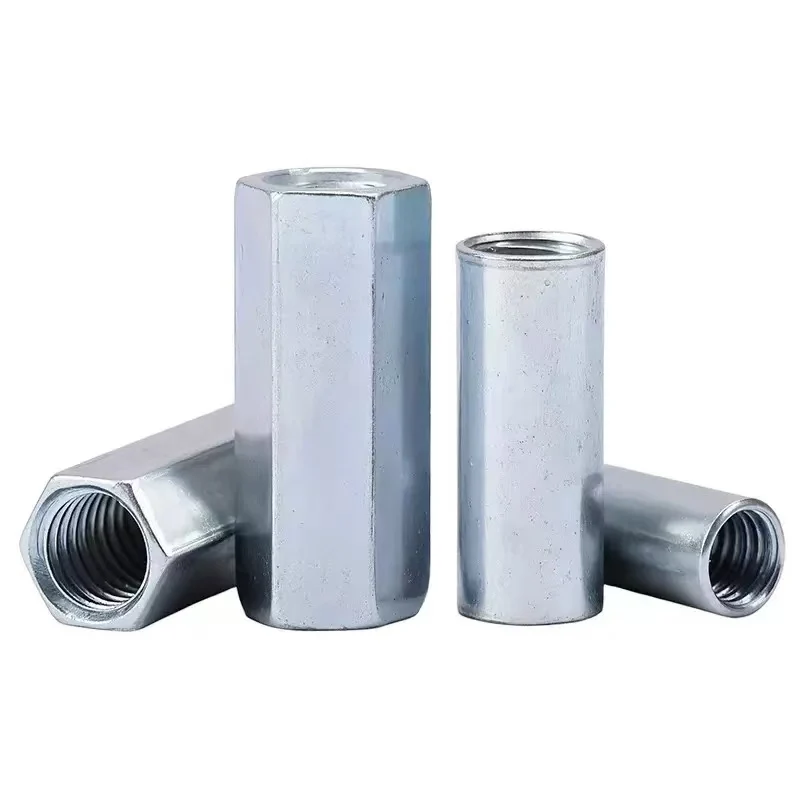
| round coupling nut | fastener catalogues | a short round body tapped through with one thread | hex coupling nut (DIN 6334): the same idea with wrench flats |
| female-female standoff, threaded spacer | electronics and enclosure catalogues | a short spacer between boards and panels, in small sizes such as M2 to M6 | male-female standoff: a stud on one end |
Forms — Blind Both Ends, Through, Two Threads, Flats
An internally threaded rod is either tapped at both ends with a solid middle or tapped right through with one thread; everything else is a feature added to one of the two. The form decides how the rod is loaded and how it is tightened.
| Form | What it is | Where it is used |
|---|---|---|
| Tapped both ends, solid middle | two blind threaded holes; the middle of the rod stays solid | posts and spacers between two plates, legs, columns in jigs and fixtures |
| Tapped right through | one thread over the full length — a long round coupling nut | joining two threaded rods; a rod can run further in to adjust the length |
| A different thread at each end | each end tapped to its own size or pitch: M10 and M8, M12 and M12 × 1.5, M10 and 3/8-16 | joining metric to inch, two sizes, or a coarse and a fine thread |
| Right-hand one end, left-hand the other | turning the rod draws both screwed parts in, or pushes them out, together, as a turnbuckle does | tie rods and links that are adjusted in place |
| Wrench flats or a hex section | flats milled on a round rod, or a hex bar with round ends | posts that have to be tightened against the screws |
| Cross hole, slot or sight hole | a cross hole for a pin or a tommy bar; a sight hole to check how far a rod has gone in | adjusters, pinned links, joints that are inspected |
| Male thread at one end | a stud on one end instead of a hole | a male-female standoff or a thread adapter: see custom standoffs and thread adapters |
Tap Drill, Thread Depth and Rod Diameter by Size, M4 to M24
Each end of the rod needs enough thread to carry the screw: about 1 to 1.5 times the thread size in steel or stainless, 1.5 to 2 times in brass and 2 to 2.5 times in aluminium. The rod needs enough wall around the thread: a round rod as large across as a standard hex coupling nut is across its flats has the same wall the nut has at its flats. For M10 that is a 17 mm rod, threaded 10 to 15 mm deep at each end in steel.
| Thread | Pitch | Tap drill | Thread depth, steel or stainless rod (1–1.5 × d) | Brass rod (1.5–2 × d) | Aluminium rod (2–2.5 × d) | Hex coupling nut: across flats × length (3 × d) | Round rod Ø with the same wall | Wall over the thread |
|---|---|---|---|---|---|---|---|---|
| M4 | 0.7 | 3.3 | 4–6 | 6–8 | 8–10 | 7 × 12 | 7 | 1.5 |
| M5 | 0.8 | 4.2 | 5–7.5 | 7.5–10 | 10–12.5 | 8 × 15 | 8 | 1.5 |
| M6 | 1 | 5 | 6–9 | 9–12 | 12–15 | 10 × 18 | 10 | 2 |
| M8 | 1.25 | 6.8 | 8–12 | 12–16 | 16–20 | 13 × 24 | 13 | 2.5 |
| M10 | 1.5 | 8.5 | 10–15 | 15–20 | 20–25 | 17 × 30 | 17 | 3.5 |
| M12 | 1.75 | 10.2 | 12–18 | 18–24 | 24–30 | 19 × 36 | 19 | 3.5 |
| M14 | 2 | 12 | 14–21 | 21–28 | 28–35 | 22 × 42 | 22 | 4 |
| M16 | 2 | 14 | 16–24 | 24–32 | 32–40 | 24 × 48 | 24 | 4 |
| M18 | 2.5 | 15.5 | 18–27 | 27–36 | 36–45 | 27 × 54 | 27 | 4.5 |
| M20 | 2.5 | 17.5 | 20–30 | 30–40 | 40–50 | 30 × 60 | 30 | 5 |
| M24 | 3 | 21 | 24–36 | 36–48 | 48–60 | 36 × 72 | 36 | 6 |
Tap drill for the coarse thread to DIN 13, as on the clearance hole and tap drill chart. Thread depth: the usual engineering rule for a tapped hole loaded by a steel screw, as a multiple of the thread size d; the weaker the rod material, the more thread it needs. For a joint that has to be rated, calculate the engagement for the screw grade and the rod material. Coupling nut: the standard hex version (DIN 6334) is three times the thread size long; a round rod as large across as that nut is across its flats has the same wall at every point that the nut has at its flats. M27, M30 and larger, and fine pitches, are made to order.
Buying internally threaded rods? Short round and hex coupling nuts, M4 to M24 up to 70 mm in zinc-plated steel, can be supplied from stock; longer rods, two threads, stainless, brass or aluminium are made to order from 1 piece. The more pieces you order, the lower the unit price. Send each thread, the thread depth, the overall length, the diameter, the material and the quantity; quote in 12 hours.
Inch Sizes — #10-24 to 1-8 UNC
The same depth rule applies to inch threads: 1 to 1.5 times the outside diameter in a steel or stainless rod and 2 to 2.5 times in aluminium. A 1/2-13 rod is threaded 0.50 to 0.75 in deep at each end in steel. Fine threads (UNF) and metric-to-inch pairs are made to order; the threads per inch of each size are on the thread pitch chart.
| Thread (UNC) | Outside Ø | Thread depth, steel or stainless (1–1.5 × d) | Aluminium (2–2.5 × d) |
|---|---|---|---|
| #10-24 | 0.190 in (4.83 mm) | 0.19–0.29 in (4.8–7.2 mm) | 0.38–0.48 in (9.7–12.1 mm) |
| 1/4-20 | 0.250 in (6.35 mm) | 0.25–0.38 in (6.4–9.5 mm) | 0.50–0.63 in (12.7–15.9 mm) |
| 5/16-18 | 0.313 in (7.94 mm) | 0.31–0.47 in (7.9–11.9 mm) | 0.63–0.78 in (15.9–19.8 mm) |
| 3/8-16 | 0.375 in (9.53 mm) | 0.38–0.56 in (9.5–14.3 mm) | 0.75–0.94 in (19.1–23.8 mm) |
| 1/2-13 | 0.500 in (12.70 mm) | 0.50–0.75 in (12.7–19.1 mm) | 1.00–1.25 in (25.4–31.8 mm) |
| 5/8-11 | 0.625 in (15.88 mm) | 0.63–0.94 in (15.9–23.8 mm) | 1.25–1.56 in (31.8–39.7 mm) |
| 3/4-10 | 0.750 in (19.05 mm) | 0.75–1.13 in (19.1–28.6 mm) | 1.50–1.88 in (38.1–47.6 mm) |
| 1-8 | 1.000 in (25.40 mm) | 1.00–1.50 in (25.4–38.1 mm) | 2.00–2.50 in (50.8–63.5 mm) |
How Deep to Tap and How Long to Make It
A standard hex coupling nut is three times its thread size long, which gives each of two rods meeting in the middle 1.5 times the thread size of engagement. A rod tapped at both ends with a solid middle is set the same way from the other side: the shortest rod is the two thread depths, plus the extra drilling below each thread, plus the solid middle you want to keep. In a blind hole the drill goes deeper than the last full thread, because a tap cuts its first threads on a taper; say on the order whether a hole may be tapped through or has to stay blind.
For a spacer or a post, the rod length is the spacing itself. Choose each screw so that it reaches the thread depth in the table without touching the bottom of the hole; a screw that bottoms out holds the rod but not the part under its head. M10 and 3/8-16 differ by about 0.5 mm in diameter and do not fit each other, so check both threads on the metric vs imperial thread chart before you order a rod with a thread at each end.
From Stock or Made to Order
Short coupling nuts in the common metric sizes are on the shelf, and we keep them in stock. A longer rod, two threads, another material or a machined feature is what we make, from 1 piece.
| What you need | On the shelf? | What we do |
|---|---|---|
| A round or hex coupling nut, M4 to M24, 12 to 70 mm long, in zinc-plated steel | Yes — and in our stock | For one piece today, buy it off the shelf at a local hardware store; or ask us — we keep them in stock (see coupling nuts in stock), and the more pieces, the lower the unit price. |
| Longer than 70 mm, tapped at both ends or right through | Partly — a few lengths in the common threads | Made to your length, held to ±0.05 mm, from 1 piece. |
| A different thread at each end: M10 and M8, M12 and 1/2-13, right-hand and left-hand | No | Made with each end tapped to its own thread. |
| 304 or 316L stainless, 303, brass or 6061 aluminium | Partly — short ranges | Made in the material you name. |
| M27, M30 and larger, or a fine pitch such as M12 × 1.5 or M16 × 1.5 | Rarely | Made to order, from 1 piece. |
| Wrench flats, a hex section, a cross hole, a knurl or a sight hole | No | Machined to your drawing, sketch or old part. |
| A rod-end bearing (heim joint) with a female thread | Yes — bearing suppliers | Buy it from a bearing supplier; we make the plain tapped rod or the stud that goes with it. |
Price for a rod the shelf does not carry: tap its row above, or send the two threads and the length. Made from 1 piece; the more pieces, the lower the unit price.
A rod threaded on the outside is a threaded rod or stud; a stud with two different threads is a double-end stud; a short hex body with two threads is a custom coupling nut.
Materials
The material sets the thread depth as much as the size does: an aluminium rod needs about twice the thread of a steel one to carry the same screw.
| Material | Where it is used |
|---|---|
| 304 stainless (1.4301, A2) | general and outdoor use; a stainless screw in a stainless rod can gall, so use anti-seize on assembly |
| 316L stainless (1.4404, A4) | marine, chemical and food washdown areas |
| 303 stainless (1.4305) | free-machining: long, deep-tapped rods in quantity, where it resists corrosion less than 304 |
| Carbon steel, zinc plated | indoor frames and fixtures; the material of the coupling nuts in stock |
| Aluminium 6061-T6 | light frames and instrument posts; thread each end 2–2.5 × d deep |
| Brass CW614N (C360) | electrical and decorative posts, non-sparking use; thread each end 1.5–2 × d deep |
Where They Go
| Application | Usual form | What sets the size |
|---|---|---|
| Machine guard and frame posts | tapped both ends, solid middle | the rod length is the spacing; the screws must reach their thread depth without bottoming |
| Jig and fixture columns | tapped both ends, wrench flats | the length sets the height of whatever sits on it, so it is held to ±0.05 mm across the batch |
| Tie rods between two plates or flanges | tapped through, or right-hand and left-hand | the rod carries the pull; each end needs the full thread depth for its material |
| Extensions for a sensor, a handle or a levelling foot | a different thread at each end | the thread of each part it joins |
| Panel and enclosure posts | short, tapped both ends | a short post is a standoff: see custom standoffs |
Thread Depth and Rod Diameter by Size — Quick Answers
How deep and how thick for an M6 internally threaded rod?
An M6 × 1 internal thread is tapped with a 5 mm drill and threaded 6–9 mm deep at each end in a steel or stainless rod, 9–12 mm in brass and 12–15 mm in aluminium. A 10 mm rod leaves 2 mm of wall over the thread, the same as a standard M6 hex coupling nut (10 mm across flats, 18 mm long) at its flats.
How deep and how thick for an M8 internally threaded rod?
An M8 × 1.25 internal thread is tapped with a 6.8 mm drill and threaded 8–12 mm deep at each end in a steel or stainless rod, 12–16 mm in brass and 16–20 mm in aluminium. A 13 mm rod leaves 2.5 mm of wall over the thread, the same as a standard M8 hex coupling nut (13 mm across flats, 24 mm long) at its flats.
How deep and how thick for an M10 internally threaded rod?
An M10 × 1.5 internal thread is tapped with a 8.5 mm drill and threaded 10–15 mm deep at each end in a steel or stainless rod, 15–20 mm in brass and 20–25 mm in aluminium. A 17 mm rod leaves 3.5 mm of wall over the thread, the same as a standard M10 hex coupling nut (17 mm across flats, 30 mm long) at its flats.
How deep and how thick for an M12 internally threaded rod?
An M12 × 1.75 internal thread is tapped with a 10.2 mm drill and threaded 12–18 mm deep at each end in a steel or stainless rod, 18–24 mm in brass and 24–30 mm in aluminium. A 19 mm rod leaves 3.5 mm of wall over the thread, the same as a standard M12 hex coupling nut (19 mm across flats, 36 mm long) at its flats.
How deep and how thick for an M16 internally threaded rod?
An M16 × 2 internal thread is tapped with a 14 mm drill and threaded 16–24 mm deep at each end in a steel or stainless rod, 24–32 mm in brass and 32–40 mm in aluminium. A 24 mm rod leaves 4 mm of wall over the thread, the same as a standard M16 hex coupling nut (24 mm across flats, 48 mm long) at its flats.
How deep and how thick for an M20 internally threaded rod?
An M20 × 2.5 internal thread is tapped with a 17.5 mm drill and threaded 20–30 mm deep at each end in a steel or stainless rod, 30–40 mm in brass and 40–50 mm in aluminium. A 30 mm rod leaves 5 mm of wall over the thread, the same as a standard M20 hex coupling nut (30 mm across flats, 60 mm long) at its flats.
What to Send for a Quote
The thread at each end (size and pitch, or inch size and threads per inch), the thread depth at each end or whether it is tapped through, the overall length, the rod diameter or the hex size, any flats or holes, the material and the quantity. For a replacement, a photo of the old rod beside a rule is enough. For 1 to a few dozen pieces, production takes about 5 working days, then 5–7 working days by courier; quote in 12 hours.
The short hex version of an internally threaded rod is a coupling nut; for M2 to M24 in 304 at 10 to 100 mm long see the 304 stainless coupling nuts page.
Internally Threaded Rod FAQ
A round or hex bar with a female thread tapped into each end, or right through its length. It joins two screws, studs or threaded parts at a set distance, spaces two plates apart, or extends a threaded connection. Short ones are sold as round coupling nuts or female-female standoffs; long ones as internally threaded rods, female threaded rods or tapped rods.
They are the same idea at different lengths and uses. A coupling nut is short, three times its thread size long in the DIN 6334 hex version, tapped through with one thread and made to join two threaded rods. A standoff is a short spacer in small sizes such as M2 to M6, between boards and panels. An internally threaded rod is longer, is often tapped only at the ends with a solid middle, and can have a different thread at each end.
About 1 to 1.5 times the thread size in steel or stainless, 1.5 to 2 times in brass and 2 to 2.5 times in aluminium: an M10 rod takes 10 to 15 mm of thread in steel and 20 to 25 mm in aluminium. In a blind hole, drill deeper than the thread, because a tap cuts its first threads on a taper. The table on this page gives the depths for M4 to M24 and #10-24 to 1-8 UNC.
17 mm leaves 3.5 mm of wall over the thread, the same wall a standard M10 hex coupling nut has at its flats (17 mm across flats). The same rule gives 13 mm for M8, 19 mm for M12 and 24 mm for M16. A smaller rod can be made for light loads; for a rod that carries a load, give the load when you ask for a quote.
Yes. Each end is tapped on its own, so one end can be M10 and the other M8, one metric and the other inch (M10 and 3/8-16), one coarse and the other fine (M12 and M12 × 1.5), or one right-hand and the other left-hand, so that turning the rod draws both parts together. Check each thread by size and pitch before ordering: M10 and 3/8-16 are about 0.5 mm apart in diameter and do not fit each other.
EKINSUN, a custom parts manufacturer in Guangdong, China, machines internally threaded rods to any length, tapped at both ends or right through, with the same or a different thread at each end, in 303, 304 or 316L stainless, zinc-plated steel, 6061 aluminium or brass, from 1 piece. Length is held to ±0.05 mm; quote in 12 hours.