Thickness decides the process
A shim or washer from 0.03 to 0.08 mm is cut by precision laser or chemical etching and left in a frame so it can be handled, 0.1 to 0.3 mm by precision laser to about ±0.03–0.05 mm, 0.5 to 3 mm by laser to ±0.05–0.1 mm, and 5 to 10 mm by laser with the bore reamed where it fits a shaft; the common thicknesses are 0.03, 0.05, 0.08, 0.1, 0.15, 0.2, 0.3, 0.5, 0.8, 1, 1.5, 2, 3, 5 and 10 mm. ±0.05 mm is checked per part on thickness, material and outline, not assumed.
| Thickness | Process | Tolerance | Handling and edge | Usual material |
|---|---|---|---|---|
| 0.03–0.08 mm | Precision laser or chemical etching | ±0.02–0.03 mm | Foil; parts stay in a frame or on a tab | Stainless 301 / 304 foil, silicon steel |
| 0.1–0.3 mm | Precision laser | ±0.03–0.05 mm | Edges near burr-free; ±0.05 mm checked per part | Stainless 304 / 316, 301 spring temper, 65Mn |
| 0.5–1 mm | Laser | ±0.05–0.1 mm | Deburred or edge-rounded; laser for 1 to a few hundred, stamping above | Stainless 304 / 316 / 430, spring steel, brass, copper |
| 1.5–3 mm | Laser | ±0.1 mm | The common washer and spacer range; deburred | Stainless, carbon steel, aluminium, brass |
| 5–10 mm | Laser, bore reamed where it fits a shaft | ±0.1–0.2 mm | Thick washers and flanges; a flat face ground when it is a fit | Stainless 304 / 316, carbon steel, aluminium |
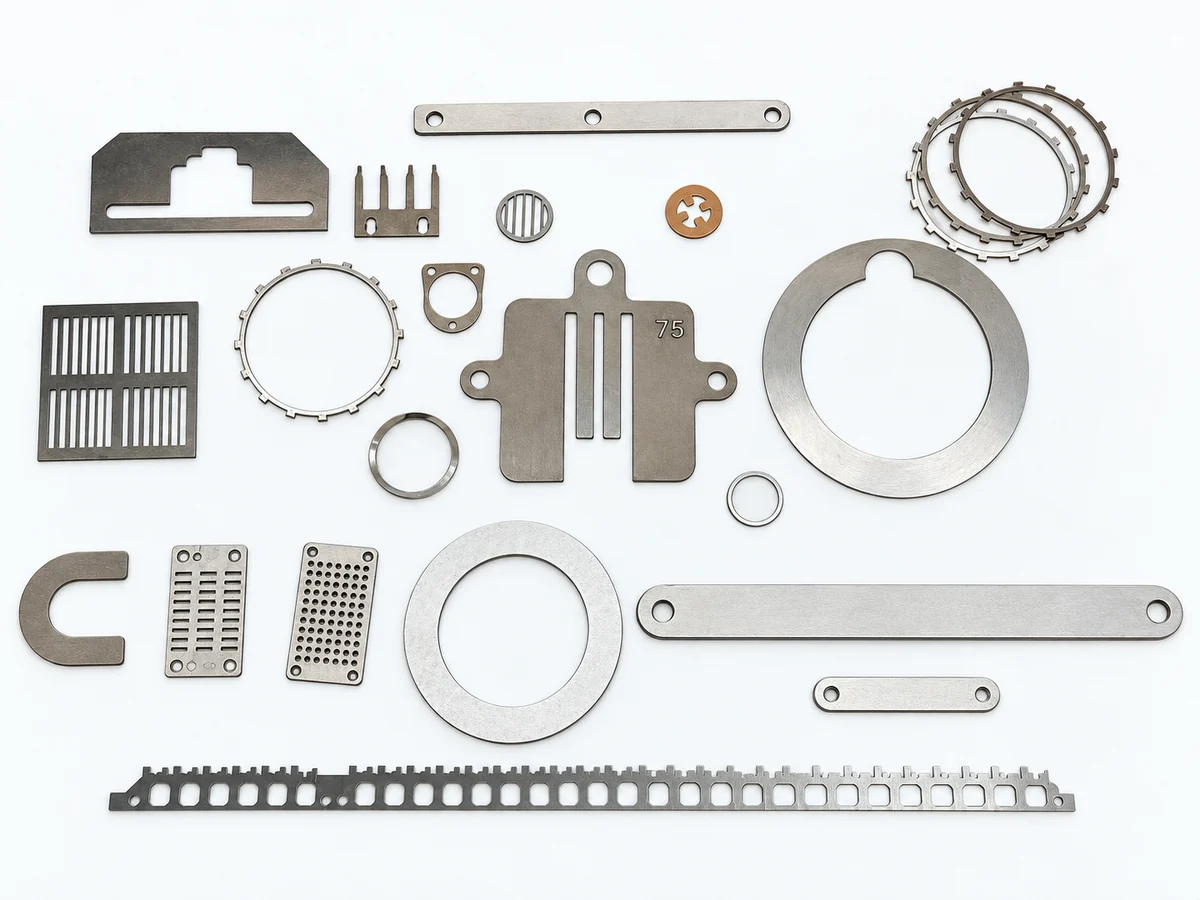
OD, ID, thickness, material: that is the whole drawing for a washer. Shims and washers from 1 piece in every thickness and material above; a pack of several thicknesses from the same outline is quoted as one line. Drawing back for approval, quote in 12 hours.
Shapes that are cut, and the numbers each one needs
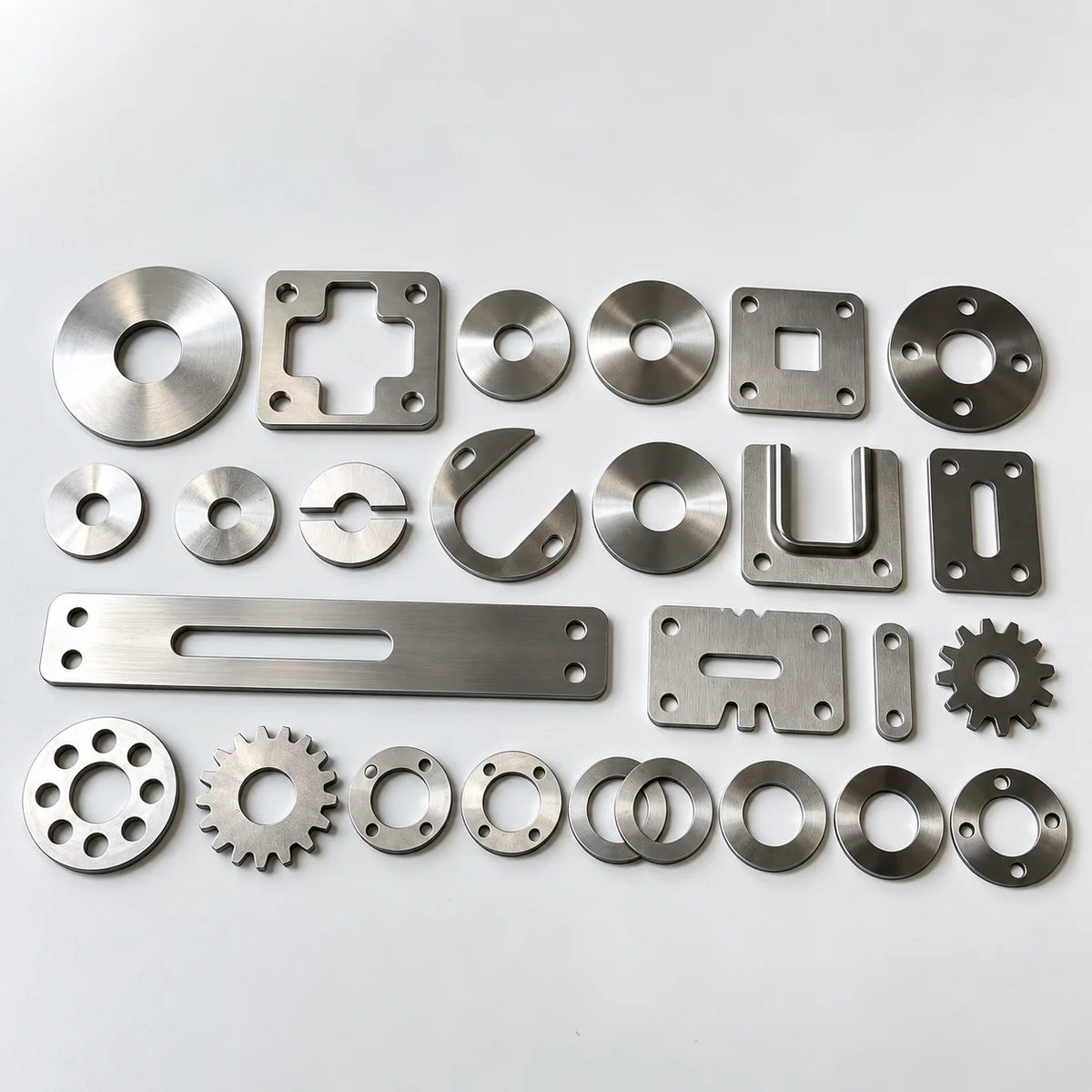
A washer is four numbers, OD, ID, thickness and material; a shim adds the outline and the hole positions from two datum edges; an open ring or C-shim adds the gap width; a toothed or tab washer adds the tooth count and form. The table gives the numbers that make a complete drawing for each shape.
| Shape | Numbers for the quote | Note |
|---|---|---|
| Round washer, flat washer | OD, ID, thickness | Bore reamed when it must fit a shaft |
| Ring and open ring, C-shaped shim | OD, ID, gap width, thickness | Slides over a shaft without dismantling |
| Square and rectangular shim, shim plate | Length, width, thickness, hole positions | Several thicknesses as a pack |
| Strip shim, slotted strip | Length, width, slot width and position | Long strips in 0.1 to 1 mm foil |
| Spacer shim with holes, flange shim | Outline, bolt circle, hole Ø, thickness | Matches the flange it sits under |
| Toothed shim, tab washer, lock ring | OD, ID, tooth count and form | Spring steel 65Mn or 301 for the spring |
| U-shaped and ear-type plate, mounting tab | Outline from two datum edges, holes | Cut flat; a tab bent on request |
| Multi-hole plate, grille, screen | Hole Ø, pitch, outline | Thin stainless; see machine guards for openings |
Which stainless grade, and when spring steel
304 is the general shim and washer grade, 316 or 316L where chlorides or cleaning chemicals are present, 301 in spring temper for a tab washer or lock ring that must spring back, 430 for a magnetic stainless, 201 where price matters more than corrosion, 65Mn spring steel for a hardened toothed washer, silicon steel for laminations, brass or copper for a conductive spacer.
| Material | Pick it when | Thickness cut | Finish |
|---|---|---|---|
| Stainless 304 / 1.4301 | A general shim, washer or spacer indoors or in a wash-down line | 0.03–10 mm | 2B, BA or brushed; passivated |
| Stainless 316 / 316L / 1.4404 | Chlorides, cleaning chemicals, marine, food | 0.05–10 mm | 2B or brushed; passivated |
| Stainless 301, spring temper | A tab washer, a lock ring or a shim that must spring back | 0.05–1 mm | Mill finish |
| Stainless 430 | A magnetic stainless, a cover plate, price-sensitive | 0.3–3 mm | BA or brushed |
| Stainless 201 | Price over corrosion resistance, dry use | 0.3–3 mm | 2B |
| 65Mn spring steel | Hardened toothed washers, spring shims, scrapers | 0.1–3 mm | Blued or plated; wire EDM when hardened |
| Silicon steel | Laminations, magnetic shims | 0.1–0.5 mm | Mill finish |
| Brass, copper | A conductive spacer or contact washer | 0.1–6 mm | Polished or plated |
| Carbon steel, aluminium 5052 / 6061 | A thick spacer or flange plate where stainless is not needed | 1–10 mm | Zinc plated; anodised |
Finishes by material: 2B, BA, brushed, mirror polished, mill finish or sandblasted on stainless; blued or plated on spring steel; polished or plated on brass and copper; passivation after cutting on 304 and 316. Edges are deburred as standard, edge-rounded, ground or polished on request; hardened 65Mn is cut by wire EDM where the laser would soften the edge.
One odd washer now, a few hundred later. The same part is quoted at 1, 10 and 100 pieces in one reply; from a few thousand a stamping die is quoted alongside. The drawing is kept for the reorder.
Where laser-cut shims and washers go
A bearing shim is a ring or an open ring in 0.05 to 0.5 mm stainless, a motor shim a slotted U that slides under the foot, a flange shim a ring with the flange's bolt holes, a mould shim a marked strip in spring steel, and a flat metal gasket a ring in annealed stainless or copper; the table gives the part, the thickness and the material each use usually takes, and all of them are cut from 1 piece.
| Use | Typical part | Thickness and material |
|---|---|---|
| Bearing shim, preload or end-float adjustment | Ring or open ring under the bearing cover | 0.05–0.5 mm stainless 304 / 301, as a pack of 0.1 + 0.2 + 0.5 |
| Motor and gearbox shim, alignment under a foot | Slotted U-shim that slides under the foot without lifting the motor | 0.1–3 mm stainless or carbon steel |
| Flange shim, pipe and valve alignment | Ring with the bolt holes of the flange | 0.5–3 mm stainless 304 / 316 |
| Mould and die adjustment shim | Square or strip shim, often marked with its thickness | 0.05–1 mm 65Mn or stainless 301 |
| Machinery clearance adjustment, guide and rail packing | Strip shim or spacer plate | 0.1–5 mm steel or stainless |
| Equipment mounting plate, instrument and sensor plate | Multi-hole plate or tab plate | 1–5 mm stainless or aluminium |
| Conductive spacer, contact washer, busbar shim | Ring or tab washer | 0.1–3 mm copper or brass |
| Flat metal gasket, sealing shim under a cover | Ring or outline with the cover's holes | 0.1–1 mm 304, 316 or copper, annealed |
| Lock ring, tab washer, toothed washer | Toothed ring, bent tab after cutting | 0.3–2 mm 65Mn hardened or 301 spring temper |
| Maintenance and replacement shims for a machine whose maker is gone | Copied from the old shim or the gap it fills | Any of the above, from 1 piece |
Will it fit, same but different, no drawing, second source
Will the shim fit? Checks before you order
A washer bore is cut at the shaft diameter plus 0.2 to 0.5 mm clearance unless it is marked as a fit, in which case it is reamed; a C-shim's gap is the shaft diameter plus 0.5 mm so it slides in from the side. A 0.1 mm foil shim has a slight edge burr toward one face, so the burr side is marked when it matters; above 0.5 mm the edge is deburred or rounded. Thickness is the sheet's, held to a few hundredths; a pack of 0.1 + 0.2 + 0.5 mm sets a gap to 0.1 mm steps.
Same washer, but one detail changed
The same washer with a 12.2 mm bore instead of 12, in 316 instead of 304, 0.3 mm thick instead of 0.5, with two tabs added, or as an open ring instead of a full ring is an edit to the kept drawing, quoted the same day. A lock washer first cut in 304 and later wanted with spring is recut in 301 spring temper or 65Mn.
No drawing: the old washer, or four numbers
A washer is OD, ID, thickness and material; a shim adds the outline and the hole positions from two datum edges. The old part posted or photographed square-on with a ruler, plus calliper numbers, is enough, and a worn washer is measured on the shaft and the seat instead. The drawing comes back for approval before the cut.
Supplier stopped, minimum too high, lead time too long
A laser-cut washer or shim is a DXF, a material and a thickness, so a second source starts from the drawing or the old part; where the previous supplier asked for 1,000 pieces, the part is made from 1 piece here with the unit price stepping down at 10 and 100, and the reorder is cut from the kept file.
Where the catalogue washer stops
A standard flat washer is cheaper from stock than from a laser; the laser earns its place with an odd bore, a large OD, a thickness between the catalogue sizes, an open ring, a pack of shims or a toothed washer the catalogue dropped.
| You need | From stock? | How it is made |
|---|---|---|
| A flat washer in a standard size, M3 to M24 | Yes — stock item | Buy it from stock; a laser-cut one-off cannot beat a stamped catalogue washer on price |
| A washer with an odd bore, a large OD or a thickness between the catalogue sizes | No | Laser cut to OD, ID and thickness from 1 piece; bore reamed when it fits a shaft |
| An open ring or C-shim that slides in under a bearing without dismantling | No | Cut with the gap at shaft diameter plus clearance; stainless or spring steel |
| A set of shims in 0.1, 0.2, 0.3 and 0.5 mm with one outline | No | Cut from four foils, marked with the thickness, packed as a set |
| A toothed lock washer or a tab washer in a size the catalogue stopped | No | Cut in 65Mn or 301 spring temper, hardened or spring tempered as the original |
| A 10 mm stainless washer or flange with a reamed bore | No | Laser cut, bore reamed, face ground where it is a fit |
| A 0.03 mm foil shim with a complex outline | No | Precision laser or etching, left in a frame or on a tab for handling |
Why two washers of the same size are not the same price
There is no list price for a laser-cut shim or washer: eight things set it, and the quote comes within 12 hours with the drawing that will be cut.
| Cost driver | What it means on a laser-cut part |
|---|---|
| Material and foil | A 0.1 mm 304 foil costs more per part to handle than a 2 mm sheet; 316 and spring steel cost more than 304 |
| Parts per sheet | Small washers nest by the hundred on one sheet; one odd washer carries the sheet set-up |
| Outline and holes | A toothed washer is a long outline; a plain ring is two circles |
| Tolerance | ±0.1 mm is the laser; ±0.05 mm, a reamed bore or a ground thickness is a second operation |
| Edge treatment | Deburring is in; edge rounding, grinding and polishing add handling per part |
| Finish | Passivation and plating carry a lot charge; brushing is per part |
| Quantity | 1 piece carries the set-up; 100 share a sheet; thousands go to a stamping die |
| Inspection | A thickness and bore report is made on request |
The cluster: laser cutting thickness and tolerance chart · laser-cut plates with holes and cutouts · replacement guards and cover plates · thin washers and precision shims 0.05–1 mm: etched, laser-cut or turned · custom thick and large-OD washers · machined washers from a sketch · plastic and insulating washers.
Frequently asked questions about laser-cut shims and washers
0.03 mm in stainless foil, cut by precision laser or chemical etching with the parts left in a frame or on a tab so they can be handled; 0.1 to 0.3 mm is cut by precision laser to about ±0.03–0.05 mm, and 0.5 mm upward by the standard laser to ±0.05–0.1 mm. Common shim thicknesses are 0.03, 0.05, 0.08, 0.1, 0.15, 0.2, 0.3, 0.5, 0.8 and 1 mm, and a pack of mixed thicknesses is cut from the same outline.
About ±0.1 mm on the outline and the bore of a standard laser-cut part, and about ±0.05 mm on small precision parts after a check of the thickness, the material and the outline; ±0.05 mm is not assumed for every part. A bore that must fit a shaft is reamed after the cut; a thickness that must be a fit is ground. The thickness itself follows the sheet, which is held to a few hundredths on thin foil.
304 for a general shim or washer, 316 or 316L where chlorides or cleaning chemicals are present, 301 in spring temper for a tab washer or a lock ring that must spring back, 430 where a magnetic stainless is wanted, and 201 where price matters and corrosion does not. 65Mn spring steel is the choice for a hardened toothed washer; silicon steel for laminations and magnetic shims; brass or copper for a conductive spacer.
Yes. An open ring, a C-shape or a U-shape with the gap cut to the shaft diameter plus clearance slides in from the side under a bearing, a motor foot or a flange; the outline is cut from the OD, ID, gap width and thickness, from 1 piece, in stainless or spring steel. A tab bent up to pull the shim out again is added on request.
Yes, from 1 piece; the laser needs no die, so one washer with an odd bore or one 0.2 mm shim costs the sheet it sits on and the cut, and the drawing is kept for the reorder. From 10 pieces the parts share one sheet; from a few thousand a stamping die is quoted alongside, which is where catalogue washers come from.
No list price: the material and the foil thickness, the number of parts on a sheet, the outline length and the hole count, the tolerance, the edge treatment and the finish, the quantity and the inspection set it, and the quote comes within 12 hours. A standard washer in a catalogue size is cheaper from stock; a washer with your bore, your OD or your thickness is where the laser earns its place.