Guard and cover types, and what to measure on the old one
A guard is a flat or folded sheet with fixing holes, a perforated or meshed area where air or sight must pass, and sometimes a hinge, a latch, a handle and a window; the table lists the guards and covers that are remade most, the material each usually comes in, and the measurements the old one must give up before it is drawn.
| Part | Form | Usual material and thickness | What to measure or photograph |
|---|---|---|---|
| Belt, chain or pulley guard | Folded box or half-shell, often perforated | Galvanised or powder-coated steel 1.5–2 mm; stainless 1.5 mm on wash-down lines | Outside length, width and depth; fixing holes from two edges; the pulley it clears |
| Fan or finger guard | Flat perforated plate or ring | Steel 1–1.5 mm, stainless 1 mm, aluminium 2 mm | Outside diameter or outline, bolt circle, hole size and pitch, the fan behind it |
| Inspection cover, hand-hole cover | Flat plate, sometimes hinged | Steel 2–3 mm, stainless 2 mm, aluminium 3 mm | Outline, screw holes from two edges, gasket groove if any, which face shows |
| Access panel or door | Folded tray with hinge and latch | Steel 1.5–2 mm, stainless 1.5 mm | Outside size, hinge side and type, latch type, handle, window size |
| Chip guard, splash guard, way cover | Folded, sometimes with a window | Stainless 1.5–2 mm, aluminium 2–3 mm, polycarbonate window | Profile of the fold, the slide it covers, the window position |
| Conveyor side guard, nip guard | Folded angle or channel | Galvanised steel 2–3 mm, stainless 2 mm | Length, leg sizes, slot positions for adjustment |
| Kick plate, sill plate, floor plate | Flat plate, chequer or plain | Aluminium 3–5 mm, steel 3–5 mm | Outline, countersunk holes, which edge is seen |
| Blanking plate, slot cover, cable cover | Flat plate | Steel 1.5–2 mm, aluminium 2 mm, stainless 1.5 mm | Outline and screw holes; the cutout it closes |
Photo of the old guard, two measurements, the material: that is the order. Belt, chain and fan guards, covers and access panels from 1 piece; perforated to the hole size the safety distance allows; hinges, latches and windows fitted. Drawing back for approval, quote in 12 hours.
Measuring a guard or cover when there is no drawing
A flat cover is measured from two straight edges: every fixing hole as X and Y from that corner, each diameter or slot, the outline and the thickness; a folded guard is measured on the outside, length, width and depth, with the fold radius and the thickness, and its fixing holes from the outside edges; a perforated area needs the hole diameter, the pitch and the pattern, straight or staggered. A photo taken square-on with a ruler in the frame records a shape that is hard to describe, and a second photo of the mounting face catches the holes that a torn guard no longer has. The drawing comes back for approval before the cut, and the part itself can be posted and is returned with the new one. A typical remake is a belt guard in 2 mm galvanised S235 with 5 mm holes at 8 mm pitch, 35 % open area, folded 60 mm deep and sitting 5 mm from the belt.
Hole size and the distance to the moving part
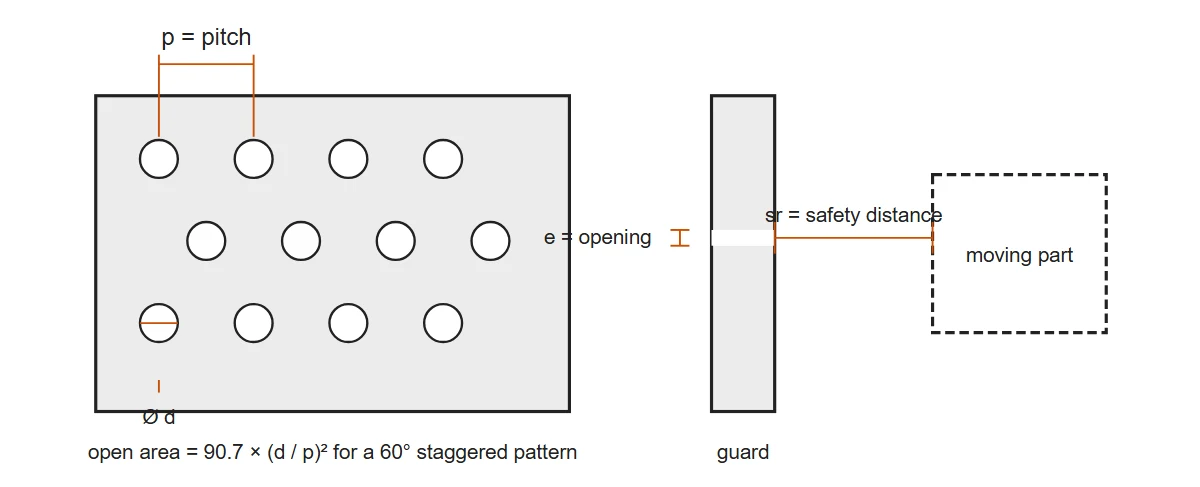
A perforated guard with round holes up to 4 mm may sit 2 mm from the moving part, with 5 or 6 mm holes 5 mm away, with 8 to 10 mm holes 20 mm away and with 10 to 12 mm holes 80 mm away; slots need more distance than round holes of the same width because a finger reaches further through a slot. The table is EN ISO 13857 Table 4 for persons of 14 and over, and the guard is cut to the hole size the distance on the machine allows.
| Opening e | Slot | Square | Round | What can reach through |
|---|---|---|---|---|
| e ≤ 4 | 2 | 2 | 2 | fingertip |
| 4 < e ≤ 6 | 10 | 5 | 5 | fingertip |
| 6 < e ≤ 8 | 20 | 15 | 5 | finger |
| 8 < e ≤ 10 | 80 | 25 | 20 | finger |
| 10 < e ≤ 12 | 100 | 80 | 80 | finger to knuckle |
| 12 < e ≤ 20 | 120 | 120 | 120 | finger / hand |
| 20 < e ≤ 30 | 850 (200 if the slot is ≤ 65 mm long) | 120 | 120 | hand / arm |
| 30 < e ≤ 40 | 850 | 200 | 120 | arm |
| 40 < e ≤ 120 | 850 | 850 | 850 | arm to shoulder |
Values are the standard's regular-opening table for adults; the machine's own risk assessment decides the opening it needs, and a guard with an interlock takes its switch and circuit from their maker.
Open area of common hole patterns
The open area of a 60° staggered pattern is 90.7 × (d/p)² and of straight rows 78.5 × (d/p)²: 5 mm holes at 8 mm pitch give 35 %, 3 mm holes at 5 mm give 33 %, 10 mm holes at 15 mm give 40 %. Fan and belt guards use 4 to 6 mm holes so the guard can sit close to the moving part; vent panels for cooling air use 8 to 12 mm holes and sit further away or cover a fan with its own finger guard.
| Hole d | Pitch p | 60° staggered | Straight rows | Safety distance, round hole |
|---|---|---|---|---|
| 2 mm | 3.5 mm | 30 % | 26 % | 2 mm |
| 3 mm | 5 mm | 33 % | 28 % | 2 mm |
| 4 mm | 6 mm | 40 % | 35 % | 2 mm |
| 5 mm | 8 mm | 35 % | 31 % | 5 mm |
| 6 mm | 9 mm | 40 % | 35 % | 5 mm |
| 8 mm | 12 mm | 40 % | 35 % | 5 mm |
| 10 mm | 15 mm | 40 % | 35 % | 20 mm |
| 12 mm | 18 mm | 40 % | 35 % | 80 mm |
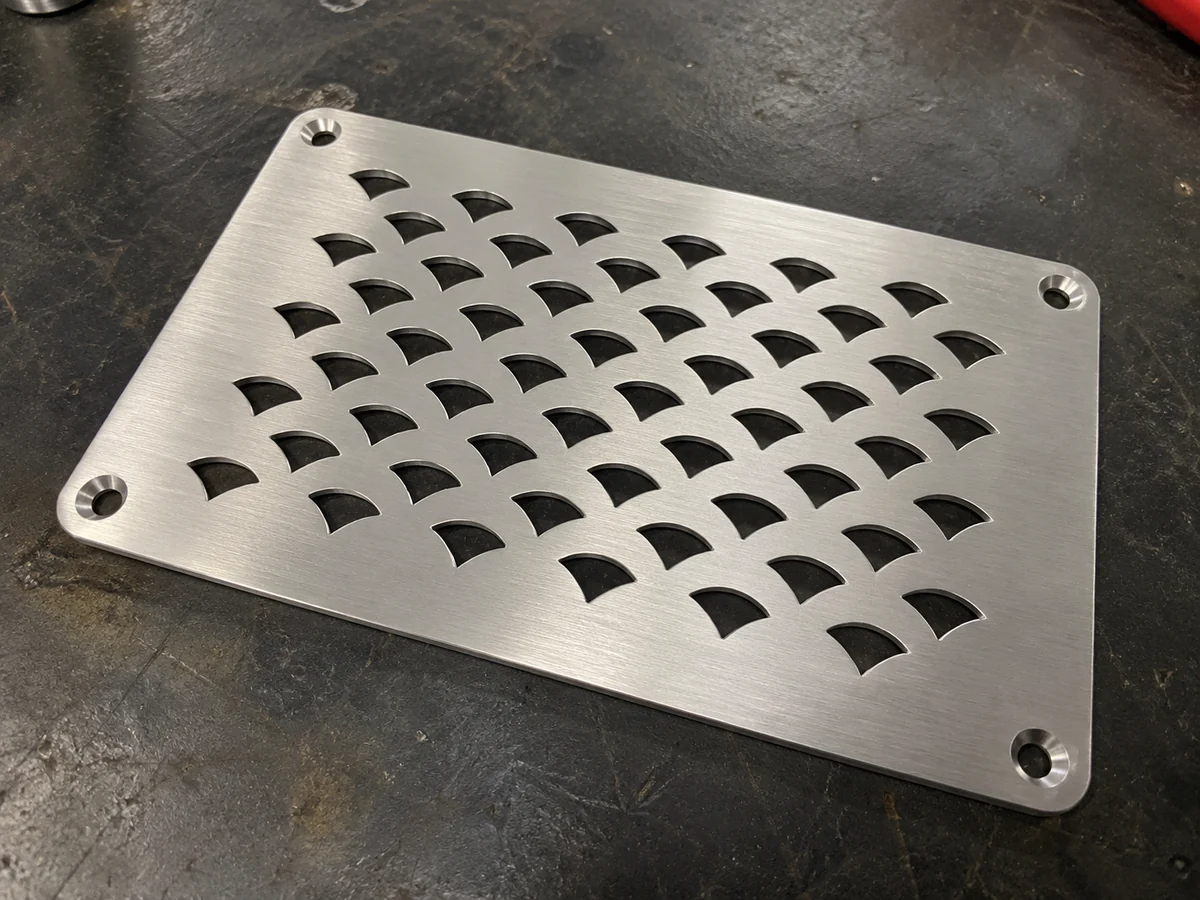
Pick the hole size from the table; the guard is cut to it. Perforated guards and covers in steel, stainless or aluminium, the pattern cut by laser so the hole size, the pitch and the outline are all yours; standard perforated sheet can also be supplied and cut to your outline. From 1 piece, quote in 12 hours.
Material for a guard by where the machine stands
Galvanised or powder-coated mild steel for a dry workshop, stainless 304 for a wash-down line and 316 where chlorides or cleaning chemicals are present, aluminium 5052 where the guard is lifted by hand; the finish follows the material, and a guard that was painted steel on a machine now washed daily is remade in stainless with the same holes.
| Environment | Material | Finish | Note |
|---|---|---|---|
| Dry workshop, indoor machinery | Mild steel S235, 1.5–3 mm | Zinc plated, or powder coated in the machine's colour | The cheapest route; RAL colour matched on request |
| Wash-down line, dairy, drinks | Stainless 304 / 1.4301, 1.5–2 mm | Brushed or bead blasted | No paint to chip; welds polished where product touches |
| Chlorides, cleaning chemicals, coastal | Stainless 316 / 1.4404, 1.5–2 mm | Brushed | 316 where 304 pits |
| Lifted by hand, overhead, vehicle | Aluminium 5052, 2–3 mm | Anodised or powder coated | Half the weight of steel; 5052 folds at 1 × t |
| Hot zone, dryer, oven | Stainless 304 or aluminised steel, 1.5–2 mm | Bare | Paint is not used near heat |
| See-through guard | Steel or stainless frame with a polycarbonate window | Powder coated frame | The window is screwed behind a laser-cut opening |
Machine down, will it fit, same but different, second source
Machine down: what to send in the next ten minutes
A photo of the old guard square-on with a ruler in the frame, a second photo of the place it bolts to, the outside length, width and depth, the fixing-hole positions from two edges, the thickness measured on a clean edge, and the material if known; a bent guard is measured on the machine rather than on the guard. The drawing comes back the same day for approval, and the cut follows.
Will the guard fit? Checks before you order
A folded guard holds about ±0.5 mm across a bend and ±0.1 mm on the holes, so fixing holes are cut as slots where the old ones were slots and the depth is drawn 1 mm larger than the pulley it clears; a perforated guard's hole size is checked against the table for the distance it sits from the moving part, and a 12 mm hole 20 mm from a belt is replaced by 6 mm holes. A powder coat adds about 0.1 mm per face, which matters only in a tight slot.
Same guard, but one detail changed
The same guard in stainless instead of painted steel, with a window added, with a hinge instead of six screws, with smaller holes to meet the safety distance, or 20 mm deeper for a wider belt is an edit to the drawing, quoted the same day; a cover first made as one replacement and later wanted for the other five machines of the line is run from the kept file.
OEM out of business, minimum too high, lead time too long
A guard is a drawing, a material, a thickness and a finish, so a second source starts from the old part; where the OEM quoted twelve weeks or a minimum of 50, the same guard is made from 1 piece here with the unit price stepping down at 10. The first guard checks the fit; the rest of the line is quoted from the kept drawing.
Where the catalogue and the OEM stop
An OEM guard that is still stocked is cheaper than a remake; the remake earns its place when the maker is gone, the material must change, the holes must shrink to meet the safety distance, or the cover needs a window, a hinge or a different depth.
| You need | From stock? | How it is made |
|---|---|---|
| The OEM guard, still listed and in stock | Yes — stock item | Buy it from stock from the maker or a dealer; a one-off remake cannot beat a stocked part |
| Standard perforated sheet by the metre | Yes — stock item | Buy it from stock from a merchant; we cut it to your outline and fold it when the shape is yours |
| The guard from a machine whose maker is gone or no longer answers | No | Measured from the old part or your photo, drawn, cut, folded, finished; see parts when the manufacturer is out of business |
| The same guard in stainless because the line is now washed down | No | Same outline and holes, cut in 304 or 316, brushed; hinges in stainless |
| A guard with smaller holes to meet the safety distance | No | Hole size and pitch chosen from the table for the distance to the hazard; cut by laser |
| A cover with a window, a hinge and a latch | No | Laser-cut opening with a polycarbonate window, piano hinge and quarter-turn latch fitted |
| A guard with a certified interlock or a CE-marked safety circuit | Yes — stock item | We make the metal; the interlock switch and the safety circuit come from their maker and the machine's safety assessment |
Why two guards of the same size are not the same price
There is no list price for a replacement guard: eight things set it, and the quote comes within 12 hours with the drawing that will be cut.
| Cost driver | What it means on a laser-cut part |
|---|---|
| Sheet and material | A 2 mm galvanised steel cover is priced on the sheet; the same cover in 304 costs more per kilogram and cuts slower |
| Holes and cut length | A perforated guard with 600 holes is 600 pierces; the hole count moves the time more than the outline |
| Bends | A box guard with five bends is five brake operations; a flat cover has none |
| Hinges, latches, handles, windows | Each is a part fitted and a step; a cover on six screws has none |
| Finish | Zinc plating and powder coating carry a lot charge; brushed stainless is handled per part |
| Tolerance | ±0.5 mm across a bend is the brake; a sealing face under 0.1 mm is a milling operation |
| Quantity | 1 guard carries the set-up; 5 for the line share one sheet and one finish lot |
| Inspection | A check against the old part's holes is in; a measurement report is made on request |
The cluster: laser cutting thickness and tolerance chart · laser-cut plates with holes and cutouts · laser-cut shims and washers for machine adjustment · sheet-metal bend radius chart · manufacturer out of business · replacement machine parts · hinges and latches · conveyor replacement parts.
Frequently asked questions about replacement guards and covers
Yes, from 1 piece. The old guard, even bent or cracked, is measured from its two straight edges and its fixing holes, or a square-on photo with a ruler plus calliper numbers is used; the drawing comes back for approval, then the guard is laser cut, folded where the old one was folded, and finished in galvanised or powder-coated steel, stainless or aluminium. The old part is posted back with the new one if it was sent.
Openings up to 4 mm need only 2 mm between the guard and the moving part, 4 to 6 mm need 10 mm for a slot and 5 mm for a round hole, 6 to 8 mm need 20 mm for a slot and 5 mm for a round hole, 8 to 10 mm need 80 mm for a slot and 20 mm for a round hole, and 10 to 12 mm need 100 mm for a slot and 80 mm for a hole; these are the EN ISO 13857 table values for adults. A guard with 5 mm round holes can sit 5 mm from a belt; one with 12 mm holes must sit 80 mm away.
A 60° staggered pattern has 90.7 × (d/p)² open area, a straight pattern 78.5 × (d/p)²: 5 mm holes at 8 mm pitch give 35 %, 3 mm holes at 5 mm pitch give 33 %, 10 mm at 15 mm give 40 %. For cooling air the open area matters; for a safety guard the hole size and the distance to the hazard matter more, which is why fan and belt guards use 4 to 6 mm holes.
Stainless 304 or 1.4301 for a wash-down line, 316 or 1.4404 where chlorides or cleaning chemicals are present; galvanised or powder-coated mild steel for a dry workshop; aluminium 5052 where weight matters or the guard is lifted by hand. A guard that was painted steel on a machine now washed daily is remade in stainless with the same holes.
Yes. A hinged inspection cover gets a piano hinge or two butt hinges and a quarter-turn latch or captive screws; a handle is folded in or bolted on; a window is a laser-cut opening with a polycarbonate sheet screwed behind it. The hinges and latches are listed on the door hardware pages and are fitted here, so the cover arrives ready to hang.
A flat or folded guard ships in about five working days, plus a finish lot where powder coating is wanted; a stainless guard with hinges takes a few days more. There is no list price: the sheet, the cut length and the number of holes, the bends, the hinges and latches, the finish, the quantity and the inspection set it, and the quote comes within 12 hours with the drawing that will be cut.