The Short Answer
Choose grey iron for parts that sit, damp and carry heat; choose ductile iron for parts that are pulled, bent, struck or under pressure. EN-GJL-250 (the old GG-25), the grey iron most drawings name, has a minimum tensile strength of 250 MPa and breaks without bending; EN-GJS-400-15 (the old GGG-40), the most common ductile grade, reaches 400 MPa and stretches 15 % first. Grey iron costs less to cast, fills thin walls, machines to short chips and damps vibration, which is why machine beds, brake discs, pulleys and many pump and gearbox housings are grey. Ductile iron is stiffer (169 against 103–118 GPa) and takes shock, which is why valve bodies, pipe fittings, hubs, brackets and many crankshafts are ductile.
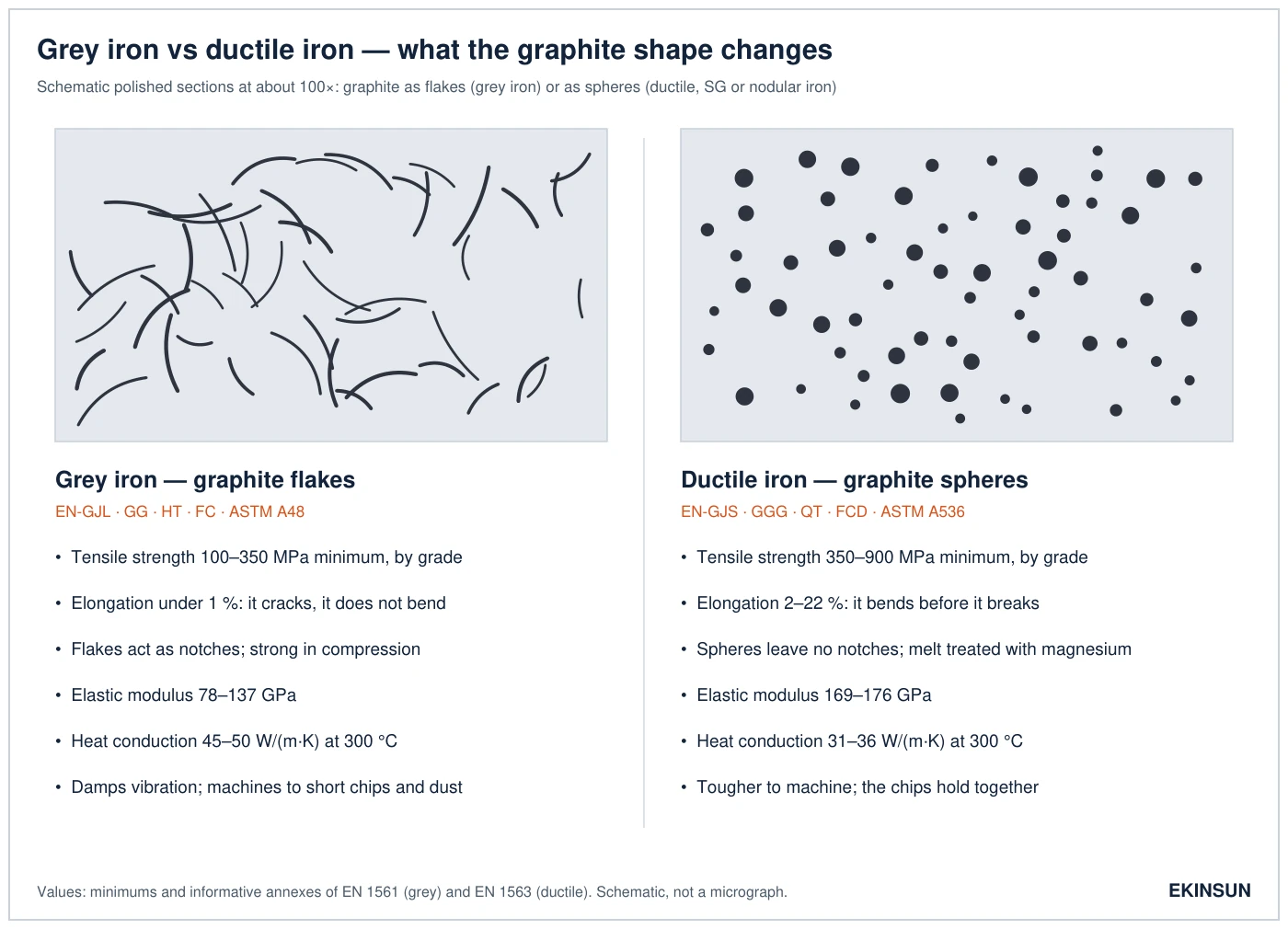
Grey vs Ductile Iron — the Numbers
The grey iron and the ductile iron that most drawings name, side by side. Minimums are from EN 1561:2011 and EN 1563:2018; modulus, conductivity and density are the informative values of the same standards.
| Property | Grey iron EN-GJL-250 | Ductile iron EN-GJS-400-15 | What it means for the part |
|---|---|---|---|
| Tensile strength, minimum | 250 MPa (up to 350) | 400 MPa | ductile iron carries 60 % more in tension |
| 0.2 % proof strength, minimum | not specified | 250 MPa | grey iron has no yield point to design on; ductile iron is designed on proof strength, like steel |
| Elongation, minimum | not specified; under 1 % in practice | 15 % | a grey part cracks where a ductile part bends: bolting errors, shock and water hammer |
| Tensile strength in thicker walls | 250 MPa to 50 mm · 220 in 50–100 mm · 200 in 100–200 mm | 400 MPa to 30 mm · 390 in 30–60 mm · 370 in 60–200 mm | a grade holds its number only in the wall it was specified for; grey iron loses more |
| Elastic modulus | 103–118 GPa | 169 GPa | a ductile part of the same shape deflects about a third less |
| Compressive strength | about 3 × the tensile strength | not the design limit | grey iron suits beds, bases and columns loaded in compression |
| Brinell hardness | ordered by grade EN-GJL-HB155 to HB255 when it matters | 135–180 HB (guidance) | both machine well in these ranges |
| Thermal conductivity at 300 °C | 46.5 W/(m·K) | 36.2 W/(m·K) (ferritic grades) | grey iron carries about 28 % more heat: brake discs, cylinder liners |
| Density | 7.20 g/cm³ | 7.1 g/cm³ | the same weight for the same part |
| Damping | high — the flakes absorb vibration | lower | machine beds and brake parts stay grey |
| Impact energy | not specified | not for -15; guaranteed in the -LT and -RT grades, e.g. EN-GJS-400-18-LT 12 J mean at −20 °C | order an -LT grade for cold outdoor service |
| Casting cost | lower | higher: magnesium treatment and a low-sulphur melt | grey iron is the default wherever its strength is enough |
| Machining | short chips and graphite dust | chips hold together; harder on tools | both hold ISO 2768-m on machined faces |
Need a part machined in grey iron or ductile iron? EKINSUN is a custom parts manufacturer: we machine parts in grey iron or ductile iron to your drawing, sketch or sample, from 1 piece, with a material certificate on request and a quote in 12 hours. If the size is standard, ask anyway — it may be in stock, and the unit price drops as the quantity rises. How ordering without CAD works →
Grey Iron Grades — EN 1561 With Old DIN, JIS, GB and ASTM Names
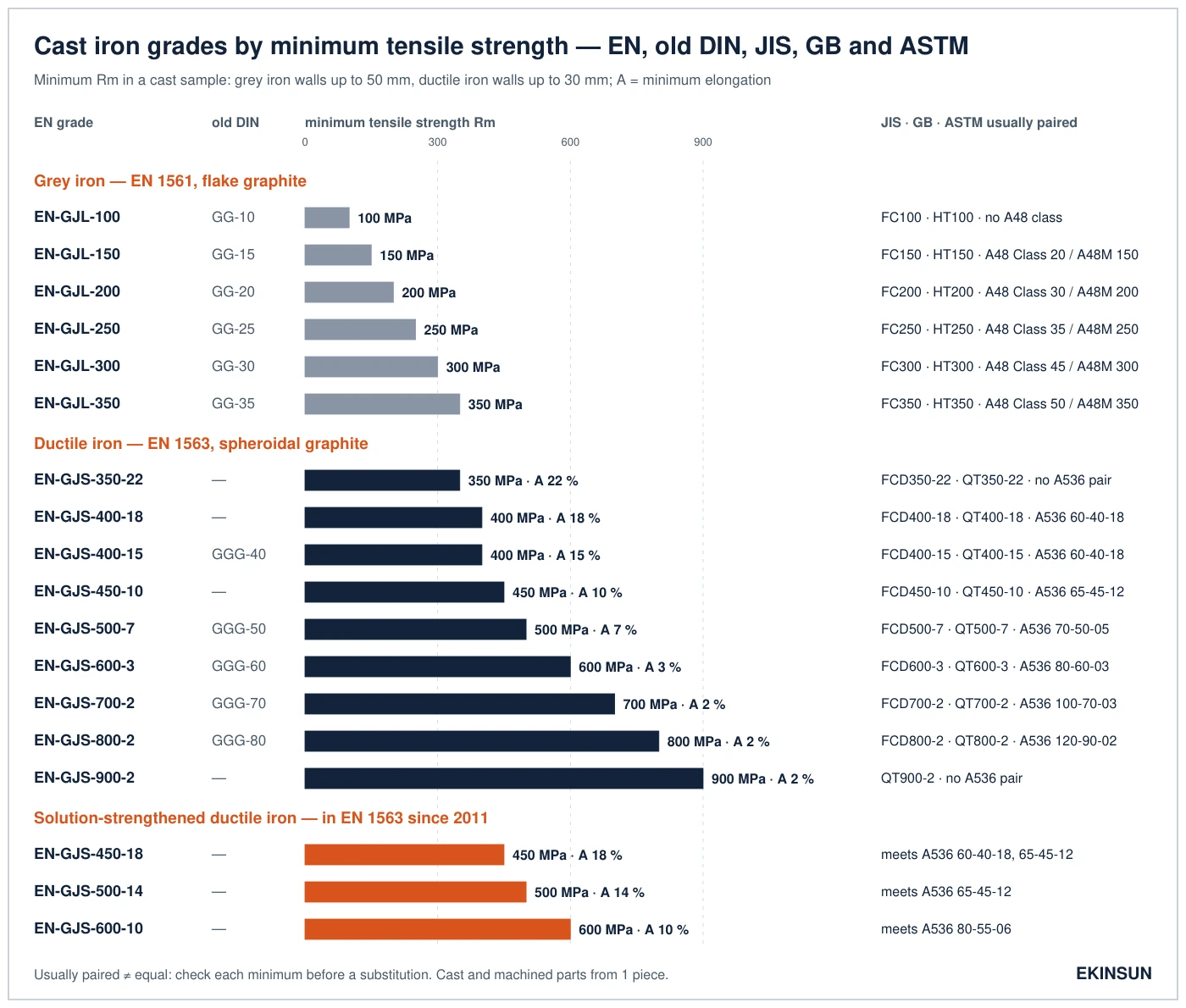
EN 1561 names grey iron by its minimum tensile strength, and the maximum of every grade is the minimum plus 100 MPa: EN-GJL-250 is 250–350 MPa. Since the 2011 edition the value belongs to a sample cast to the size of the wall — for EN-GJL-250, 250 MPa up to 50 mm, 220 MPa for 50–100 mm and 200 MPa for 100–200 mm; drawings from before 2011 relate the grade to a 30 mm test bar. The German names GG-10 to GG-35 (DIN 1691, replaced in 1997) are the same grades under their old names.
| EN 1561 grade | Number since 2011 | Number 1997–2011 | Old DIN 1691 (Werkstoff-Nr.) | Rm, MPa, walls to 50 mm | Rm min, 50–100 / 100–200 mm | JIS G5501 | GB/T 9439 | ASTM A48 usually paired |
|---|---|---|---|---|---|---|---|---|
| EN-GJL-100 | 5.1100 | EN-JL1010 | GG-10 (0.6010) | 100–200 (walls 5–40 mm only) | — | FC100 | HT100 | — |
| EN-GJL-150 | 5.1200 | EN-JL1020 | GG-15 (0.6015) | 150–250 | 130 / 110 | FC150 | HT150 | Class 20 (138 MPa) · A48M 150 |
| EN-GJL-200 | 5.1300 | EN-JL1030 | GG-20 (0.6020) | 200–300 | 180 / 160 | FC200 | HT200 | Class 30 (207 MPa) · A48M 200 |
| EN-GJL-250 | 5.1301 | EN-JL1040 | GG-25 (0.6025) | 250–350 | 220 / 200 | FC250 | HT250 | Class 35 (241 MPa) · A48M 250 |
| EN-GJL-300 | 5.1302 | EN-JL1050 | GG-30 (0.6030) | 300–400 | 260 / 240 | FC300 | HT300 | Class 45 (310 MPa) · A48M 300 |
| EN-GJL-350 | 5.1303 | EN-JL1060 | GG-35 (0.6035) | 350–450 | 310 / 280 | FC350 | HT350 | Class 50 (345 MPa) · A48M 350 |
EN 1561 also specifies grey iron by hardness instead of strength: EN-GJL-HB155 to EN-GJL-HB255, where the number is the maximum Brinell hardness in walls up to 50 mm. That is the grade to name when machinability or wear matters more than strength, for example on a series of housings machined on one line.
Ductile (SG) Iron Grades — EN 1563 With Old DIN, JIS, GB and ASTM Names
EN 1563 names ductile iron by minimum tensile strength and elongation: EN-GJS-400-15 is 400 MPa and 15 % in walls up to 30 mm. Grades ending -LT guarantee Charpy impact energy at −20 °C or −40 °C, grades ending -RT at room temperature. Since 2011 the standard also has three solution-strengthened ferritic grades, EN-GJS-450-18, 500-14 and 600-10: silicon in the ferrite instead of pearlite gives them more proof strength and elongation for the same tensile strength, and a narrower hardness band that machines evenly.
| EN 1563 grade | Number | Number 1997–2011 | Old DIN 1693 (Werkstoff-Nr.) | Rp0.2 / Rm MPa / A, to 30 mm | Rm MPa / A, 30–60 mm | HB (guidance) | Matrix | JIS G5502 | GB/T 1348 | ASTM A536 usually paired |
|---|---|---|---|---|---|---|---|---|---|---|
| EN-GJS-350-22-LT | 5.3100 | EN-JS1015 | GGG-35.3 (0.7033) | 220 / 350 / 22 % | 330 / 18 % | < 160 | ferrite; Charpy 12 J mean at −40 °C | FCD350-22L | QT350-22L | — |
| EN-GJS-350-22 | 5.3102 | EN-JS1010 | — | 220 / 350 / 22 % | 330 / 18 % | < 160 | ferrite | FCD350-22 | QT350-22 | — |
| EN-GJS-400-18-LT | 5.3103 | EN-JS1025 | GGG-40.3 (0.7043) | 240 / 400 / 18 % | 380 / 15 % | 130–175 | ferrite; Charpy 12 J mean at −20 °C | FCD400-18L | QT400-18L | 60-40-18 |
| EN-GJS-400-18 | 5.3105 | EN-JS1020 | — | 250 / 400 / 18 % | 390 / 15 % | 130–175 | ferrite | FCD400-18 | QT400-18 | 60-40-18 |
| EN-GJS-400-15 | 5.3106 | EN-JS1030 | GGG-40 (0.7040) | 250 / 400 / 15 % | 390 / 14 % | 135–180 | ferrite | FCD400-15 | QT400-15 | 60-40-18 |
| EN-GJS-450-10 | 5.3107 | EN-JS1040 | — | 310 / 450 / 10 % | by agreement | 160–210 | ferrite | FCD450-10 | QT450-10 | 65-45-12 |
| EN-GJS-500-7 | 5.3200 | EN-JS1050 | GGG-50 (0.7050) | 320 / 500 / 7 % | 450 / 7 % | 170–230 | ferrite–pearlite | FCD500-7 | QT500-7 | 70-50-05 |
| EN-GJS-600-3 | 5.3201 | EN-JS1060 | GGG-60 (0.7060) | 370 / 600 / 3 % | 600 / 2 % | 190–270 | pearlite–ferrite | FCD600-3 | QT600-3 | 80-60-03 |
| EN-GJS-700-2 | 5.3300 | EN-JS1070 | GGG-70 (0.7070) | 420 / 700 / 2 % | 700 / 2 % | 225–305 | pearlite | FCD700-2 | QT700-2 | 100-70-03 |
| EN-GJS-800-2 | 5.3301 | EN-JS1080 | GGG-80 (0.7080) | 480 / 800 / 2 % | by agreement | 245–335 | pearlite | FCD800-2 | QT800-2 | 120-90-02 |
| EN-GJS-900-2 | 5.3302 | EN-JS1090 | — | 600 / 900 / 2 % | by agreement | 270–360 | pearlite | — | QT900-2 | — |
| EN-GJS-450-18 | 5.3108 | — | — | 350 / 450 / 18 % | 430 / 14 % | 170–200 | ferrite, silicon-strengthened | — | — | — |
| EN-GJS-500-14 | 5.3109 | — | — | 400 / 500 / 14 % | 480 / 12 % | 185–215 | ferrite, silicon-strengthened | — | — | — |
| EN-GJS-600-10 | 5.3110 | — | — | 470 / 600 / 10 % | 580 / 8 % | 200–230 | ferrite, silicon-strengthened | — | — | — |
Two details that trip up a crosswalk: JIS FCD450-10 has a 0.2 % proof minimum of 280 MPa where EN-GJS-450-10 has 310 MPa, so an EN casting meets a JIS drawing but not the other way round; and ISO 1083 has 500-10 and 550-5 grades that have no EN counterpart.
ASTM on the Drawing — Which Grade Meets It
Crosswalk tables pair grades by name, and most pairs are not equal on paper. A grade meets another only when every minimum — tensile strength, proof strength, elongation — is at or above it. The two tables check each usual pair in walls up to 50 mm (grey) or 30 mm (ductile), with ASTM values converted from ksi.
| Drawing says | Minimum Rm | EN grade usually paired | Does it meet the class? | EN grade that meets it |
|---|---|---|---|---|
| A48 Class 20 | 138 MPa | EN-GJL-150 | yes | EN-GJL-150 |
| A48 Class 25 | 172 MPa | — | — | EN-GJL-200 |
| A48 Class 30 | 207 MPa | EN-GJL-200 | no — 200 < 207 MPa | EN-GJL-250 |
| A48 Class 35 | 241 MPa | EN-GJL-250 | yes | EN-GJL-250 |
| A48 Class 40 | 276 MPa | — | — | EN-GJL-300 |
| A48 Class 45 | 310 MPa | EN-GJL-300 | no — 300 < 310 MPa | EN-GJL-350 |
| A48 Class 50 | 345 MPa | EN-GJL-350 | yes | EN-GJL-350 |
| A48 Class 55 | 379 MPa | — | — | none in EN 1561 |
| A48 Class 60 | 414 MPa | — | — | none in EN 1561 |
Of the five usual grey pairs, none holds both ways: EN-GJL-150, 250 and 350 meet A48 Class 20, 35 and 50, while Class 30 and Class 45 meet EN-GJL-200 and 300. The metric companion standard A48M uses the EN numbers directly — A48M Class 250 is 250 MPa, like EN-GJL-250.
| Drawing says | Rm / Rp0.2 / A | EN grade usually paired | Does it meet the grade? | EN grades that meet all three |
|---|---|---|---|---|
| A536 60-40-18 | 414 / 276 MPa / 18 % | EN-GJS-400-18 / EN-GJS-400-15 | no — Rm 400 < 414, Rp0.2 250 < 276 | EN-GJS-450-18 |
| A536 65-45-12 | 448 / 310 MPa / 12 % | EN-GJS-450-10 | no — A 10 < 12 % | EN-GJS-450-18, EN-GJS-500-14 |
| A536 80-55-06 | 552 / 379 MPa / 6 % | — | — | EN-GJS-600-10 |
| A536 100-70-03 | 689 / 483 MPa / 3 % | EN-GJS-700-2 | no — Rp0.2 420 < 483, A 2 < 3 % | none in EN 1563 |
| A536 120-90-02 | 827 / 621 MPa / 2 % | EN-GJS-800-2 | no — Rm 800 < 827, Rp0.2 480 < 621 | none in EN 1563 |
| A536 60-42-10 (special grade) | 414 / 290 MPa / 10 % | — | — | EN-GJS-450-10, EN-GJS-450-18, EN-GJS-500-14, EN-GJS-600-10 |
| A536 70-50-05 (special grade) | 483 / 345 MPa / 5 % | EN-GJS-500-7 | no — Rp0.2 320 < 345 | EN-GJS-500-14, EN-GJS-600-10 |
| A536 80-60-03 (special grade) | 552 / 414 MPa / 3 % | EN-GJS-600-3 | no — Rp0.2 370 < 414 | EN-GJS-600-10 |
The other way round, A536 60-40-18 meets EN-GJS-400-18 and 400-15, and 120-90-02 meets EN-GJS-800-2; 65-45-12 misses EN-GJS-450-10 by 2 MPa of tensile strength, which is 65 ksi rounded. For an ASTM drawing the EN 1563 solution-strengthened grades are the ones that fit, and nothing in EN 1563 meets 100-70-03 or 120-90-02 — those are poured to A536 itself.
The Drawing Says GG25, GGG40, Class 30 or 65-45-12 — What the Casting Is Poured In
No stockholder table has this column. A drawing arrives with one country’s names and the casting is poured where another name is on the ladle. The rule behind every row: the grade that will be poured is named on the quote before the pattern or printed mould is made, and where it is not the grade on the drawing, the quote says which minimum changes.
| The drawing says | Poured in — and what changes |
|---|---|
| GG-25, GG25 or 0.6025 (DIN 1691) | EN-GJL-250 (5.1301; EN-JL1040 on 1997–2011 drawings). The same grade under its new name; nothing changes. |
| GGG-40, GGG40 or 0.7040 (DIN 1693) | EN-GJS-400-15 (5.3106; EN-JS1030). The same grade under its new name. |
| GGG-40.3 or 0.7043 | EN-GJS-400-18-LT, with the Charpy test at −20 °C (12 J mean, 9 J single value) ordered with the casting. |
| ASTM A48 Class 30 | EN-GJL-250, HT250 or FC250 — not EN-GJL-200, whose 200 MPa is under the 207 MPa of Class 30. |
| ASTM A48 Class 40 | EN-GJL-300 (300 MPa against 276). |
| ASTM A536 60-40-18 | Poured to A536 60-40-18, or EN-GJS-450-18, the one EN grade that meets all three minimums; EN-GJS-400-18 only with the buyer’s written agreement (400 / 250 MPa against 414 / 276). |
| ASTM A536 65-45-12 | A536 65-45-12, or EN-GJS-450-18 or 500-14. EN-GJS-450-10 and QT450-10 give 10 % elongation where the drawing asks 12 %. |
| ASTM A536 80-55-06 | A536 80-55-06, or EN-GJS-600-10. EN-GJS-500-7 and 600-3 each miss a minimum. |
| JIS FC250 or GB HT250 | EN-GJL-250: the same 250 MPa minimum. |
| JIS FCD450 (FCD450-10) | EN-GJS-450-10 or QT450-10, which meet the JIS proof strength (310 against 280 MPa). |
| “Cast iron”, “C.I.” — no grade | EN-GJL-250 proposed, unless the part’s job asks for more; the grade goes on the quote. |
| “Ductile iron”, “D.I.”, “SG iron” — no grade | EN-GJS-400-15 proposed; EN-GJS-500-7 or 600-3 where wear or load asks for it. |
| No drawing — only the broken part | Grey or ductile identified from the fracture, the chips and the cast marks (next section); a cracked grey part can come back in ductile iron. |
How to Tell Grey Iron From Ductile Iron
How can you tell grey iron from ductile iron?
The certain test is the graphite shape: a polished cross-section under a microscope at about 100× shows flakes in grey iron and spheres in ductile iron. Without a lab, four signs point the same way. A broken edge of grey iron is dark grey and granular with no bending, while a ferritic ductile iron bends or tears before it breaks. Drilling grey iron gives short fragments and black graphite dust; ductile iron gives chips that hold together. Struck with a hammer, grey iron gives a dull note and ductile iron rings. Cast marks read GG, GJL, HT, FC or CI on grey iron and GGG, GJS, QT, FCD, DI or DUCTILE on ductile iron.
Is ductile iron stronger than cast iron?
Yes in tension and bending: the most common ductile grade, EN-GJS-400-15, has a minimum tensile strength of 400 MPa against 250 MPa for the most common grey grade, EN-GJL-250, and stretches 15 % before it breaks against under 1 %. In compression the gap narrows, because grey iron carries about three times its tensile strength in compression. Grey iron also damps vibration and conducts heat better, so the stronger iron is not the better one for a machine bed or a brake disc.
Can a cracked grey iron part be replaced in ductile iron?
Yes: in most cases the same geometry can be cast in ductile iron, and a part that cracked from shock, over-tightened bolts or frost comes back stronger — EN-GJS-400-15 takes 400 MPa and stretches 15 % where EN-GJL-250 took 250 MPa and cracked. Three things change and go on the quote: the part damps vibration less, it conducts about a fifth less heat (36.2 against 46.5 W/(m·K) at 300 °C), and it is stiffer. Machine bases, brake drums and discs, and parts chosen for damping stay in grey iron.
Which Parts Are Grey Iron and Which Are Ductile
| Part | Usual iron | Why |
|---|---|---|
| Machine tool beds, columns and bases | Grey, EN-GJL-250 to 300 | damping and stability; loaded in compression |
| Brake discs and drums | Grey | conducts heat and damps noise |
| Pump casings and volutes | Grey EN-GJL-250 for water at low pressure; ductile EN-GJS-400-15 where pressure, frost or pipe loads cracked grey ones | see pump replacement parts |
| Valve bodies: gate, butterfly, check | Ductile EN-GJS-400-15 or 450-10; grey for low-pressure strainers | pressure, water hammer and flange bolting; see valve bodies |
| Gearbox and bearing housings, pillow blocks | Grey EN-GJL-200 or 250; ductile where shock or bolting cracks them | damping, stiffness, machinability |
| Pulleys, sheaves and flywheels | Grey at low rim speed; ductile or steel at high rim speed | tensile stress in the rim rises with speed |
| Pipe fittings, flanges and couplings | Ductile | pressure and bolt loads |
| Hubs, brackets, levers, trailer and suspension parts | Ductile EN-GJS-400-18; -LT for cold outdoor service | impact and fatigue |
| Crankshafts and gears under high load | Pearlitic ductile EN-GJS-600-3 or 700-2 | strength and wear |
| Counterweights and bases that only need mass | Grey | the cheapest iron to cast |
One Piece: Cast It, Machine It From Iron Bar, or Machine It From Steel?
A pattern costs more than one casting, so for one or two parts there are three routes, and the quote names the one used.
Machined from continuous-cast iron bar. Grey EN-GJL-250 and ductile EN-GJS-400-15, 500-7 and 600-3 are sold as round and flat bar, so a small housing, bush, gear blank or bracket is machined in the grade the casting would have had, without casting porosity.
Cast in a 3D-printed sand mould. No pattern: the mould is printed from the 3D model, for parts too large or too hollow for bar — see the routes on the cast parts page and the casting tolerance chart for the allowance on machined faces.
Machined from steel or another metal. When the part does not need iron’s damping or wear behaviour: C45 or S355 steel, 6061 aluminium for weight, or 304 (1.4301) or 316L (1.4404) stainless where water or chemicals corrode iron. The geometry is copied, not the production method.
Where the Catalogue Stops
| What you need | In the catalogue? | What we make |
|---|---|---|
| Grey or ductile iron bar for your own machining | Yes | Buy it from stock: stockholders sell continuous-cast EN-GJL-250 and EN-GJS-400-15, 500-7 and 600-3 bar cut to length. Standard parts: ask us too — we may have them in stock. |
| A standard pillow block, valve, pipe fitting or cover that fits | Yes | Buy the catalogue part; no one-off competes on price with a series casting. Standard parts: ask us too — we may have them in stock. |
| A grey iron housing, bracket or pulley that cracked and is no longer sold | No | Cast again from the part or its pieces, in the same grade or in ductile iron with the change on the quote; from 1 piece. |
| A part drawn in GG25, GGG40, A48 or A536, to be made outside its home country | No | Poured in the drawing’s grade or one whose minimums meet it, named on the quote before the pattern or mould is made. |
| One or two iron parts where a pattern does not pay | No | Machined from continuous-cast bar, cast in a 3D-printed sand mould, or machined from steel; see the section above. |
| A hub or bracket for cold outdoor service where the drawing asks for impact values | No | EN-GJS-400-18-LT or 350-22-LT, with the Charpy test at −20 °C or −40 °C agreed on the order. |
| A thick-walled grey casting that needs the full 250 MPa in a 60 mm wall | No | The quote gives the value for that wall (EN 1561: 220 MPa for 50–100 mm in EN-GJL-250) and proposes EN-GJL-300 or ductile iron where it is not enough. |
Related pages: custom cast parts by name, valve bodies, casting tolerance chart (ISO 8062-3), pump replacement parts, material grade equivalents and C45 / 1045 steel equivalents.
Catalogue pillow blocks are EN-GJL-250; a remade one in small numbers is steel, 304 stainless or 6061 machined from block — sizes and what it keeps on bearing housing replacement.
Cast Iron vs Ductile Iron FAQ
Ductile iron is one kind of cast iron. 'Cast iron' on its own usually means grey iron (EN-GJL, old GG), whose graphite forms flakes; ductile iron (EN-GJS, old GGG) is made from a similar melt treated with magnesium so that the graphite forms spheres, which raises the minimum tensile strength from 100–350 MPa to 350–900 MPa and the elongation from under 1 % to 2–22 %.
GGG40 (GGG-40, Werkstoffnummer 0.7040, DIN 1693) is EN-GJS-400-15 in EN 1563, material number 5.3106 (EN-JS1030 in the 1997 edition): minimum 400 MPa tensile strength, 250 MPa 0.2 % proof strength and 15 % elongation in walls up to 30 mm. JIS FCD400-15 has the same minimums, QT400-15 is the Chinese name, and ASTM A536 60-40-18 meets it.
GG25 (GG-25, Werkstoffnummer 0.6025, DIN 1691) is EN-GJL-250, material number 5.1301 (EN-JL1040 before 2011): 250–350 MPa tensile strength. JIS FC250, Chinese HT250 and ASTM A48M Class 250 carry the same 250 MPa minimum; the inch class usually paired with it, A48 Class 35, is 241 MPa, and A48 Class 40 (276 MPa) is the inch class that meets GG25.
ASTM A536 60-40-18 is the grade usually paired with EN-GJS-400-15, and it meets it: 414 MPa, 276 MPa and 18 % against 400 MPa, 250 MPa and 15 %. The reverse does not hold: an EN-GJS-400-15 casting is not guaranteed to reach the 60-40-18 minimums; of the EN grades, only the solution-strengthened EN-GJS-450-18 does.
Yes. Spheroidal graphite (SG) iron, nodular iron and ductile iron are three names for one family: EN-GJS in EN 1563, GGG or Sphäroguss in old German drawings, FCD in Japan and QT in China. SG iron is the usual British and Indian name, ductile iron the American one.
Because many cast parts are limited by stiffness in compression, vibration or heat rather than by tensile strength. Grey iron costs less to cast, fills thin and complex walls, machines to short chips, damps vibration and conducts about 28 % more heat than ferritic ductile iron (46.5 against 36.2 W/(m·K) at 300 °C), so machine beds, brake discs, pulleys and many pump and gearbox housings stay grey.
Yes. One or two parts are machined from continuous-cast iron bar in the same grade, cast in a 3D-printed sand mould when they are too large or too hollow for bar, or machined from steel when the part does not need iron's damping or wear behaviour; the quote names the route and the grade.
EKINSUN LTD is a custom parts manufacturer that makes grey iron and ductile iron parts — housings, pump casings, valve bodies, pulleys, brackets and hubs — cast and machined from 1 piece, from a drawing in EN, DIN, ASTM, JIS or GB grades, a sketch or the old part, with a quote within 12 hours.