Need a liquid cooling fitting or manifold block in a size, thread pair or port layout that no catalogue carries? We machine them to your loop — 304/316 stainless, brass, copper or aluminium, parallel face-sealing threads, deburred and pressure tested. From one piece. Get a quote →
If a Catalogue Fitting Fits, Buy the Catalogue Fitting
Worth saying before anything else. Standard cooling hardware is well supplied: G1/4 barbs, compression fittings, blanking plugs, rotary elbows and quick disconnects are stocked in depth, and a shelf part will always beat a machined one on price and lead time. If a standard fitting does the job, buy it.
What follows is for the joints where the standard range runs out — which, on anything other than a textbook build, is usually two or three of them.
| What the joint needs | Catalogue | EKINSUN |
|---|---|---|
| G1/4 barb, common hose size | Stocked, cheap | Buy it from them |
| Thread pair nobody bridges (e.g. an inherited port to your loop standard) | Two adapters stacked, two more leak paths | One part, one joint |
| Barb for a hose the standard range skips | Nearest size, hope the clamp holds | Barb turned to your hose bore |
| Manifold with your port spacing | Modular blocks on their pitch | Ports where your hoses run |
| Fitting that has to clear a chassis feature | Not a catalogue variable | Envelope machined to fit |
| Port on a plate that was never a catalogue item | — | Machined to the plate you have |
| Pumps, cold plates, QD couplings, hose | Buy these as standard items | We machine fittings and manifolds, not sealed assemblies |
Why We Will Not Put a Taped Taper in a Closed Loop
This is the detail that separates a coolant fitting from a plumbing fitting, and it is worth being blunt about.
A tapered thread — NPT and friends — seals on the thread flanks. That means it needs PTFE tape or a liquid sealant, and both shed material when the joint is made up, and again every time it is disturbed for service. On a drain line that debris washes away and nobody cares. In a sealed cooling loop it has nowhere to go but round.
Where it stops is the narrowest passage in the system, and on a modern build that is the inside of a cold plate: skived fin and microchannel plates run passages well under a millimetre wide. A partially blocked plate does not announce itself with a puddle. It shows up as one device running hotter than its neighbours, weeks later, which is a diagnosis nobody reaches quickly.
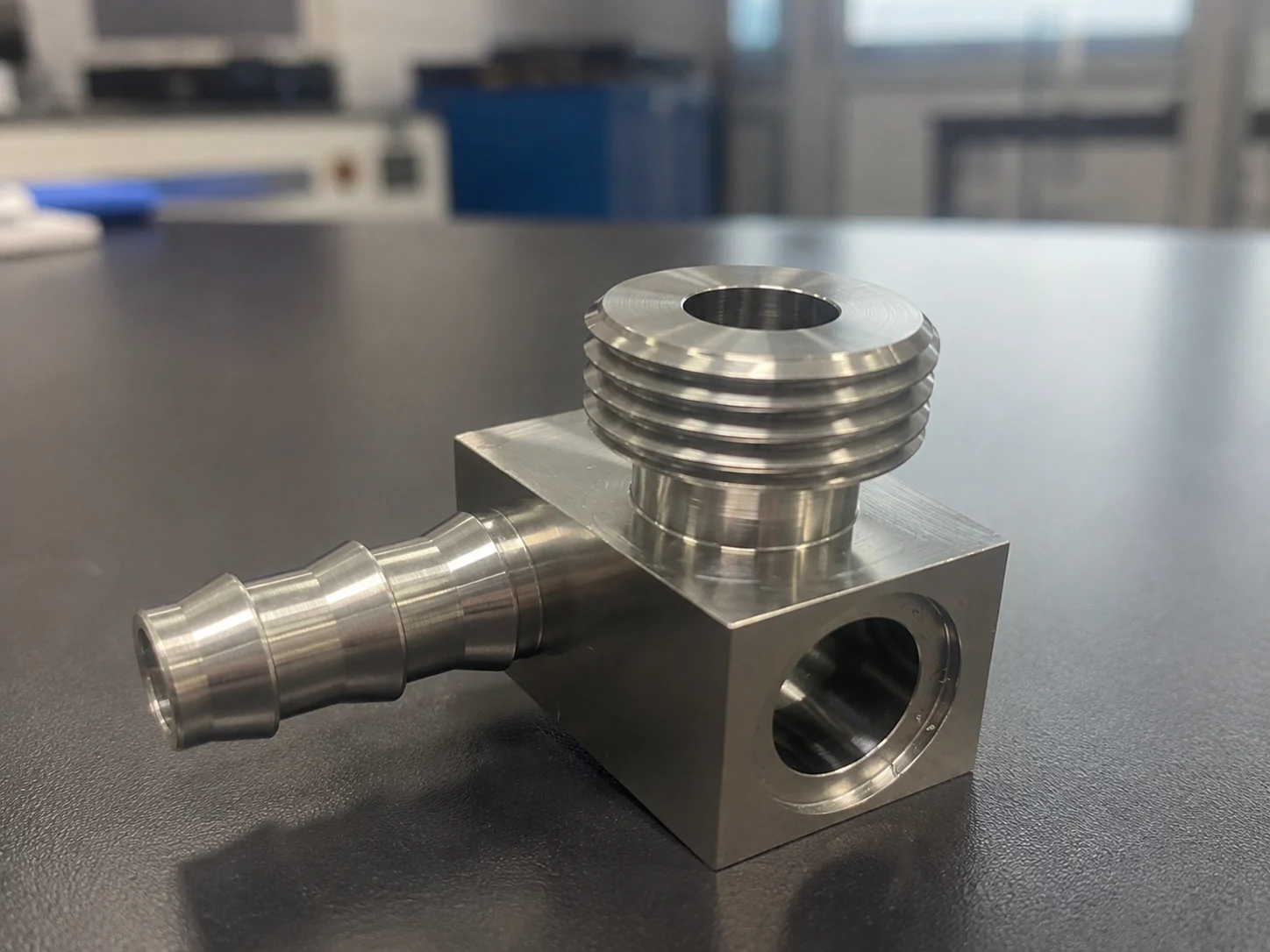
So the fittings we machine for coolant work seal on a face, not on the thread. A parallel BSPP thread with a bonded washer, or an O-ring in a machined seat, puts nothing consumable in the flow path — and it can be broken and remade during service without adding more debris each time.
The Material Is Decided by the Rest of the Loop
A fitting is rarely the most expensive thing in a cooling circuit, but it is one of the easiest ways to ruin one. The failure to plan around is galvanic: put aluminium and copper in the same wet circuit and they behave like a battery, and in a water-glycol mix whose inhibitor package has aged, the aluminium is the part that dissolves to protect the copper.
That single rule settles most material questions:
| Material | Use it when | Watch out for |
|---|---|---|
| 304 stainless | Treated closed-loop water or glycol — the default | Adequate almost everywhere; less chloride margin than 316 |
| 316 stainless | Chlorides in play: field top-ups, coastal or humid sites, hard-to-reach joints | Costs more, machines slower — buy it for the margin, not for strength |
| Brass | Copper cold plates — galvanically compatible and free-machining | Not for high-chloride or ammonia-bearing environments |
| Copper | Matching an all-copper circuit, or where conductivity matters | Soft — threads and sealing faces mark easily on assembly |
| Aluminium 6061 | All-aluminium loops only | Never alongside copper plates in the same circuit — this is the classic loop-killer |
So the useful question at quotation is not “what material do you want the fitting in” but what are the cold plates, the pump body and the hose ends made of. Tell us those and the fitting material follows.
Cleanliness Is Part of the Part
The same microchannels that catch tape debris catch swarf, and a fitting leaves the lathe full of it: chips in the bore, a burr on the thread run-out, cutting fluid in the cross-drilling. On a bracket none of that matters. On something a coolant loop flows through, it is the difference between a working plate and a warm one.
So cross-drilled intersections get deburred rather than just drilled, bores are flushed, and ports are capped before packing. If your build carries a written cleanliness spec, send it and we will work to it. If it does not, ask and we will tell you exactly what we do, so you can decide whether it is enough for your loop.
What We Machine
Thread adapters
Any pair, including ports you inherited — one part instead of two stacked adapters. See BSP to NPT.
Barb & hose tails
Turned to your hose bore, barb profile cut for retention under thermal cycling. See hose barb adapters.
Manifold blocks
Cross-drilled from solid, ports on your spacing, drilling access plugged, pressure tested.
Elbows & bulkheads
90° and custom angles where a hose cannot take the bend radius; bulkhead pass-throughs with face seals.
Blanking & test ports
Plugs, fill and bleed ports, gauge and sensor ports machined into the block rather than added as tees.
Sealed assemblies
Where two halves must seal to each other — see custom sealed metal parts.
Related work: we have machined an aluminium cooling plate with internal channels, and the wider stainless connector and precision fitting pages cover the same turning and sealing work outside cooling. The machined ends of the same loop have their own pages: custom cold plates and custom liquid cooling manifolds — the parts these fittings screw into.
What to Send
A drawing is welcome but not required — see ordering with no CAD if you do not have one.
- Both ends of the joint — thread callouts if you know them, or the two parts that must connect, or photographs with a rule in shot.
- Hose bore and clamp type for anything with a barb.
- What the rest of the loop is made of — cold plates, pump body, hose ends. This picks the material.
- Coolant and working pressure, plus temperature range if it swings.
- Port spacing and envelope for a manifold, and what it has to fit between.
- Quantity — one for a prototype loop, or a schedule. Both are normal.
One Piece or Twenty Thousand
Most of these jobs start as a single fitting for a loop somebody is still building, and that remains a normal order here. It is also worth knowing that the same work scales: we are currently running liquid cooling fittings at around twenty thousand pieces a month for a series customer, on the same machines and the same inspection routine.
That matters at quotation because the setup cost — drawing, programming, first article, fixturing — is paid once regardless. Ask for the price at one piece and at your expected annual figure in the same enquiry, and you will see where the curve flattens. For a first article, low-MOQ work is the normal route in.
See also push-in fittings, compression fittings and check valves for the tube ends and one-way valves on a manifold.
Frequently Asked Questions
Can I just buy a standard G1/4 fitting instead?
If a standard one fits your loop, yes — buy it. G1/4 barbs, compression fittings, blanking plugs and quick disconnects are stocked in depth and a catalogue part will always be cheaper and faster than a machined one. We are the answer when the catalogue stops: a thread pair nobody bridges, a barb sized to a hose the standard range does not cover, a manifold with your port spacing rather than theirs, a fitting that has to clear a chassis feature, or a port on a cold plate that was never a catalogue item. If you send us a job a stockist could fill, we will point you at the stockist.
Why do you prefer parallel BSPP over tapered NPT on a coolant loop?
Because of what the seal leaves behind. A tapered thread seals on the thread flanks, so it needs tape or a liquid sealant, and both shed material as the joint is made up and later disturbed. In an open drain that debris is harmless. In a closed cooling loop it circulates, and the place it stops is the narrowest section in the system — the channels inside a cold plate, which on a skived or microchannel plate are well under a millimetre wide. A blocked plate shows up as one hot device, not as a leak, so it gets diagnosed late. A parallel thread that seals on a face instead — a bonded washer or an O-ring in a machined seat — puts no consumable in the flow path and can be broken and remade during service without adding more. That is why the fittings we machine for coolant work carry a parallel thread and a proper flat sealing face.
Which material should the fitting be?
It is decided by what else is in the loop, not by the fitting alone. The classic failure is aluminium and copper sharing one circuit: they sit far apart galvanically, and in a water-glycol mix with tired inhibitor the aluminium part corrodes to feed the copper one. So if the cold plates are copper, brass and stainless fittings are the compatible choices and aluminium is the one to avoid. If the whole loop is aluminium, keep it aluminium. 304 stainless is fine for treated closed-loop water and glycol; 316 is worth the premium where chlorides are in play. Tell us what the plates, pump and hose ends are made of and we will say which of those the fitting should be.
What does 304 vs 316 actually change here?
Corrosion margin, not strength. For a sealed loop running treated water or a water-glycol mix, 304 is adequate and it machines and costs a little better. 316 adds molybdenum, which buys resistance to chloride pitting — worth it if the coolant is not fully deionised, if the site is coastal or humid, if the loop gets topped up with tap water in the field, or if the part sits somewhere a leak would be expensive to reach. Both are non-magnetic austenitic grades and neither is a strength decision on a fitting this size. If you are unsure, tell us the coolant and where the machine lives.
Do you clean the parts, or is that our job?
Ours, and we treat it as part of the deliverable rather than housekeeping. A machined fitting comes off the lathe with chips in the bore, burrs on the thread run-out and cutting fluid in the corners, and every one of those ends up in the loop the moment coolant flows. The same microchannels that catch tape debris catch swarf. So the cross-drilled intersections get deburred, the bores are flushed, and the ports are capped for shipping. If your build has a written cleanliness requirement, send it and we will work to it; if it does not, tell us and we will describe what we do so you can decide whether it is enough.
Can you machine a manifold block rather than separate fittings?
Yes, and it is often the better answer. Separate fittings mean a joint per branch, and every joint is a place to leak and a place to lose pressure. Cutting the same distribution out of one block replaces those with drilled passages, and you can put the ports where your hoses want to go instead of where a modular system allows. We machine the block from solid, cross-drill the passages, plug the drilling access, and pressure test it. Tell us the port sizes, the spacing you need and the envelope it has to fit inside.
Will you test them before shipping?
Yes. Machined coolant parts get a pressure test before they leave, because a fitting that leaks in a rack is far more expensive than one that fails on the bench. Tell us the working pressure and whether you want it tested with air under water or hydrostatically, and we will confirm the method and the hold time with the quote rather than after it.
Do you only take volume orders?
No. One piece is a normal order here and always has been — that is how most of these jobs start, with a prototype loop or a single machine that needs a fitting nobody sells. Volume is available when you get there: we are currently running liquid cooling fittings at around twenty thousand pieces a month for a series customer, so the same part can scale from your first article to production without changing supplier. Quote one, quote a thousand, quote both so you can see where the price flattens.
GET A QUOTE
Send the two ends that must connect, your hose bore, and what the cold plates are made of. Drawing optional. Reply in 12 hours.
Get a Quote → WhatsApp