What a Camber Bolt Kit Is and How the Eccentric Moves the Arm
A camber bolt kit is an eccentric bolt, two cam plates and a nut that hold a control arm in a slotted bracket: turning the bolt rolls the cams against guides on the bracket and slides the arm by up to twice the cam offset. The cam under the head is fixed to the bolt; the second cam has a D-shaped hole that keys onto a flat on the shank, so both turn together, and on some kits the second cam carries its own hex nut. Index marks on the cam face record the setting. EKINSUN supplies these kits by OEM reference number and makes other kits from the old one, from 1 kit.
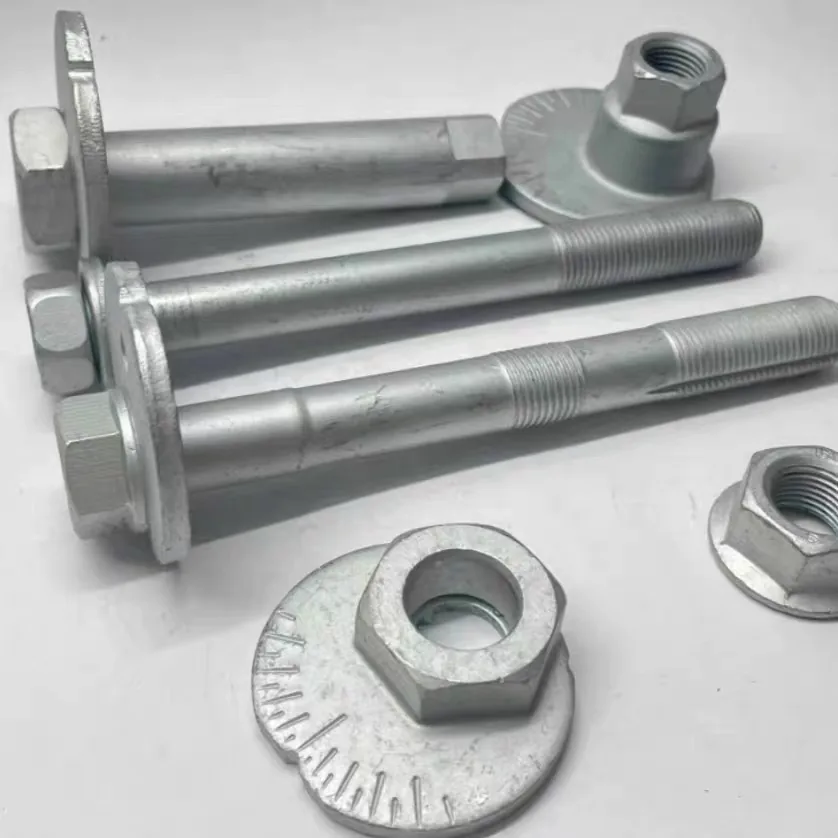
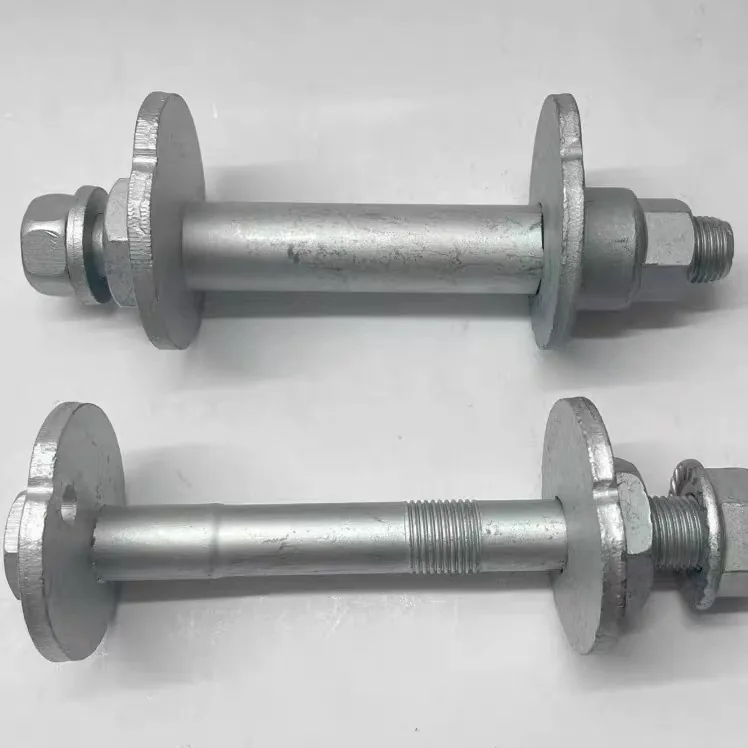
| Part | What it does | What fails |
|---|---|---|
| Eccentric bolt | passes through the arm bushing sleeve and both bracket slots; the cam under the head is fixed to it | rusts into the bushing sleeve and has to be cut out |
| Head-side cam plate | rolls against the bracket guides as the bolt turns; its offset sets the travel | rim worn or bent, guides on the bracket worn with it |
| Nut-side cam plate | keys onto the flat on the shank so both cams move together; on some kits it carries the nut | D-hole rounded out, so the cams no longer turn together |
| Nut | clamps the bushing sleeve between the brackets and locks the setting | prevailing-torque nut loses its grip after removal; thread corroded |
| Index marks / notch | show the cam position so a setting can be read and repeated | painted over or rusted, the old setting is lost |
The Five OEM Reference Numbers in the Photos
The kits in the photos carry five Toyota reference numbers, and only one of them, 48409-42020, is a rear part: it is the rear toe adjusting cam listed for the 2001–2005 RAV4. The other four are front lower control arm cams or a kit matched by VIN. Kits to these numbers can be supplied; a superseded or discontinued number is made from the old kit.
| OEM ref. | Catalogue name | Axle | Listed for |
|---|---|---|---|
| 48190-60040 | Lower control arm camber adjusting eccentric (bolt) | Front | 4Runner, FJ Cruiser, Tacoma (aftermarket cross-reference lists) |
| 48409-60020 | Cam sub-assembly, front suspension toe adjust | Front | 4Runner, FJ Cruiser, Tacoma (dealer listing) |
| 48190-0K040 | Camber adjusting bolt kit (kit label) | By VIN | No public catalogue confirmation found; matched by VIN or chassis code |
| 48409-34041 | Lower arm cam; current number 48409-0C020 | Front | Tundra 2007–2019, Sequoia 2008–2019 (aftermarket cross-reference) |
| 48409-42020 | Alignment camber adjusting eccentric (rear), rear suspension toe adjust cam | Rear | RAV4 2001–2005 (dealer listing) |
Names and vehicles as given in Toyota dealer parts listings and aftermarket cross-reference lists, read on 24 October 2026; model years and chassis codes vary, so every number is confirmed against the VIN before an order. The numbers are cross-references: these kits are not Toyota genuine parts. Toyota, 4Runner, FJ Cruiser, Tacoma, Tundra, Sequoia and RAV4 are trademarks of Toyota Motor Corporation.
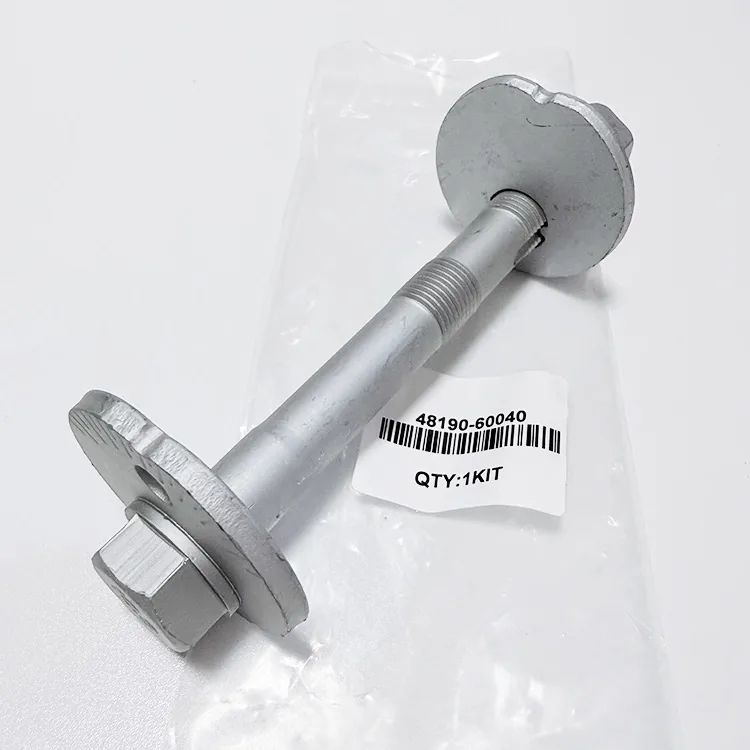
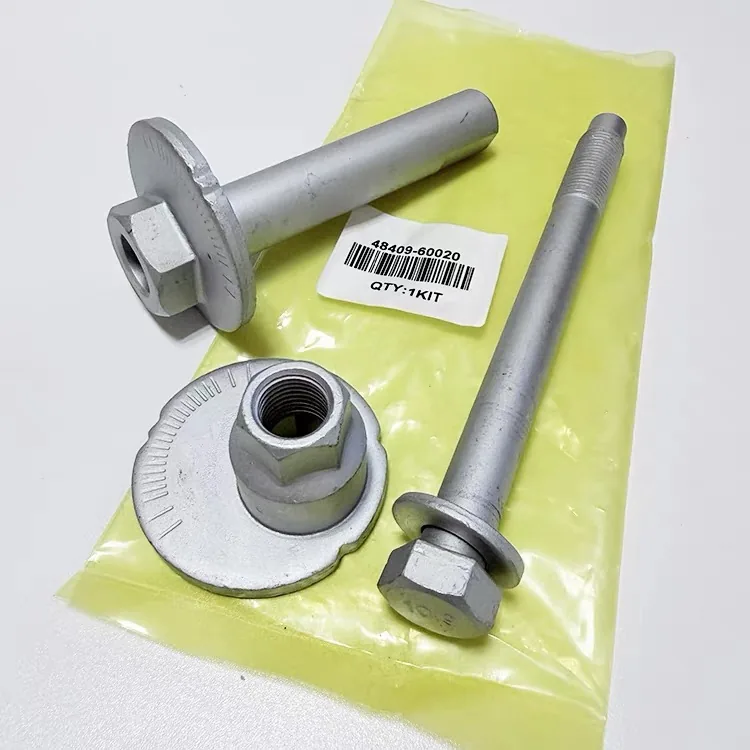
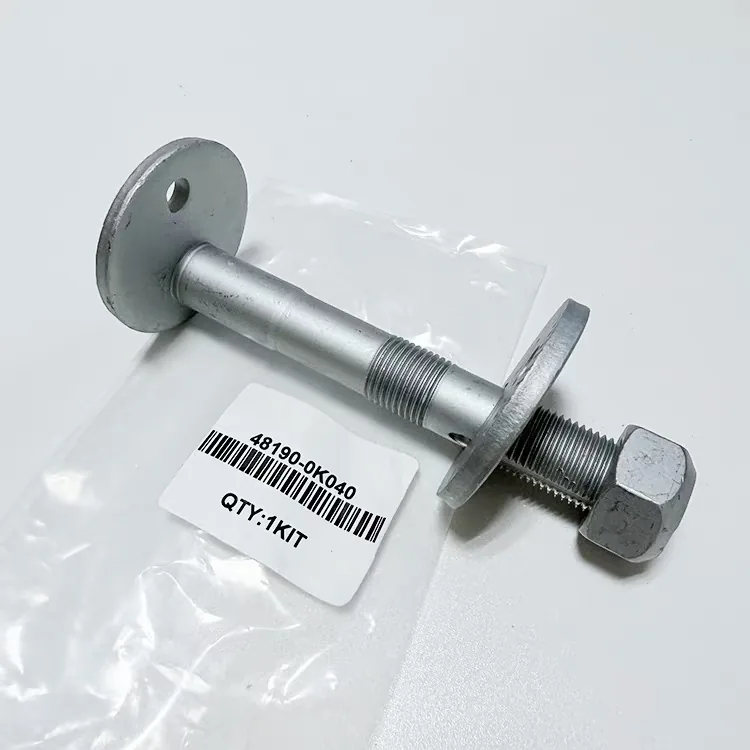
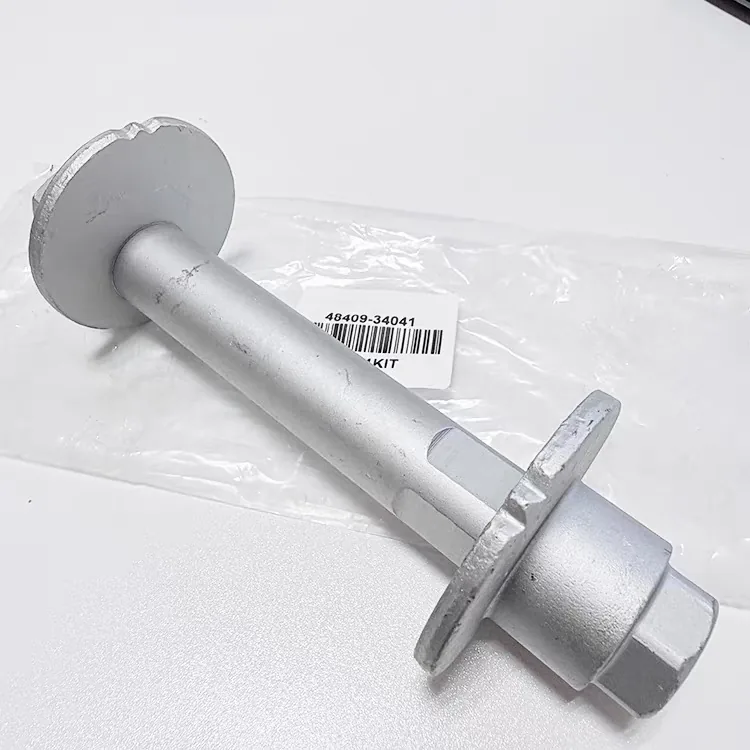
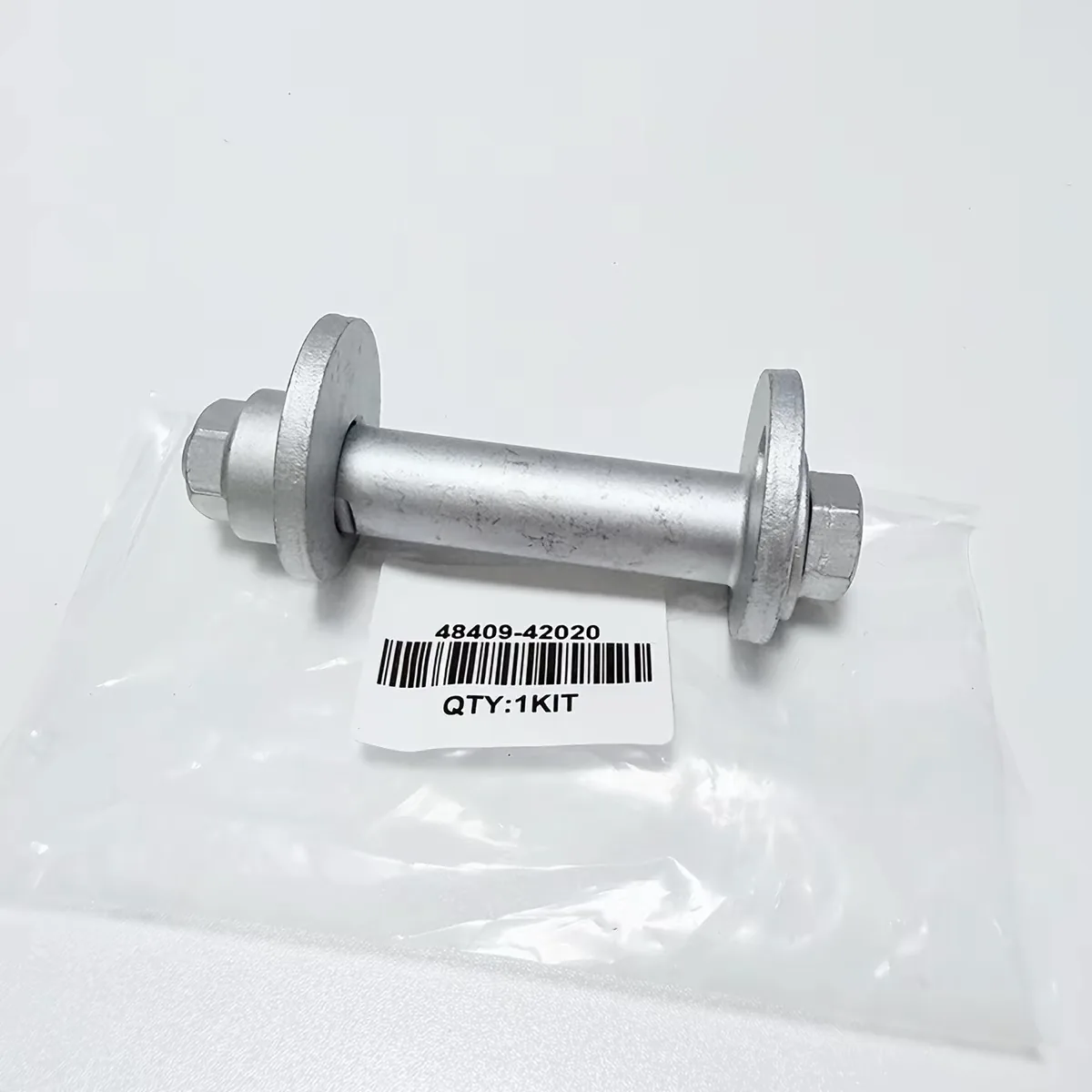
A kit to one of these numbers, or a number that is no longer supplied? Send the OEM number or a photo of the old kit with the label, the vehicle and the quantity. Kits are supplied by reference number or made from the old kit from 1 kit; the more kits, the lower the price per kit. Quote in 12 hours.
Front Camber Cams and Rear Toe Cams
Front cams on a double-wishbone pickup or SUV sit at the two inner pivots of the lower control arm: turning both the same way moves the ball joint in or out and sets camber, turning them against each other swings the arm and sets caster. Rear cams sit on a toe link, a trailing arm or a lower arm, and set toe or, on some axles, camber.
| Position | Adjusts | Arm | Example in the photos |
|---|---|---|---|
| Front, lower arm, both pivots | camber (cams turned together), caster (cams turned against each other) | lower control arm of a double-wishbone front axle | 48190-60040, 48409-34041 |
| Front, toe adjust cam | toe on axles where the cam replaces a tie-rod adjustment | lower arm or a toe link | 48409-60020 (catalogue name: toe adjust) |
| Rear, toe link or trailing arm | toe; on some multi-link axles camber as well | toe link, trailing arm, rear lower arm | 48409-42020 |
| Strut top or knuckle (other cars) | camber, with a cam bolt in place of one strut-to-knuckle bolt | MacPherson strut to knuckle | not in the photos; made to the strut bolt size |
How Much Adjustment a Cam Gives, and Extended-Range Cams
A cam with an offset e moves the bolt 2e from one end of its turn to the other, and at the lower ball joint that becomes a camber change of roughly 2e divided by the distance between the ball joints. With 300 mm between the joints, a 3 mm offset gives about 1.1°; an extended-range cam with 5 mm offset gives about 1.9°, which is what a lifted truck needs when the standard cam runs out.
| Cam offset e | Total travel 2e | Camber range, about |
|---|---|---|
| 2 mm | 4 mm | 0.76° |
| 3 mm | 6 mm | 1.15° |
| 4 mm | 8 mm | 1.53° |
| 5 mm | 10 mm | 1.91° |
Range = arctan(2e / 300 mm). The distance between the ball joints differs by vehicle; the table shows the scale, not the range of a particular kit. A larger offset needs a longer slot in the bracket and guides that still hold the cam rim.
More range than the standard cam gives? Send the vehicle, the lift height, the OEM number of the standard kit and a photo of the bracket slot; we check how much offset the slot allows before quoting, from 1 kit.
Grade, Thread and Coating of a Replacement Cam Bolt
The kits in the photos are property class 12.9, and a replacement cam bolt is made to the same class to ISO 898-1, at least 1220 N/mm² tensile and 1100 N/mm² yield, with a class 12 nut, because it carries the arm loads in shear through the bushing sleeve. Chassis cam bolts usually have a fine-pitch metric thread such as M12 × 1.25, M14 × 1.5 or M16 × 1.5; the old bolt is measured, not assumed.
| Part | Material / grade | Why |
|---|---|---|
| Bolt | 42CrMo4 (SCM440) quenched and tempered to 12.9 | the 12.9 minimum of 1220 / 1100 N/mm²; the shank is turned and threaded on our CNC lathes, heat treatment at a partner factory |
| Nut | class 12, prevailing torque or flange nut as on the original | a nut weaker than the bolt strips before the bolt reaches its clamp load |
| Cam plates | carbon steel plate, pressed in series, machined in small numbers | the rim and the D-hole carry the turning load, not the clamp load |
| Coating | zinc flake (ISO 10683), or electro-zinc baked after plating (ISO 4042) | electro-zinc without baking can embrittle a 12.9 bolt with hydrogen |
Class minima and the hydrogen embrittlement rule are on the bolt grade chart; the steel and its equivalents on 4140 / 42CrMo4; tightening values by size on the metric bolt torque chart. The vehicle maker’s torque for the cam bolt always comes first.
When the Old Cam Bolt Is Seized in the Bushing
The most common reason to need a new kit is a cam bolt rusted into the steel sleeve of the arm bushing: it turns, but will not come out, and is cut between the bracket and the bushing. After that the bushing is usually replaced as well, and a new kit goes in with its cams set to the centre; the nut is tightened with the suspension at ride height so the bushing is not preloaded twisted, and the alignment is set on a rig. A smear of anti-seize on the shank, not on the thread, helps the next person.
What to Measure From an Old Kit
Nine details make a kit from the old one: the OEM number if the label survives, the shank diameter where it passes through the bushing, the thread and pitch, the length under the head, the cam diameter and offset, the width of the flat, the form of the nut-side cam, the coating and the quantity. The cam offset is half the difference between the largest and smallest distance from the bolt axis to the cam rim.
| Measure | How | Example |
|---|---|---|
| OEM number | label on the bag, or the parts catalogue by VIN | 48409-42020 |
| Shank diameter | caliper on the unworn part of the shank | 14 mm |
| Thread | diameter and pitch gauge | M14 × 1.5 |
| Length under head | from under the head-side cam to the thread end | to the millimetre |
| Cam diameter and offset e | e = (largest − smallest distance from bolt axis to rim) / 2 | e = 3 mm |
| Flat on the shank | width across the flat and its length | D-flat for the nut-side cam |
| Nut-side cam | loose cam plate, or cam with integral nut | 48409-60020 has the nut on the cam |
| Coating and quantity | as the original or zinc flake; kits now and later | 100 kits, 500 later |
Buy a Kit or Have One Made
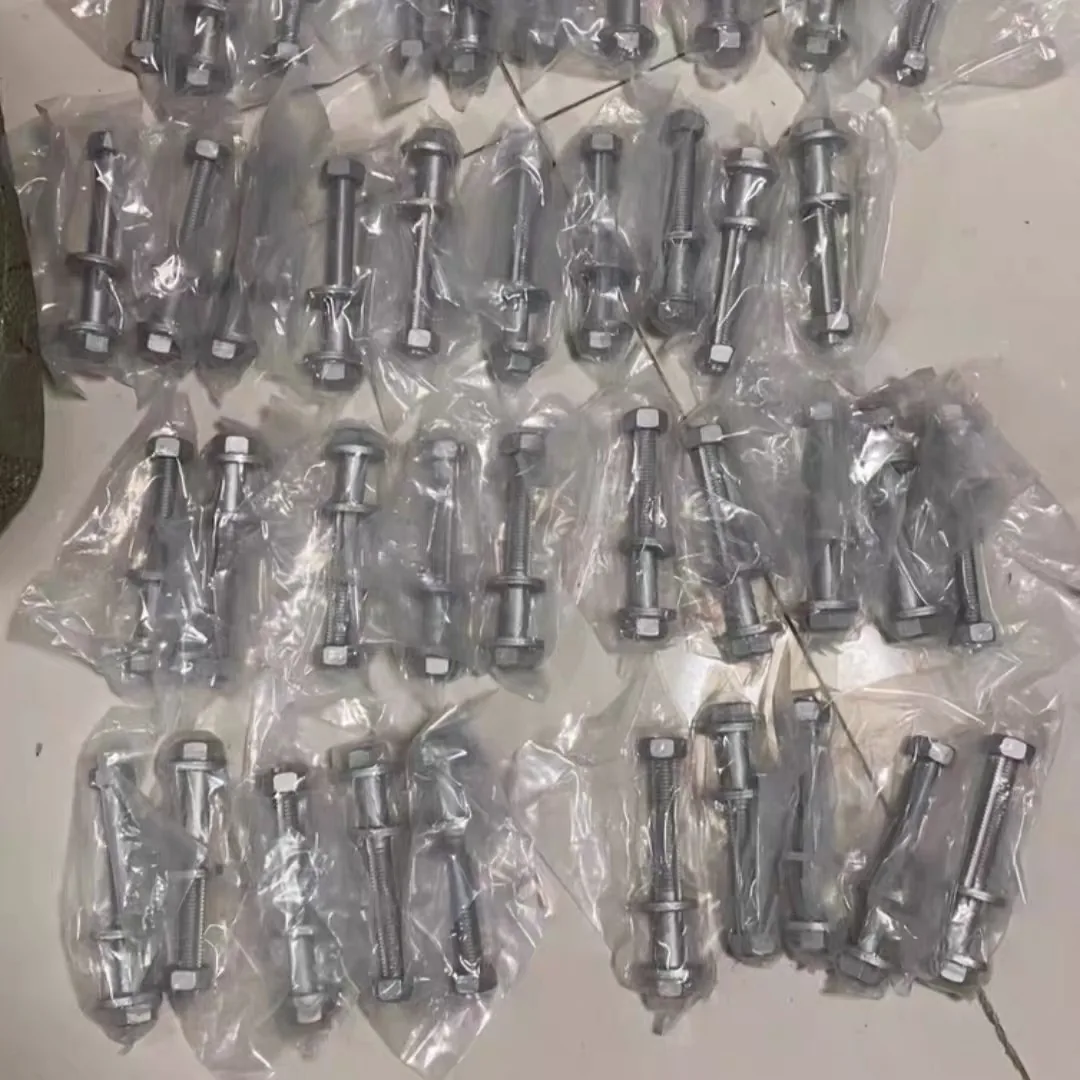
A genuine kit for a common vehicle is sold by the dealer parts counter and by parts stores, and for one vehicle that is the quickest route. A kit made to order starts where that stops: the superseded number, the larger offset, the fleet or distributor quantity and the kit for a vehicle that is no longer supported.
| What you need | On the shelf? | What we do |
|---|---|---|
| A genuine kit for a current vehicle, one car | Yes — dealer and parts stores | Buy it there, or ask us: kits to OEM numbers can be supplied, and the more kits, the lower the price. |
| A kit whose number is superseded or no longer supplied | Often not | Made from the old kit or the cut-out pieces: bolt, both cams and nut, from 1 kit. |
| Extended-range cams for a lifted vehicle | For popular trucks only | Larger offset machined to the slot length of your bracket. |
| Kits for a fleet or a distributor, own part number | No | Supplied in neutral bags labelled with your number, to you or to the end customer. |
| A stainless steel cam bolt | Not recommended | We do not make it: A4-80 has 600 N/mm² proof stress against 1100 for 12.9. |
| The wheel alignment itself | Alignment shops | Not our work: we make the parts; the setting is done on an alignment rig. |
Price and Quantity
A camber bolt kit is quoted per kit from 1 kit, within 12 hours, because the price depends on five things that change from kit to kit: the bolt diameter and length, which set the bar size and turning time; heat treatment to 12.9; whether the cams are pressed or machined; the coating; and the quantity, which spreads the setup.
| Quantity | Price | Note |
|---|---|---|
| 1–5 kits | quoted per kit | machined cams, setup carried by few kits |
| 10–50 kits | quoted per kit, lower | setup shared; one coating batch |
| 100+ kits | volume price | about 15% below the 100-kit price at 500 kits, about 25% at 1,000 |
Shipping is quoted DDP door to door, duties and taxes paid, 5–7 working days by courier to Europe and North America. Other automotive parts made from a sample are on automotive replacement parts; bolts copied from an old one on replacement bolts from a sample. Elsewhere on the same chassis: leaf spring shackles and hangers and trailer axle spindles.
This page in other languages: Deutsch · Français · Norsk · Italiano
Camber Bolt Kits — Buyer Questions
A camber bolt is an eccentric bolt: a cam plate fixed under the head and a second cam keyed to a flat on the shank sit in guides on the bracket, and the shank passes through the control arm bushing in a slotted hole. Turning the head turns both cams, and the offset of the cams pushes the bolt along the slot by up to twice the cam offset, which moves the arm in or out and changes camber, caster or toe. Tightening the nut locks the setting.
Both exist. Of the five reference numbers in the photos, 48409-42020 is a rear toe adjusting cam (listed for the 2001–2005 RAV4); 48190-60040, 48409-60020 and 48409-34041 are front lower control arm cams, listed for 4Runner, FJ Cruiser and Tacoma, and for 2007–2019 Tundra and 2008–2019 Sequoia; 48190-0K040 is matched by VIN. Rear cams usually set toe on a toe link or lower arm; front cams set camber and caster at the lower arm pivots.
Loosened and re-tightened at an alignment, yes, if the shank, the flat and the thread are undamaged; a prevailing-torque nut is replaced. A bolt that had to be cut because it rusted into the bushing sleeve is replaced with the whole kit: bolt, both cam plates and nut, because the cams and the nut were made as a set.
The parts are the same kind: an eccentric bolt, cam plates and a nut. The name follows the arm it sits in. On a lower control arm pivot the cam moves the ball joint in or out and changes camber; on a toe link or trailing arm it moves the end of the link and turns the wheel in or out, which is toe. Catalogues name them by function, for example Toyota's "camber adjusting eccentric" and "cam sub-assembly, toe adjust".
Yes. A new kit is fitted with the cams set to the old marks or to the centre, the nut is tightened with the suspension at ride height, and the alignment is then measured and set on an alignment rig, after which the nut is tightened to the vehicle maker's torque. The cam bolt cannot be set by eye.
Property class 12.9 to ISO 898-1, the class of the kits in the photos, with a minimum tensile strength of 1220 N/mm² and yield of 1100 N/mm², and a class 12 nut. Coating is zinc flake, which avoids the hydrogen embrittlement risk of electro-zinc on a 12.9 bolt, or electro-zinc followed by baking. Stainless A4-80 is not a substitute: its 600 N/mm² proof stress is below a class 8.8 bolt.
Yes, when the bracket allows it. A cam offset of 3 mm moves the pivot 6 mm in total, roughly 1.1° of camber with 300 mm between the ball joints; a 5 mm offset gives 10 mm, roughly 1.9°. The larger offset only works if the slot in the bracket is long enough and the cam still sits in its guides, so we check the slot length and the guide spacing from photos or the old kit before quoting.
There is no list price: kits are quoted by reference number or from the old kit, from 1 kit, in 12 hours. The price depends on the bolt length and diameter, whether the cams are pressed or machined, heat treatment to 12.9, the coating and the quantity; the more kits, the lower the price per kit, about 15% below the 100-kit price at 500 kits and about 25% below at 1,000.
EKINSUN — a custom parts manufacturer in Shenzhen, China — supplies eccentric camber and toe adjust bolt kits by OEM reference number and makes other kits from the old kit, a photo with caliper readings or a drawing: bolt in class 12.9, both cam plates and the nut, from 1 kit, quoted in 12 hours, shipped DDP with duties paid. Distributors can have kits in neutral bags with their own part number.
Request a quote
OEM number or old kit + vehicle + quantity. Reply within 12 hours.
// Cam bolts in brief
- →Bolt class 12.9: 1220 / 1100 N/mm²
- →Offset e moves the pivot 2e
- →Rear toe cam: 48409-42020
- →From 1 kit, quote in 12 h
or by email: [email protected]